 Back
BackPhotosynthesis: Using Light to Make Food (Campbell Biology, Ch. 7) – Study Notes
Study Guide - Smart Notes
 Tailored notes based on your materials, expanded with key definitions, examples, and context.
Photosynthesis: Using Light to Make Food
An Introduction to Photosynthesis
Photosynthesis is the process by which photoautotrophs convert solar energy into chemical energy, producing organic molecules that sustain most life on Earth. This process occurs primarily in plants, algae, and some bacteria.
Photoautotrophs: Organisms that use sunlight to synthesize organic compounds from carbon dioxide and water.
Chemoautotrophs: Organisms (mainly bacteria and archaea) that obtain energy from inorganic chemical reactions.
Heterotrophs: Organisms that consume other organisms for energy and organic molecules.
Example: Plants, algae, and cyanobacteria are photoautotrophs; animals and fungi are heterotrophs.
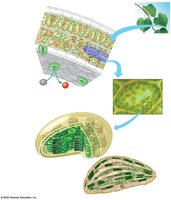
Photosynthesis Occurs in Chloroplasts in Plant Cells
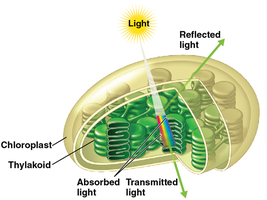
Chloroplasts are the organelles where photosynthesis takes place. They have a double membrane, internal stacks of thylakoids, and a fluid-filled stroma. Chlorophyll, the main pigment, is embedded in the thylakoid membranes.
Thylakoids: Membranous sacs where the light reactions occur.
Stroma: The dense fluid surrounding the thylakoids, site of the Calvin cycle.
Chlorophyll: Pigment that absorbs light energy, mainly in the blue and red wavelengths.
Gas Exchange and Water Loss in Leaves
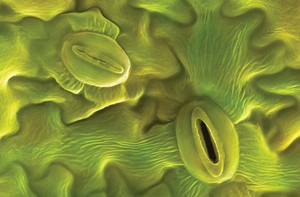
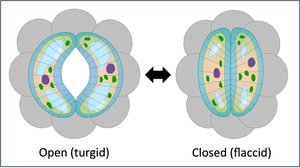
Gas exchange in plants occurs through microscopic pores called stomata, primarily located on the underside of leaves. Stomata regulate the entry of CO2 and the exit of O2, as well as water loss through transpiration.
Stomata: Openings controlled by guard cells that balance gas exchange and water conservation.
Transpiration: The process of water vapor loss from plant leaves.
Tracing Photosynthesis with Isotopes
Experiments using isotopes have shown that the oxygen released during photosynthesis comes from water (H2O), not carbon dioxide (CO2). The increase in plant mass during growth is primarily due to the incorporation of carbon from CO2.
Photosynthesis as a Redox Process
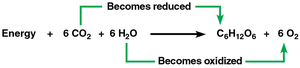
Photosynthesis is a redox (oxidation-reduction) process. Water is oxidized (loses electrons), and carbon dioxide is reduced (gains electrons) to form glucose.
Oxidation: Loss of electrons (H2O → O2).
Reduction: Gain of electrons (CO2 → C6H12O6).
Equation:

Stages of Photosynthesis
Photosynthesis occurs in two main stages:
Light Reactions: Occur in the thylakoid membranes; convert solar energy to chemical energy (ATP and NADPH).
Calvin Cycle: Occurs in the stroma; uses ATP and NADPH to fix carbon dioxide and produce sugars.
The Light Reactions: Converting Solar Energy to Chemical Energy
Light reactions use pigments to absorb specific wavelengths of light. Chlorophyll absorbs red and blue light, reflecting green, while carotenoids absorb other wavelengths and protect the plant from excess light.
Photosystems and Electron Transport
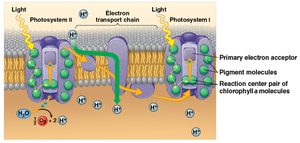
Photosystems are complexes in the thylakoid membrane that capture solar energy. Each photosystem consists of a light-harvesting complex and a reaction center. Excited electrons are transferred through an electron transport chain, generating ATP and NADPH.
Photosystem II: Splits water to replace lost electrons, releasing O2.
Photosystem I: Transfers electrons to NADP+, forming NADPH.
ATP and NADPH Production
ATP is produced by photophosphorylation, where the electron transport chain pumps H+ into the thylakoid space, creating a gradient. H+ flows back through ATP synthase, generating ATP. NADPH is produced by the reduction of NADP+ at the end of the electron transport chain. Both ATP and NADPH are released into the stroma for use in the Calvin cycle.
The Calvin Cycle: Reducing CO2 to Sugar
The Calvin cycle uses ATP and NADPH to convert CO2 into G3P, a three-carbon sugar. The cycle includes carbon fixation (by the enzyme Rubisco), reduction, release of G3P, and regeneration of RuBP.
Carbon fixation: Incorporation of CO2 into organic molecules.
Reduction: Conversion of 3-phosphoglycerate to G3P using ATP and NADPH.
Regeneration: RuBP is regenerated to continue the cycle.
For every three CO2 molecules, one G3P is produced.
Alternative Carbon Fixation Pathways
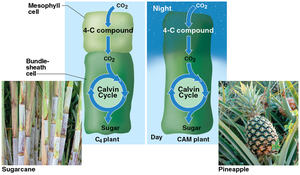
In hot, dry climates, plants may close their stomata to conserve water, leading to photorespiration—a wasteful process where Rubisco binds O2 instead of CO2. C4 and CAM plants have evolved mechanisms to minimize photorespiration by first fixing CO2 into four-carbon compounds.
C4 plants: Fix CO2 in mesophyll cells, then transfer it to bundle-sheath cells for the Calvin cycle (e.g., sugarcane).
CAM plants: Fix CO2 at night, store it as organic acids, and use it during the day (e.g., pineapple).
The Global Significance of Photosynthesis
Photosynthesis provides food and oxygen for almost all living organisms. It also plays a crucial role in the carbon cycle and helps regulate atmospheric CO2 levels.
About 50% of carbohydrates produced are used in cellular respiration by plants.
Sugars are used to build other organic molecules and structural components like cellulose.
Photosynthesis and Climate Change
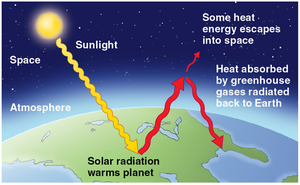
The greenhouse effect is caused by gases like CO2 trapping heat in the atmosphere. Reducing fossil fuel use and deforestation can help moderate climate change by lowering greenhouse gas emissions.
Greenhouse effect: Sunlight warms Earth's surface; greenhouse gases absorb and radiate heat back to Earth.
Climate change: Long-term shifts in temperature and weather patterns, largely driven by increased greenhouse gases.
Summary Table: Key Steps and Products of Photosynthesis
Stage | Location | Inputs | Outputs |
|---|---|---|---|
Light Reactions | Thylakoid membrane | Light, H2O, NADP+, ADP + Pi | O2, NADPH, ATP |
Calvin Cycle | Stroma | CO2, NADPH, ATP | G3P (sugar), NADP+, ADP + Pi |
Key Terms and Concepts
Autotroph: Organism that makes its own food from inorganic substances.
Heterotroph: Organism that obtains food by consuming other organisms.
Chloroplast: Organelle where photosynthesis occurs.
Stomata: Pores for gas exchange in leaves.
Photosystem: Protein complex that captures light energy.
Photophosphorylation: ATP production using light energy.
Calvin Cycle: Series of reactions that synthesize sugars from CO2.
Photorespiration: Process that consumes O2 and releases CO2, reducing photosynthetic efficiency.
