 Back
BackPhotosynthesis: Using Light to Make Food (Campbell Biology, Ch. 7) – Study Notes
Study Guide - Smart Notes
 Tailored notes based on your materials, expanded with key definitions, examples, and context.
Photosynthesis: Using Light to Make Food
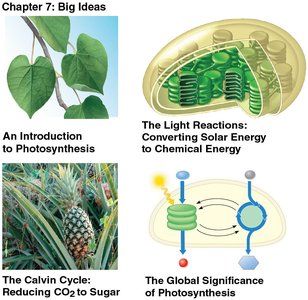
An Introduction to Photosynthesis
Photosynthesis is the process by which plants, algae, and some bacteria convert light energy into chemical energy, producing organic molecules that sustain most life on Earth.
Photoautotrophs are organisms that use light energy to synthesize organic compounds from inorganic substances. They are the primary producers in ecosystems.
Heterotrophs are organisms that obtain energy and carbon by consuming other organisms or organic matter.
Photoautotrophs require light energy, carbon dioxide (CO2), water (H2O), and minerals from the environment to make their own food.
Photosynthesis is essential for the production of oxygen and organic molecules used by heterotrophs.
Photosynthesis Occurs in Chloroplasts
Structure and Function of Chloroplasts
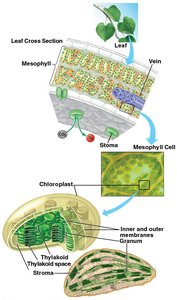
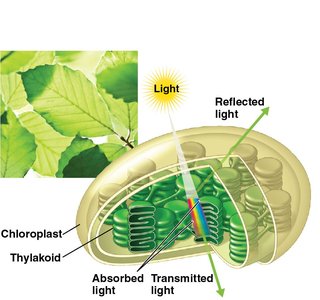
Photosynthesis takes place in chloroplasts, specialized organelles found in the cells of green plants and algae.
Chloroplasts are surrounded by a double membrane and contain internal stacks of membranes called thylakoids, which are suspended in a fluid called the stroma.
Chlorophyll is the main pigment that absorbs light energy for photosynthesis.
CO2 enters leaves through stomata, and water is delivered via veins. Both reach the chloroplasts in the mesophyll cells.
The Chemical Equation and Redox Nature of Photosynthesis
Overall Equation
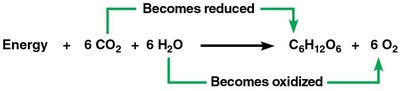
The overall chemical equation for photosynthesis is:

Photosynthesis as a Redox Process
Photosynthesis is a redox (oxidation-reduction) process, similar to cellular respiration but in reverse direction.
In photosynthesis, water is oxidized (loses electrons) and carbon dioxide is reduced (gains electrons).
Cellular respiration is an exergonic process, while photosynthesis is endergonic (requires energy input).
Stages of Photosynthesis
The Light Reactions and the Calvin Cycle
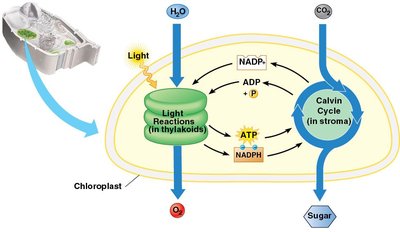
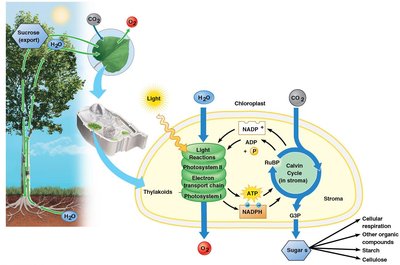
Photosynthesis occurs in two main stages: the light reactions and the Calvin cycle, which are linked by the energy carriers ATP and NADPH.
Light reactions (in thylakoids): Convert solar energy to chemical energy, producing ATP and NADPH, and releasing O2 as a byproduct.
Calvin cycle (in stroma): Uses ATP and NADPH to fix CO2 into organic molecules (sugar).
Carbon fixation is the process of incorporating CO2 into organic compounds.
The Light Reactions: Converting Solar Energy to Chemical Energy
Absorption of Light by Pigments
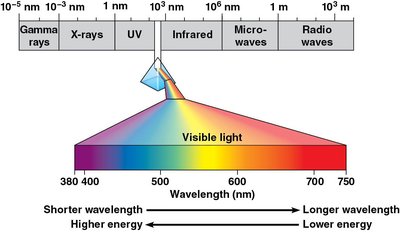
Light reactions are driven by the absorption of visible light by pigments in the chloroplasts.
Sunlight is a form of electromagnetic energy. Only certain wavelengths (visible light) are absorbed by chlorophyll and other pigments.
Carotenoids are accessory pigments that absorb additional wavelengths and protect the plant from excess light (photoprotection).
Green light is least effective at driving photosynthesis because it is reflected, not absorbed, by chlorophyll.
Photosystems and Energy Capture
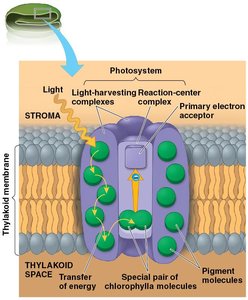
Photosystems are complexes in the thylakoid membrane that capture solar energy and initiate electron transport.
Each photosystem consists of a light-harvesting complex and a reaction-center complex.
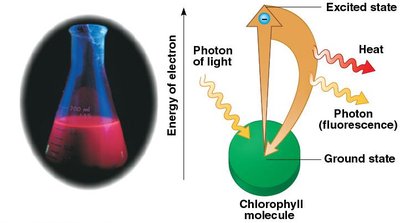
Photoexcited electrons from chlorophyll a are transferred to a primary electron acceptor.
In isolated chlorophyll, energy is released as heat and fluorescence; in intact chloroplasts, energy is used for chemical work.
Electron Transport and ATP/NADPH Formation
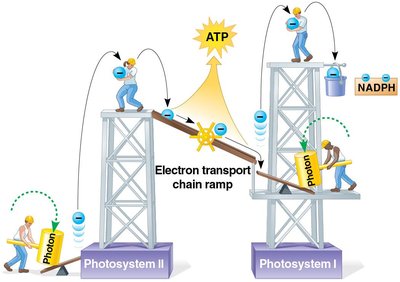
Two photosystems (II and I) are connected by an electron transport chain, converting light energy into ATP and NADPH.
Electrons move from photosystem II to photosystem I, generating a proton gradient used to make ATP (photophosphorylation).
Photosystem II regains electrons by splitting water, releasing O2.
Photosystem I transfers electrons to NADP+, forming NADPH.
The Calvin Cycle: Reducing CO2 to Sugar
Steps of the Calvin Cycle
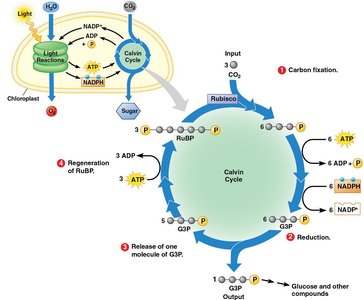
The Calvin cycle uses ATP and NADPH to convert CO2 into G3P, a three-carbon sugar that can be used to form glucose and other organic molecules.
Carbon fixation: CO2 is attached to RuBP by the enzyme rubisco.
Reduction: ATP and NADPH are used to reduce 3-PGA to G3P.
Release of G3P: One G3P molecule exits the cycle to be used in biosynthesis.
Regeneration of RuBP: The remaining G3P is used to regenerate RuBP, enabling the cycle to continue.
Alternative Carbon Fixation Pathways
Plants have evolved different mechanisms to fix carbon, especially in hot, dry climates.
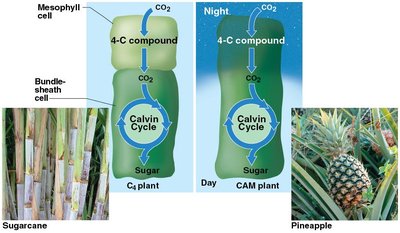
C3 plants: Use the Calvin cycle directly; susceptible to photorespiration when stomata close.
C4 plants: First fix CO2 into four-carbon compounds, which supply CO2 to the Calvin cycle even when stomata are closed (e.g., sugarcane).
CAM plants: Open stomata at night to fix CO2 into organic acids, which release CO2 for the Calvin cycle during the day (e.g., pineapple).
The Global Significance of Photosynthesis
Photosynthesis and Life on Earth
Photosynthesis provides food and oxygen for almost all living organisms and is the foundation of most ecosystems.
About 50% of carbohydrates produced by photosynthesis are used in cellular respiration by plants.
Sugars are also used to synthesize proteins, lipids, and cellulose (the main component of plant cell walls).
Photosynthesis and Climate Change
Photosynthesis plays a critical role in regulating atmospheric CO2 and thus influences global climate.
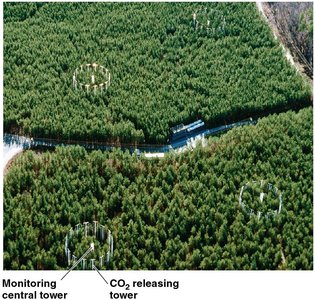
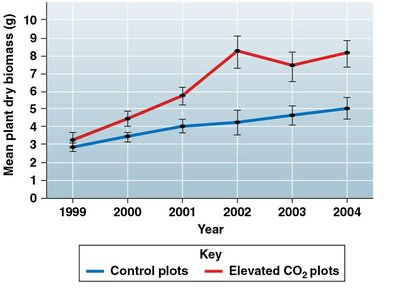
Rising CO2 levels may affect plant growth, as studied in laboratory and field experiments.
Long-term field studies help scientists understand the impact of elevated CO2 on ecosystems.
The Greenhouse Effect and Mitigation
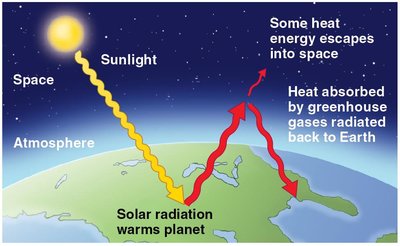
CO2 and other greenhouse gases trap heat in the atmosphere, contributing to global warming and climate change.
The greenhouse effect is the warming of Earth due to the trapping of heat by greenhouse gases.
Reducing fossil fuel use and deforestation can help moderate climate change.
International agreements, such as the Paris climate conference, aim to limit greenhouse gas emissions.
Summary Table: Comparison of Photosynthetic Pathways
Pathway | Main Feature | Example Plants | Adaptation |
|---|---|---|---|
C3 | Direct Calvin cycle | Wheat, rice | Efficient in cool, moist climates |
C4 | Four-carbon compound intermediate | Sugarcane, corn | Reduces photorespiration in hot, dry climates |
CAM | CO2 fixed at night | Pineapple, cacti | Conserves water in arid environments |
