 Back
Photosynthesis: Using Light to Make Food
Study Guide - Smart Notes
 Tailored notes based on your materials, expanded with key definitions, examples, and context.
Photosynthesis: Using Light to Make Food
Introduction to Photosynthesis
Photosynthesis is a fundamental biological process that sustains nearly all life on Earth by converting solar energy into chemical energy. This process is carried out by plants, algae, and certain bacteria, and it forms the basis of energy flow in most ecosystems.
Photosynthesis transforms light energy into chemical energy stored in the bonds of sugar molecules.
It uses carbon dioxide (CO2) and water (H2O) as starting materials and releases oxygen (O2) as a by-product.
Organisms that produce their own organic matter from inorganic ingredients are called autotrophs.
Photoautotrophs (such as plants, algae, and cyanobacteria) use photosynthesis and are the primary producers in most ecosystems.
Diversity of Photoautotrophs
Photoautotrophs are found in diverse environments and include:
Plants – primarily terrestrial producers.
Photosynthetic protists – such as kelp, which are aquatic and multicellular.
Photosynthetic bacteria – such as cyanobacteria, which are important in aquatic ecosystems.
Chloroplasts: The Sites of Photosynthesis
Structure and Function
Chloroplasts are specialized organelles where photosynthesis takes place. They are primarily found in the interior cells of leaves and contain the pigment chlorophyll, which is essential for capturing light energy.
Chloroplasts have a double-membrane envelope.
The inner membrane surrounds the stroma, a thick fluid where the Calvin cycle occurs.
Within the stroma are stacks of thylakoids (membranous sacs), organized into grana.
Chlorophyll molecules are embedded in the thylakoid membranes.
Stomata are tiny pores in leaves that allow gas exchange (CO2 in, O2 out).
Overview of Photosynthesis
Stages of Photosynthesis
The process of photosynthesis can be divided into two main stages, which are interconnected by energy- and electron-carrying molecules:
Light Reactions: Occur in the thylakoid membranes, where chlorophyll absorbs solar energy and converts it into chemical energy in the form of ATP and NADPH.
Calvin Cycle: Occurs in the stroma, using ATP and NADPH to convert CO2 into energy-rich sugars (such as G3P, which can be used to make glucose and other organic compounds).
The Electromagnetic Spectrum and Light Absorption
Light and Pigments
Photosynthetic organisms use pigments to absorb light energy. Different pigments absorb different wavelengths of light, which influences the efficiency of photosynthesis.
Chlorophyll a: Main pigment, absorbs blue-violet and red light, and participates directly in light reactions.
Chlorophyll b: Accessory pigment, absorbs blue and orange light, and transfers energy to chlorophyll a.
Carotenoids: Yellow-orange pigments, absorb mainly blue-green light, and provide photoprotection.
The Process of Science: What Colors of Light Drive Photosynthesis?
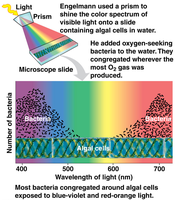
In 1883, Theodor Engelmann conducted an experiment to determine which wavelengths of light are most effective for photosynthesis. He used a prism to shine the color spectrum onto algal cells and observed where oxygen-seeking bacteria congregated.
Bacteria clustered around regions exposed to blue-violet and red-orange light, indicating these wavelengths drive the most photosynthesis.
Photosystems and Light Harvesting
Photosystems: Structure and Function
Photosystems are complexes of pigment molecules and proteins in the thylakoid membrane that harvest light energy and funnel it to a reaction center.
Each photosystem contains hundreds of pigment molecules (chlorophylls a and b, carotenoids).
Light energy excites electrons in these pigments, which are then transferred to the reaction center.
Excited electrons are used to generate ATP and NADPH during the light reactions.
Light Energy and Electron Excitation
Light behaves as both waves and particles (photons). When pigments absorb photons, their electrons become excited and can participate in chemical reactions.
The energy of a photon is inversely related to its wavelength (shorter wavelength = higher energy).
Most excited electrons return to their ground state, releasing energy as heat or light (fluorescence).
The Calvin Cycle: Making Sugar from Carbon Dioxide
Calvin Cycle Overview
The Calvin cycle is a series of enzyme-catalyzed reactions that occur in the stroma of the chloroplast. It uses ATP and NADPH from the light reactions to fix carbon dioxide and produce sugars.
The main product is glyceraldehyde 3-phosphate (G3P), a three-carbon sugar.
G3P can be used to synthesize glucose and other organic molecules.
Key equation for photosynthesis:
Evolution Connection: Improving Biofuel Production
Directed Evolution in Algae
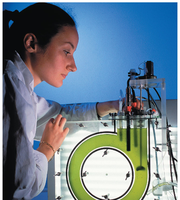
Scientists are using directed evolution to improve the efficiency of biofuel production in algae. This process involves inducing mutations and selecting for strains that produce higher yields of biofuel.
Algae are exposed to mutation-promoting chemicals.
Strains with the highest biofuel output are selected and subjected to further rounds of mutation and selection.
Over time, this can lead to algae that are more efficient at producing biofuels.
Additional info: Directed evolution is a laboratory technique that mimics natural selection to evolve proteins or organisms toward a user-defined goal.
