 Back
BackPhylogenies and Evolutionary Relationships: Classification, Trees, and Applications
Study Guide - Smart Notes
 Tailored notes based on your materials, expanded with key definitions, examples, and context.
Phylogenies: Evolutionary Relationships and Systematics
Introduction to Phylogeny and Systematics
Phylogeny refers to the evolutionary history of a species or group of species. Systematics is the scientific discipline that classifies organisms and determines their evolutionary relationships. Understanding phylogeny is essential for tracing the lineage and diversity of life, and for organizing biological classification in a meaningful way.
Phylogeny: The evolutionary history and relationships among species.
Systematics: The study of classification and evolutionary relationships.
Application: Used to reconstruct evolutionary trees and understand biodiversity.
Binomial Nomenclature
Scientific Naming of Organisms
To avoid confusion caused by common names, biologists use Latin scientific names in a two-part format called binomial nomenclature, established by Carolus Linnaeus. This system ensures each species has a unique, universally recognized name.
Genus: The first part of the binomial, capitalized and italicized (e.g., Castor).
Specific epithet: The second part, unique to each species within the genus (e.g., canadensis).
Example: Castor canadensis (North American beaver).
Formatting: Entire binomial is italicized; genus is capitalized.
Hierarchical Classification
Linnaean System and Taxonomic Hierarchy
Linnaeus grouped species into a hierarchy of increasingly inclusive categories. This system structures biological diversity and reflects evolutionary relationships, though higher categories may not be directly comparable across lineages.
Taxonomic ranks: Domain → Kingdom → Phylum → Class → Order → Family → Genus → Species.
Taxon: Any named group at any level of the hierarchy.
Example: Castor (genus), Rodentia (order).
Classification: Based on shared characteristics; may differ in diversity between lineages.
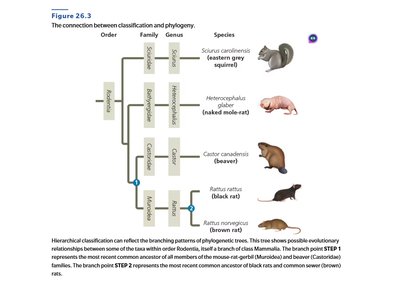
Linking Classification and Phylogeny
Phylogenetic Trees and Evolutionary History
Phylogenetic trees are branching diagrams that represent hypotheses about evolutionary relationships. These trees often mirror taxonomic classification, but new evidence (e.g., DNA) can lead to reclassification to better reflect evolutionary history.
Phylogenetic tree: Diagram showing evolutionary relationships.
Branch point (node): Represents the common ancestor of diverging lineages.
Rooted tree: Has a branch point representing the most recent common ancestor of all taxa in the tree.
Basal taxon: Lineage that diverges early and lies on a branch originating near the common ancestor.
Interpreting Phylogenetic Trees
Patterns of Descent and Sister Taxa
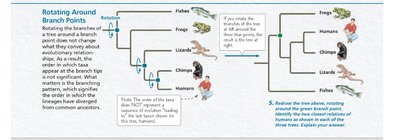
Phylogenetic trees show patterns of descent, not necessarily phenotypic similarity or the timing of evolutionary events. Sister taxa are groups that share an immediate common ancestor. The order of taxa at the tips does not imply a sequence of evolution.
Sister taxa: Closest relatives sharing a recent common ancestor.
Branch rotation: Rotating branches around a node does not change relationships.
Patterns of descent: Trees show relationships, not direct ancestry or evolutionary sequence.
Example: Humans and chimpanzees are sister taxa; neither evolved from the other, but both from a common ancestor.
Applications of Phylogenies
Practical Uses: Species Identification and Conservation
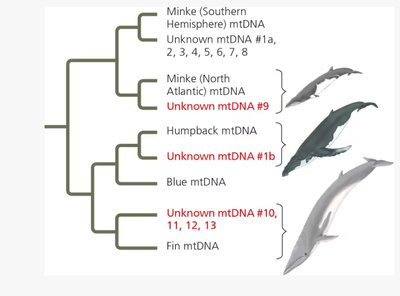
Phylogenetic analysis of DNA sequences can be used to identify species and populations, which is important in wildlife conservation and forensic science. For example, gene trees constructed from mitochondrial DNA can reveal whether animal products are from protected species.
Gene tree: Phylogenetic tree showing relatedness among DNA sequences.
Wildlife forensics: DNA analysis helps detect illegal hunting and trade.
Example: Identifying whale meat samples using mtDNA sequences to determine legality of harvest.
Summary Table: Taxonomic Hierarchy
Rank | Example (Rodent) |
|---|---|
Domain | Eukarya |
Kingdom | Animalia |
Phylum | Chordata |
Class | Mammalia |
Order | Rodentia |
Family | Muridae |
Genus | Rattus |
Species | Rattus norvegicus |
Key Points for Exam Preparation
Binomial nomenclature provides unique, universal names for species.
Linnaean classification organizes species into hierarchical taxa.
Phylogenetic trees represent hypotheses about evolutionary relationships.
Interpret trees as patterns of descent, not direct ancestry or sequence.
DNA-based phylogenies are powerful tools for species identification and conservation.
