 Back
Phylogenies and the History of Life: Structured Study Notes
Study Guide - Smart Notes
 Tailored notes based on your materials, expanded with key definitions, examples, and context.
Phylogenies and the History of Life
Introduction to Phylogeny
Phylogeny is the study of the evolutionary relationships among organisms. Systematics is the scientific field that groups and classifies organisms, while taxonomy is the systematic naming and classification of organisms. The Linnean Hierarchy, developed by Carolus Linnaeus, is a classification system that organizes living things into nested groups based on shared characteristics. Phylogenetics focuses on evolutionary relationships, and ideally, taxonomy should reflect phylogeny.
Systematics: Groups and classifies organisms based on evolutionary relationships.
Taxonomy: The naming and classification of organisms.
Linnean Hierarchy: Domain, Kingdom, Phylum, Class, Order, Family, Genus, Species.
Phylogenetics: Study of evolutionary relationships.
Taxon: Any group at any taxonomic level.
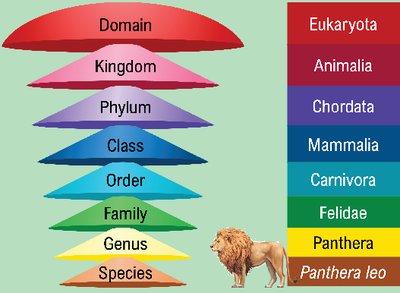
Example: The mnemonic "Dear King Phillip Came Over For Good Soup" helps remember the order of taxonomic ranks.
Binomial Nomenclature
Binomial nomenclature is a two-word naming system used in Linnean taxonomy. It uses Latin names, with the first word being the genus (capitalized) and the second word being the species (lowercase). Both words are always written in italics.
Genus: Capitalized, italicized.
Species: Lowercase, italicized.
Example: Panthera leo (lion)
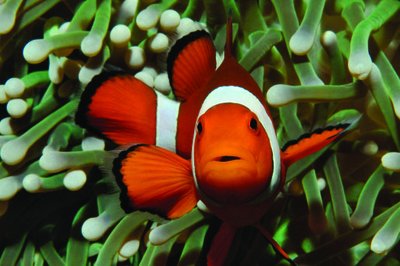
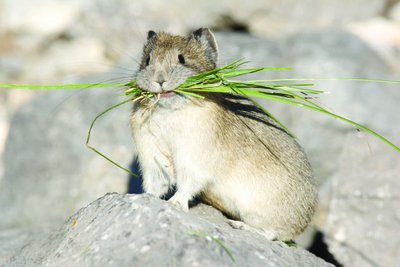
Example: Correct formatting for scientific names: Amphiprion ocellaris (clownfish), ochotona princeps (pika).
Reading a Phylogenetic Tree
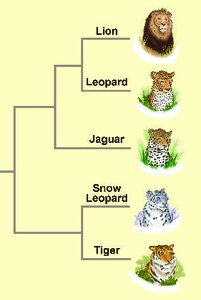
A phylogenetic tree is a branching diagram that shows evolutionary relationships among taxa. Groups are formed by finding a common ancestor, represented by nodes where lines diverge. Phylogenetic trees can be read similarly to family trees.
Branch: Represents a lineage over time.
Node (Branch Point): Last common ancestor of multiple taxa.
Root: Common ancestor for all organisms on the tree.
Sister Taxa: Organisms that share an immediate common ancestor.
Polytomy: Node with more than two branches.
Clade (Monophyletic Group): Group that includes a node and all descendants from that node.
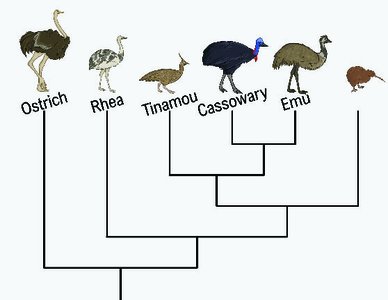
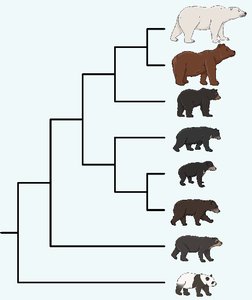
Parts of a Phylogenetic Tree
Phylogenetic trees use specific vocabulary to describe their structure. Understanding these terms is essential for interpreting evolutionary relationships.
Branch: Line representing a lineage.
Node: Point of divergence, representing the last common ancestor.
Root: The base of the tree, representing the most recent common ancestor of all taxa.
Sister Taxa: Two taxa that share a node.
Polytomy: Node with more than two descendant lineages.
Clade: A group consisting of a node and all its descendants.
Interpreting Branch Length
Branch length in phylogenetic trees can represent different things, such as time, amount of evolution, or nothing at all. Longer branches may indicate more genetic changes or longer time periods, depending on the context.
Branch length: May represent time, amount of evolution, or simply branching order.
Shorter branch: Indicates fewer genetic changes or earlier branching events.
Building Phylogenetic Trees
Phylogenetic trees are constructed using shared derived characters (synapomorphies) and the principle of parsimony. Shared derived characters are traits present in more than one taxon that evolved after the common ancestor. Shared ancestral characters are traits present at the root of the tree.
Shared derived character: Trait present in multiple taxa, evolved after the common ancestor.
Shared ancestral character: Trait present at the root of the tree.
Parsimony: The simplest explanation, with the fewest evolutionary changes, is preferred.
Character Matrix, Ingroups, and Outgroups
A character matrix is used to identify shared derived characters and construct phylogenetic trees. An outgroup is a taxon known to be more distantly related than any in the ingroup, helping to root the tree and identify ancestral traits.
Taxon | Lays Eggs | 4 Limbs | Amnion | Mammary Glands | Gizzard |
|---|---|---|---|---|---|
Fish | 1 | 0 | 0 | 0 | 0 |
Frog | 1 | 1 | 0 | 0 | 0 |
Mouse | 0 | 1 | 1 | 1 | 0 |
Platypus | 1 | 1 | 1 | 1 | 0 |
Bird | 1 | 1 | 1 | 0 | 1 |
Crocodile | 1 | 1 | 1 | 0 | 1 |
The Fossil Record
The fossil record provides evidence of the history of life on Earth. Fossils are physical evidence of past organisms, often found in sedimentary rock. The fossil record is biased toward organisms with hard tissues, those that lived recently, and those in favorable environments.
Fossils: Physical evidence of past life.
Sedimentary rock: Common site for fossil formation.
Biases: Hard-bodied, recent, and abundant organisms are more likely to be fossilized.
Dating Fossils
Fossils can be dated using relative dating (based on strata) or absolute dating (using radioactive isotopes). Carbon-14 dating is used for recent fossils, while other isotopes like Uranium-238 are used for older rocks.
Relative dating: Based on the position of fossils in rock layers.
Absolute dating: Based on radioactive decay; e.g., C-14 for recent fossils, U-238 for older rocks.
Half-life: Time for half of a radioactive isotope to decay.
Formula:
History of Life and Major Events
The geologic record chronicles major events in the history of life, including the first fossils, the Great Oxygenation Event, the Cambrian Explosion, the appearance of eukaryotes, multicellular organisms, and the colonization of land.
First fossils: 3.5 billion years ago.
Great Oxygenation Event: 2.7-2.4 billion years ago.
Cambrian Explosion: 535-525 million years ago.
First eukaryotes: 1.8 billion years ago.
Colonization of land: 500 million years ago.
Extinctions
Extinction events shape the tree of life. Background extinctions occur at a steady rate, while mass extinctions are catastrophic events that affect many species simultaneously. The Permian and Cretaceous extinctions are two of the most significant events in Earth's history.
Background extinction: Average, ongoing extinction rate.
Mass extinction: Catastrophic event affecting many species.
Permian extinction: Caused by volcanic activity, wiped out 95% of marine species.
Cretaceous extinction: Caused by asteroid impact, wiped out non-avian dinosaurs.
Sixth extinction: Ongoing, largely due to human impacts.
Adaptive Radiation
Adaptive radiation is an evolutionary event where a single lineage gives rise to many diverse species, often after mass extinctions or due to evolutionary innovations. Lineages diversify to fill ecological niches.
Ecological opportunity: Species fill open niches.
Evolutionary innovation: New trait increases fitness.
Cambrian Explosion: Adaptive radiation that introduced nearly every animal phylum.
Developmental Genes and Regulation
Evolutionary changes often result from changes in gene regulation. Heterochrony refers to changes in the timing or rate of development. Homeotic genes, such as Hox genes, determine the spatial organization of body parts and enable complex body plans.
Heterochrony: Changes in developmental timing or rate.
Homeotic genes: Control body plan organization.
Hox genes: First seen in animal phyla, control head-to-tail orientation.
Origin of Complex Traits
Complex traits can arise through exaptation, where existing traits gain new functions. For example, feathers originally evolved for insulation and were later used for flight. Complex structures, such as eyes, evolve through intermediate stages, each providing an advantage.
Exaptation: Existing trait gains a new function.
Intermediate structures: Each stage offers a selective advantage.
Cladistics: Monophyletic, Paraphyletic, and Polyphyletic Groups
Cladistics classifies organisms based on common ancestry. A clade is a monophyletic group, including an ancestor and all its descendants. Paraphyletic groups include an ancestor and some descendants, while polyphyletic groups do not include the common ancestor.
Monophyletic group: Ancestor and all descendants.
Paraphyletic group: Ancestor and some descendants.
Polyphyletic group: Group without the common ancestor.
Phylogenetics and Genome Evolution
Homologous genes are descended from the same ancestral gene. Orthologs are homologous genes in different species, while paralogs are homologous genes within the same genome, arising through gene duplication. The molecular clock estimates divergence times based on mutation rates, calibrated with fossil records.
Homologs: Genes descended from a common ancestor.
Orthologs: Homologous genes in different species.
Paralogs: Homologous genes within a genome.
Molecular clock: Estimates divergence times using mutation rates.
Formula:
*Additional info: Academic context and explanations have been expanded for clarity and completeness. Only images directly relevant to the explanation have been included.*
