 Back
Phylogenies and the History of Life: Taxonomy, Systematics, and Phylogenetic Trees
Study Guide - Smart Notes
 Tailored notes based on your materials, expanded with key definitions, examples, and context.
Phylogenies and the History of Life
Microevolution, Macroevolution, and Speciation
Evolution results in changes at multiple levels: allele frequencies within populations (microevolution), the formation of new species (speciation), and the diversification of groups of species (macroevolution). Understanding these processes is essential for studying biological diversity.
Species: Groups of actually or potentially interbreeding natural populations that are reproductively isolated from other such groups.
Approximately 1.9 million species have been named, with new discoveries ongoing.
Species are organized into a hierarchical system of names to facilitate classification.
Taxonomy: The Classification of Life
Taxonomy is the field of biology concerned with the classification of organisms. It uses a hierarchical system to organize living things based on shared characteristics and evolutionary relationships.
Taxon: A named group of organisms (plural: taxa).
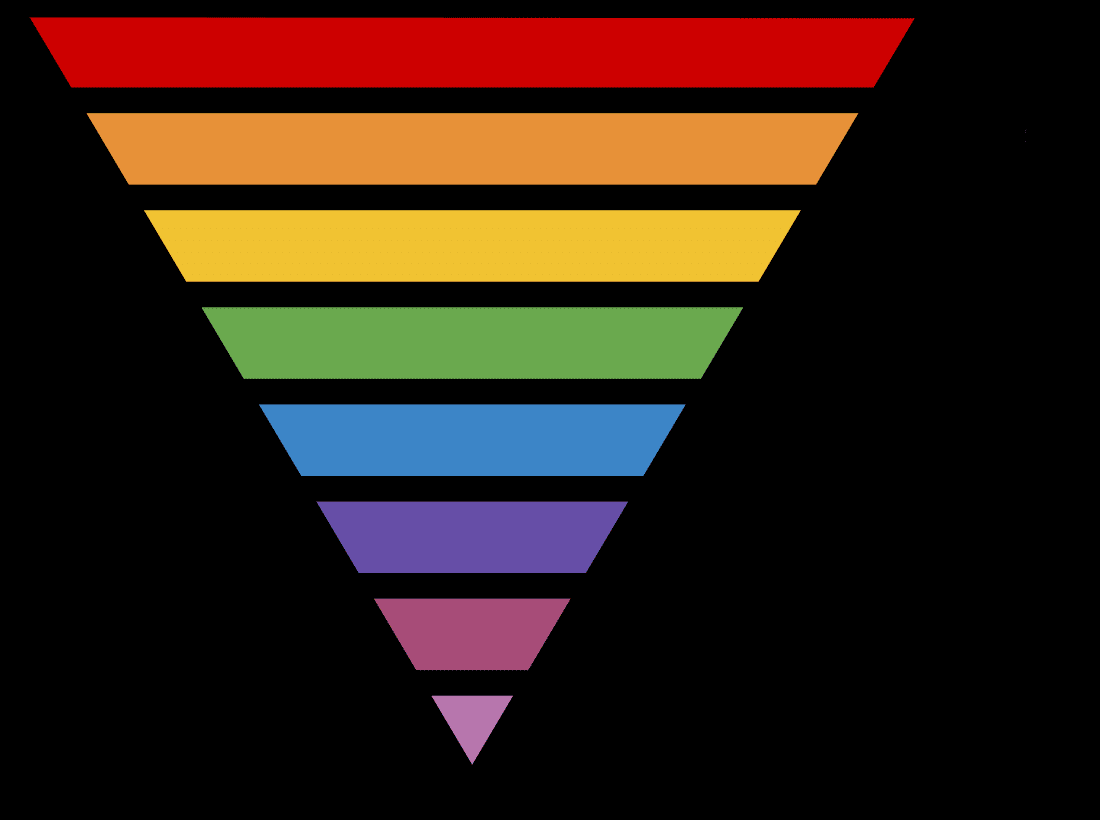
Taxonomic Hierarchy: The system of classification from broadest to most specific: Domain, Kingdom, Phylum, Class, Order, Family, Genus, Species.
Systematics: Studying Biological Diversity and Evolutionary History
Systematics is a broader scientific discipline that includes taxonomy and focuses on understanding biological diversity and reconstructing evolutionary history. Systematists use various methods to determine relatedness among species and test hypotheses about evolutionary relationships.
Systematics includes taxonomy but also uses numerical and molecular methods to assess relatedness.
Evolutionary history is reconstructed and visualized using diagrams called phylogenies or phylogenetic trees.
Traditional vs. Modern Classification Methods
Historically, organisms were classified based on external morphology. Modern methods utilize DNA sequencing to provide a more accurate representation of evolutionary relationships.
DNA sequencing can confirm or refute traditional groupings.
Some traditional groups are found to be artificial and require reclassification based on genetic data.
Phylogenetic Trees: Visualizing Evolutionary Relationships
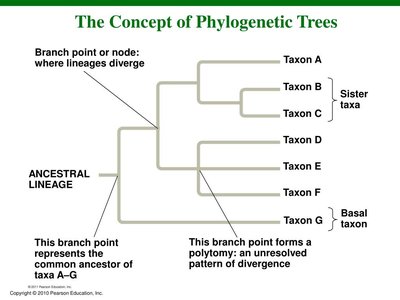
A phylogenetic tree is a diagram that represents the evolutionary relationships among species or groups. It shows how species diverged from common ancestors and helps clarify the history of life.
Branch point (node): Where lineages diverge.
Ancestral lineage: The common ancestor of all taxa in the tree.
Polytomy: An unresolved pattern of divergence.
Sister taxa: Two descendants that split from the same node; each is the other's closest relative.
Basal taxon: The earliest diverging lineage in the tree.
Monophyletic and Paraphyletic Groups
Classification aims to reflect evolutionary history. Systematists distinguish between monophyletic and paraphyletic groups:
Monophyletic group: Includes an ancestral species and all its descendants. This grouping passes the "one snip test" and is considered natural.
Paraphyletic group: Includes an ancestral species and only some of its descendants. This grouping is artificial and does not accurately reflect evolutionary relationships.
Only monophyletic groups should be named, according to systematists.
Phylogenetic Tree Styles and Examples
Phylogenetic trees can be drawn in various styles, such as bracket or tree diagrams. They illustrate evolutionary relationships and key traits that define major groups.
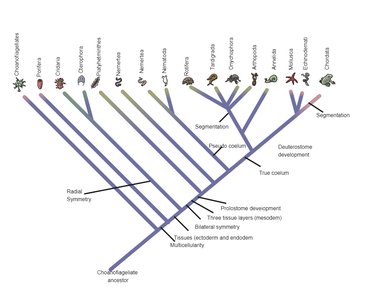
Traits such as radial symmetry, segmentation, and tissue layers are mapped onto the tree to show evolutionary innovations.
Phylogenies help identify sister groups and trace the origin of major characteristics.
Summary Table: Types of Groups in Phylogenetic Classification
Group Type | Definition | Example |
|---|---|---|
Monophyletic | Ancestral species and all descendants | Mammals |
Paraphyletic | Ancestral species and some descendants | Reptiles (excluding birds) |
Polyphyletic (Additional info: not discussed in original notes) | Group with members from different ancestors | Marine mammals (whales and seals) |
Additional info: Polyphyletic groups are also recognized in systematics but are considered artificial, as they do not include the most recent common ancestor of all members.
