 Back
Phylogenies, Biological Diversity, and Animal Classification: Study Notes for General Biology
Study Guide - Smart Notes
 Tailored notes based on your materials, expanded with key definitions, examples, and context.
Phylogenies and Systematics
Introduction to Phylogenies
Phylogenies are diagrams that represent the evolutionary history and relationships among species or groups of species. They are central to understanding macroevolution, speciation, and the classification of life.
Phylogeny: A diagram (phylogenetic tree) showing evolutionary relationships.
Systematics: The scientific study of biological diversity and evolutionary history, including taxonomy.
Taxonomy: The field of biology where organisms are classified and named.
Taxon: A named group at any level of classification (plural: taxa).
Example: The classification of humans: Domain Eukarya, Kingdom Animalia, Phylum Chordata, etc.
Phylogenetic Tree Structure
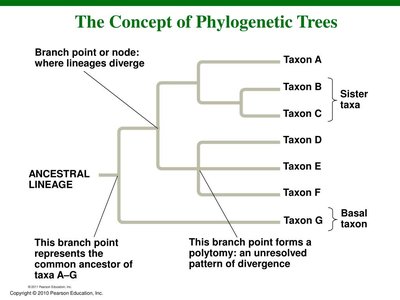
Phylogenetic trees illustrate how species diverge from common ancestors. They help identify evolutionary relationships and groupings.
Monophyletic Group: Includes an ancestral species and all its descendants (preferred grouping).
Paraphyletic Group: Includes an ancestral species and only some descendants (artificial grouping).
Sister Groups: Two lineages that branch from the same node; each is the other's closest relative.
Basal Taxon: The earliest diverging lineage in a phylogeny.
Additional info: Modern systematics uses DNA sequencing to improve classification accuracy, sometimes overturning traditional morphology-based groupings.
History of Life and Biological Diversity
Major Events in the History of Life
The history of life on Earth spans billions of years, marked by key evolutionary events and mass extinctions.
Earth formed: 4.6 billion years ago
First life (prokaryotes): 3.8 billion years ago
Photosynthesis begins: 3.5 billion years ago
First eukaryotes: 2.1 billion years ago
Multicellularity: 1.5 billion years ago
First animals: 700 million years ago
Major mass extinctions: 5 in the last 444 million years
Cambrian Explosion: Rapid diversification of animal life
Mass Extinction: Period where at least 50% of species go extinct globally within 1 million years.
Tree of Life: The largest phylogeny, showing three domains—Bacteria, Archaea, and Eukarya.
Classification and Domains of Life
Taxonomic Hierarchy
Organisms are classified in a hierarchical system, from broadest to most specific: Domain, Kingdom, Phylum, Class, Order, Family, Genus, Species.
Species Name: Consists of two words—Genus + specific epithet (e.g., Homo sapiens).
Always underline genus and species names.
Three Domains of Life
The three domains of life are distinguished primarily by cell type and genetic differences.
Bacteria: Prokaryotic, unicellular, cell wall of peptidoglycan, diverse metabolic pathways.
Archaea: Prokaryotic, unicellular, cell wall of various compositions, often extremophiles.
Eukarya: Eukaryotic, includes protists, plants, fungi, and animals.
Domain | Kingdoms | Cell Type |
|---|---|---|
Bacteria | Multiple | Prokaryotic |
Archaea | Multiple | Prokaryotic |
Eukarya | Protista, Plantae, Fungi, Animalia | Eukaryotic |
Prokaryotic and Eukaryotic Diversity
Prokaryotic Cells vs. Eukaryotic Cells
Prokaryotic and eukaryotic cells differ in size, structure, and complexity.
Feature | Prokaryotic Cells | Eukaryotic Cells |
|---|---|---|
Cell Size | 1-2 micrometers | 10-100 micrometers |
Plasma Membrane | Present | Present |
DNA Form | 1 circular chromosome | Many shaped chromosomes |
Nucleus | Absent | Present |
Cell Division | Binary fission | Mitosis/Meiosis |
Membrane-bound Organelles | Absent | Present |
Ribosomes | Smaller | Larger |
Cytoskeleton | Absent | Present |
Bacterial Diversity
Bacteria are highly diverse, with many lineages and metabolic pathways.
Cell wall of peptidoglycan
Common shapes: cocci (spheres), bacilli (rods), spirilla (spirals)
Cluster arrangements: staphylo (clusters), strepto (lines)
Horizontal gene transfer increases genetic variation
Archaeal Diversity
Archaea are prokaryotes with unique adaptations, often living in extreme environments.
Cell wall composition varies (not peptidoglycan)
Extremophiles: hyperthermophiles, acidophiles, methanogens, halophiles
Also found in less extreme environments, especially oceans
Diversification of Eukaryotes
Origin of Eukaryotic Cells
Eukaryotic cells likely formed through endosymbiosis, where a large cell engulfed a smaller cell that became an organelle.
Endosymbiosis Hypothesis: Mitochondria and chloroplasts originated from engulfed prokaryotes.
Evidence: Both organelles have circular DNA, prokaryotic ribosomes, divide by binary fission, and are surrounded by two membranes.
Secondary endosymbiosis: Eukaryotic cells engulf other eukaryotes, leading to further complexity.
Kingdoms within Eukarya
Eukarya includes four main kingdoms: Protista (artificial group), Plantae, Fungi, and Animalia.
Protista: Paraphyletic, mostly unicellular, includes "algae" (photosynthetic) and "protozoa" (heterotrophic).
Plantae: Multicellular, photosynthetic, cell walls of cellulose, alternation of generations life cycle.
Fungi: Mostly multicellular, cell walls of chitin, chemoheterotrophic, decomposers, mutualists (mycorrhizae, lichens).
Animalia: Multicellular, no cell walls, chemoheterotrophic, embryonic blastula stage, mobile.
Multicellularity
Multicellularity evolved independently many times, with complex multicellularity requiring cell adhesion, communication, and differentiation.
Complex multicellularity evolved in red algae, brown algae, green algae/plants, animals, fungi.
Requirements: cell-to-cell adhesion, communication, and differentiation guided by regulatory genes.
Animal Diversity and Classification
Basal Lineages and Bilateria
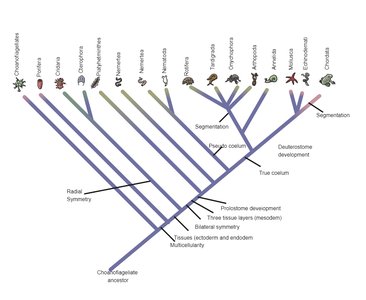
Animals are classified based on symmetry, tissue layers, and developmental patterns.
Phylum Porifera: Sponges, no tissues, no symmetry.
Phylum Ctenophora: Comb jellies, diploblastic, biradial symmetry.
Phylum Cnidaria: Jellies, corals, radial symmetry, two tissue layers.
Bilateria: Bilateral symmetry, three tissue layers (ectoderm, mesoderm, endoderm).
Protostome Animals
Protostomes develop the mouth before the anus during embryonic development. Major phyla include:
Rotifera: Rotifers, aquatic.
Platyhelminthes: Flatworms, includes planaria, flukes, tapeworms.
Annelida: Segmented worms, earthworms, leeches.
Mollusca: Mollusks, snails, slugs, clams, octopi, squids.
Nematoda: Roundworms, hookworm, pinworm, heartworm.
Tardigrada: Waterbears, herbivores.
Arthropoda: Arthropods, insects, arachnids, crustaceans.
Deuterostome Animals
Deuterostomes develop the anus before the mouth. Major phyla include:
Echinodermata: Sea stars, sea urchins, sand dollars, pentaradial symmetry as adults.
Chordata: Includes vertebrates, lancelets, tunicates; characterized by dorsal nerve cord, notochord, pharyngeal slits, post-anal tail.
Vertebrate Diversity
Vertebrates are classified by major groups:
Jawless fishes: lampreys, hagfish
Cartilaginous fish: sharks, rays
Ray-finned fish: trout, bass, seahorses
Lobed-finned fish: coelacanth, lungfish, tetrapods
Amphibians: frogs, salamanders
Reptiles: snakes, lizards, turtles, birds, dinosaurs
Mammals: monotremes (egg-laying), marsupials (pouched), placental mammals
Primates: lemurs, monkeys, apes (including humans)
Introduction to Ecology
Ecological Hierarchy
Ecology studies how organisms interact with their environment, which includes both abiotic and biotic factors. The ecological hierarchy organizes these interactions at different levels.
Individual: Single organism
Population: Group of individuals of the same species
Community: Groups of populations of different species
Ecosystem: Community plus abiotic environment
Biosphere: All ecosystems on Earth
Emergent Properties: New properties arise at each level due to interactions and arrangements of parts.
Population Ecology
Population ecology focuses on factors affecting population density, growth, and distribution.
Population Size (N): Number of individuals
Population Range: Geographic area
Population Density: Number per unit area
Distribution: Random, clumped, or uniform
Population Growth Equation:
Where = births, = immigration, = deaths, = emigration.
Rate of change:
Normalized to population size:
Rule of 72: gives doubling time of population.
Population Growth Models
Linear Growth: Rare, assumes no change in breeding individuals or population limits.
Exponential Growth: New individuals contribute to reproduction, no population limit.
Logistic Growth: Includes carrying capacity, the maximum population supported by habitat.
