 Back
Phylogeny and Biological Classification: Understanding Evolutionary Relationships
Study Guide - Smart Notes
 Tailored notes based on your materials, expanded with key definitions, examples, and context.
Phylogeny
What is a Phylogeny?
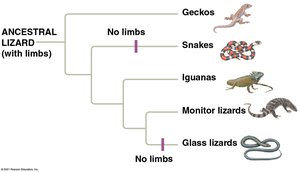
Phylogeny refers to the evolutionary relationships among organisms, illustrating how species are related through common ancestry. Scientists use phylogenetic trees and cladograms to hypothesize these relationships based on shared traits and genetic information.
Cladogram: A diagram that represents a hypothesis about the evolutionary history of a group of organisms. It is constructed using shared derived characteristics.
Shared Ancestry: Cladograms show which organisms share a common ancestor, but do not indicate the amount of evolutionary change or time elapsed.
Limitations: Cladograms do not show evolutionary distance, complexity, or include all organisms.
Extant Organisms: Living species shown on a cladogram are not ancestral to each other.
Classification System
Linnaean Hierarchy and Taxa
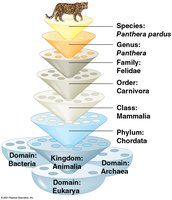
The classification system, first developed by Carl Linnaeus in the 18th century, organizes living organisms into hierarchical categories called taxa (singular: taxon). This system helps scientists communicate about species and understand their relationships.
Basic Ranks: Domain, Kingdom, Phylum, Class, Order, Family, Genus, Species
Taxon: A group of one or more populations of an organism or organisms seen by taxonomists to form a unit.
Example of Classification
The following table illustrates the classification of the leopard (Panthera pardus):
Rank | Example |
|---|---|
Domain | Eukarya |
Kingdom | Animalia |
Phylum | Chordata |
Class | Mammalia |
Order | Carnivora |
Family | Felidae |
Genus | Panthera |
Species | Panthera pardus |
Traditional Biological Diversity
Prokaryotes vs. Eukaryotes
Historically, biological diversity was divided into two main groups: prokaryotes and eukaryotes, based on cellular structure.
Prokaryotes: Single-celled organisms without a nucleus (Kingdom Monera). They are simple and small.
Eukaryotes: Organisms with cells that contain a nucleus. Includes four kingdoms: Animals, Plants, Fungi, and Protists. These can be unicellular or multicellular and are generally more complex.
Current Classification System
The Three-Domain System
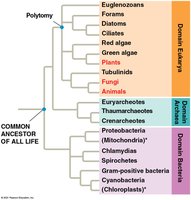
Modern classification recognizes three domains, reflecting major differences in cellular organization and genetics. Each domain contains multiple kingdoms and phyla.
Domain Bacteria: Includes most prokaryotes, formerly part of Kingdom Monera.
Domain Archaea: Prokaryotes distinct from bacteria, also formerly part of Monera.
Domain Eukarya: All eukaryotic organisms, including animals, plants, fungi, and protists.
Organisms Not on the Tree of Life
Some biological entities, such as viruses, viroids, and prions, are not included in the tree of life because they do not meet all the criteria for living organisms (e.g., lack of cellular structure).
Examples of Phylogenetic Trees and Classification
Cladogram Example: Carnivores
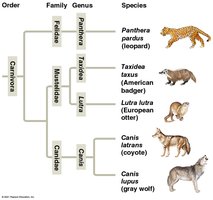
The following diagram shows the evolutionary relationships among several carnivorous mammals, illustrating how classification reflects phylogeny.
Key Terms
Phylogeny: The evolutionary history and relationships among individuals or groups of organisms.
Cladogram: A branching diagram showing the cladistic relationship between a number of species.
Taxon (plural: taxa): A group of one or more populations of an organism or organisms seen by taxonomists to form a unit.
Domain: The highest taxonomic rank in the hierarchical biological classification system.
