 Back
BackL3 Biodiversity
Study Guide - Smart Notes
 Tailored notes based on your materials, expanded with key definitions, examples, and context.
Phylogeny and Phylogenetic Trees
Introduction to Phylogeny
Phylogeny is the study of the evolutionary relationships among species. It seeks to reconstruct the evolutionary history of organisms, showing how species are related through common ancestry. The primary tool for visualizing these relationships is the phylogenetic tree.
Phylogenetic tree: A diagram that represents hypotheses about the evolutionary relationships among species, based on evidence such as the fossil record, morphology, embryological development, chromosomes, and macromolecules.
Helps us understand how organisms are related and trace the lineage of species.
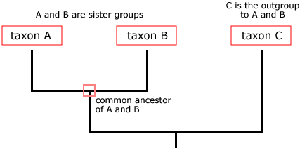
Structure of a Phylogenetic Tree
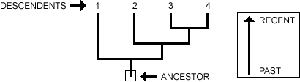
Phylogenetic trees are structured to show the passage of evolutionary time from ancestral lineages to their descendants. The root represents the most ancient ancestor, while the tips represent current species or groups.
Root: Represents the ancestral lineage.
Tips: Represent the descendants of that ancestor.
Moving from the root to the tips moves forward in evolutionary time.
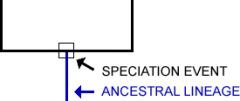
Speciation and Branching
When a lineage splits, a speciation event occurs, resulting in two or more daughter lineages. This is depicted as a branching point (node) on the tree.
Each branch point (node) represents a common ancestor shared by the descendant lineages.
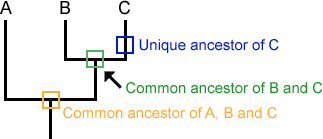
Shared and Unique Ancestry
Phylogenies trace patterns of shared ancestry. Each lineage has unique evolutionary history as well as history shared with other lineages.
Nodes indicate common ancestors.
Some ancestors are unique to a single lineage, while others are shared among multiple lineages.
Clades and Cladistics
Definition of a Clade
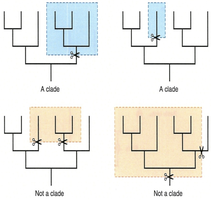
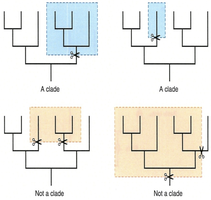
A clade is a taxonomic group that includes a single common ancestor and all its descendants (living and extinct). Clades are identified by making a single cut on a phylogenetic tree; if all the resulting branches are included, it is a clade.
Outgroup: A more distantly related group used as a reference for determining evolutionary relationships within the ingroup.
Identifying Clades
Clades can be visually identified on a phylogenetic tree. If a single cut can separate a group from the rest of the tree, it is a clade; if two or more cuts are needed, it is not a clade.
Cladistics
Cladistics is a system of taxonomy that reconstructs phylogenies by inferring relationships based on shared derived characteristics (synapomorphies). It determines the sequence in which groups evolved and focuses on recently evolved traits.
Derived traits are unique characteristics found in a particular group.
More closely related species share more derived characters.
Cladogram vs. Clade
A cladogram is a branching diagram that represents the phylogenetic relationships among organisms. It is used to visualize the arrangement of clades based on shared derived characters.
Major Vertebrate Clades
Examples of Vertebrate Clades
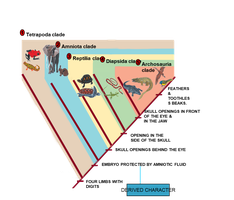
Several major clades are recognized within vertebrates, each defined by unique derived characters:
Tetrapoda: Vertebrates with four limbs with digits.
Amniota: Vertebrates whose embryos are protected by amniotic fluid.
Reptilia: Vertebrates with skull openings behind the eye.
Diapsida: Vertebrates with two openings in the side of the skull.
Archosauria: Vertebrates with skull openings in front of the eye and in the jaw, and features such as feathers and toothless beaks.
Nodes and Derived Characters
Each node on a cladogram represents the most recent common ancestor of a clade. Derived characters are used to define clades and are mapped onto the branches of the cladogram.
Traditional vs. Modern Taxonomy
Traditional Taxonomy
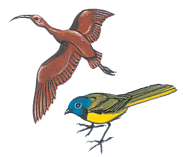
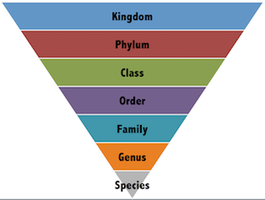
Traditional taxonomy groups species primarily by morphological characteristics and arranges them into a set number of taxonomic ranks (kingdom, phylum, class, order, family, genus, species).
Advantage: Simple and convenient for classification.
Disadvantages: May not accurately reflect evolutionary relationships; convergent evolution and mutations can lead to misclassification.
Modern Taxonomy (Phylogenetic Systematics)
Modern taxonomy uses evolutionary relationships (phylogeny) to group organisms into clades of varying sizes, not limited to fixed ranks. It relies on both morphological and genetic evidence.
Advantages: Reveals true evolutionary relationships, even those that go back millions of years.
Disadvantage: Requires detailed analysis of fossil and genetic data, which can be complex and time-consuming.
Comparison of Traditional and Modern Classification
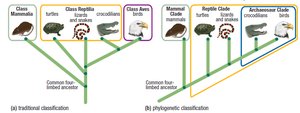
Modern taxonomy can result in different groupings than traditional taxonomy. For example, crocodilians are grouped with birds in modern taxonomy due to a more recent common ancestor, while traditional taxonomy groups them with turtles, snakes, and lizards based on physical features.
Constructing Cladograms
Steps in Constructing a Cladogram
Constructing a cladogram involves identifying shared derived characters and arranging species based on these traits to reflect their evolutionary relationships.
List the organisms and their characteristics.
Determine which characteristics are derived (unique to certain groups).
Arrange the organisms in a branching diagram based on shared derived characters.
Example: Worksheet exercises and textbook references can help practice constructing cladograms.
Summary Table: Traditional vs. Modern Taxonomy
Aspect | Traditional Taxonomy | Modern Taxonomy (Cladistics) |
|---|---|---|
Basis of Classification | Morphological characteristics | Evolutionary relationships (phylogeny) |
Grouping | Fixed taxonomic ranks | Clades of varying sizes |
Advantages | Simple, convenient | Reflects true evolutionary history |
Disadvantages | May misclassify due to convergent evolution | Requires complex data analysis |
