 Back
BackPhylogeny and Systematics: Evolutionary Relationships and Classification
Study Guide - Smart Notes
 Tailored notes based on your materials, expanded with key definitions, examples, and context.
Phylogeny and Systematics
Introduction to Phylogeny and Systematics
Phylogeny is the evolutionary history of a species or group of related species, while systematics is the scientific discipline focused on classifying organisms and determining their evolutionary relationships. These concepts are foundational for understanding the diversity of life and the connections among organisms.
Phylogeny: The evolutionary history and relationships among species.
Systematics: The study of biological diversity in an evolutionary context, including taxonomy and phylogenetics.
Taxonomy: The science of naming and classifying organisms.
Binomial Nomenclature and Hierarchical Classification
Developed by Carolus Linnaeus, binomial nomenclature provides a standardized way to name species using two parts: the genus and the specific epithet. This system is still used today and is essential for clear scientific communication.
Genus: The first part of the scientific name, capitalized.
Specific epithet: The second part, unique to each species within the genus.
Formatting: The full species name is italicized (e.g., Homo sapiens).
Linking Classification and Phylogeny
Classification systems aim to reflect evolutionary relationships, but traditional placement within the Linnaean system does not always match phylogenetic evidence. Modern systematics increasingly relies on evolutionary history, often revealed by DNA and molecular data.
Phylogenetic tree: A branching diagram representing evolutionary relationships.
Reclassification: New evidence (e.g., DNA) may lead to changes in classification to better reflect evolutionary history.
Understanding Phylogenetic Trees
Phylogenetic trees are hypotheses about evolutionary relationships. Each branch point represents the divergence of two lineages from a common ancestor. The arrangement of taxa at the tips does not indicate evolutionary order or phenotypic similarity.
Branch point: Represents divergence from a common ancestor.
Sister taxa: Groups sharing a common ancestor not shared by other groups.
Rooted tree: Includes a branch for the most recent common ancestor of all taxa.
Basal taxon: A lineage that diverges early in the history of the group.
Inferring Phylogenies: Morphological and Molecular Data
Systematists use morphological, genetic, and biochemical data to infer phylogenies. Only features resulting from common ancestry (homologies) are useful for determining evolutionary relationships.
Homology: Similarity due to shared ancestry.
Analogy: Similarity due to convergent evolution, not shared ancestry.
Convergent evolution: Unrelated species evolve similar traits due to similar environmental pressures.
Evaluating Molecular Homologies
DNA sequence alignment is used to identify homologous genes. Closely related species differ at few sites, while distantly related species differ at many sites. Computer programs and statistical tools help distinguish true homologies from coincidental matches.
Insertions and deletions: Point mutations that shift DNA sequences.
Sequence alignment: Comparing DNA sequences to identify similarities.
Cladistics and Grouping Organisms
Cladistics groups organisms by common ancestry. A clade includes an ancestor and all its descendants. Groups can be monophyletic, paraphyletic, or polyphyletic.
Monophyletic group: Ancestor and all descendants (a true clade).
Paraphyletic group: Ancestor and some, but not all, descendants.
Polyphyletic group: Distantly related species without their most recent common ancestor.
Shared Ancestral and Derived Characters
Characters can be ancestral (originating in an ancestor) or derived (unique to a clade). The distinction is relative to the group being studied.
Shared ancestral character: Present in ancestor and descendants.
Shared derived character: Evolutionary novelty unique to a clade.
Outgroup comparison: Used to differentiate ancestral and derived characters.
Phylogenetic Trees with Proportional Branch Lengths
Branch lengths in some trees reflect the number of genetic changes or the passage of time, often calibrated with fossil data.
Genetic changes: Longer branches indicate more changes.
Time calibration: Fossil data used to estimate divergence times.
Maximum Parsimony and Maximum Likelihood
Systematists use principles of maximum parsimony (fewest evolutionary events) and maximum likelihood (most probable tree given DNA data) to narrow down possible phylogenetic trees.
Maximum parsimony: Fewest base changes or character appearances.
Maximum likelihood: Probability-based approach using models of DNA evolution.
Phylogenetic Trees as Hypotheses
Phylogenetic trees allow predictions about features shared by ancestors and descendants. Phylogenetic bracketing is used to infer traits in extinct groups based on living relatives.
Phylogenetic bracketing: Predicts ancestral traits based on shared features in related groups.
Case Study: Phylogeny of Australasian Teals
Phylogeny, Biogeography, and Taxonomy of Australasian Teals
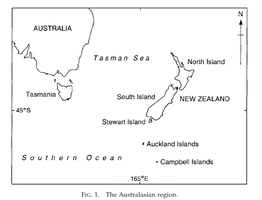
This case study explores the evolutionary relationships and classification of Australasian teals, a group of duck species distributed across Australia, New Zealand, and surrounding islands.
Biogeography: The study of the geographic distribution of species.
Taxonomy: Classification of teals based on morphological and genetic data.
Phylogenetic Tree of Australasian Teals
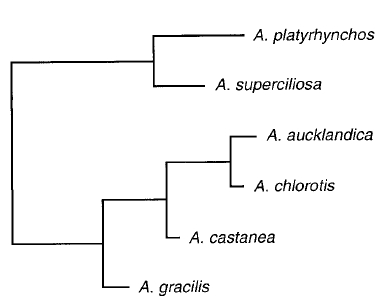
The phylogenetic tree below shows the evolutionary relationships among several species of Australasian teals. Each branch point represents a divergence event, and the tree helps clarify which species are most closely related.
Morphological Diversity in Teals
Australasian teals exhibit significant morphological diversity, which can be observed in their plumage and body structure. These differences are important for species identification and understanding evolutionary adaptation.
Example: Comparison of chestnut teal and grey teal individuals.


Genetic Analysis and Species Delimitation
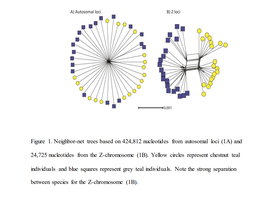
Genetic data, such as DNA sequencing, is used to clarify species boundaries and evolutionary relationships. Neighbor-net trees based on genetic loci can reveal strong separation between species, especially when analyzing sex chromosomes.
Autosomal loci: Genes found on non-sex chromosomes.
Z-chromosome: Sex chromosome in birds, important for species differentiation.
Molecular Clocks and Evolutionary Time
Molecular Clocks
Molecular clocks estimate the timing of evolutionary events by comparing genetic differences and calibrating them with known fossil dates. The rate of molecular change is assumed to be relatively constant for some genes.
Equation: Where is the number of genetic differences, is the rate of change, and is time since divergence.
Calibration: Fossil record used to estimate rates and dates.
Changing Views of the Tree of Life
From Kingdoms to Domains
Biological classification has evolved from two kingdoms (plants and animals) to three domains: Bacteria, Archaea, and Eukarya. This reflects deeper evolutionary relationships revealed by molecular data.
Bacteria: Most known prokaryotes.
Archaea: Diverse prokaryotes, some closely related to eukaryotes.
Eukarya: Organisms with true nuclei, including plants, fungi, and animals.
Horizontal Gene Transfer
Horizontal gene transfer (HGT) is the movement of genes between genomes, which can blur evolutionary relationships and complicate the tree of life. HGT occurs via plasmids, viral infection, and other mechanisms.
Impact: HGT has played a key role in the evolution of both prokaryotes and eukaryotes.
Example: The alga Galdieria sulphuraria acquired genes from bacteria and archaea.
Summary Table: Types of Phylogenetic Groups
Group Type | Definition | Example |
|---|---|---|
Monophyletic | Ancestor and all descendants | Birds |
Paraphyletic | Ancestor and some descendants | Reptiles (excluding birds) |
Polyphyletic | Distantly related species, not including common ancestor | Marine mammals |
Key Terms
Phylogeny
Systematics
Taxonomy
Clade
Homology
Analogy
Molecular clock
Horizontal gene transfer
Additional info: Academic context and definitions have been expanded for clarity and completeness. Images included are directly relevant to the explanation of Australasian teal phylogeny and genetic analysis.
