 Back
Phylogeny and the Tree of Life: Organizing Biological Diversity Ch. 26
Study Guide - Smart Notes
 Tailored notes based on your materials, expanded with key definitions, examples, and context.
Phylogeny and the Tree of Life Ch. 27
Organizing the Diversity of Life
The vast diversity of life on Earth is organized through scientific classification systems that reveal evolutionary relationships. Approximately 1.8 million species have been named, with estimates of total species ranging from 10 million to over 100 million. Despite this diversity, unity exists at many levels, such as the universal use of DNA as the genetic language.
Unity in Diversity: Many cellular and organismal structures are shared among groups of organisms.
DNA: The universal genetic material connecting all life forms.
Systematics: The scientific discipline that classifies organisms and determines their evolutionary relationships.
Taxonomy: The ordered division and naming of organisms.
Phylogeny: The evolutionary history of a species or group of related species.
Cladistics: A method of systematics that groups organisms by common descent.
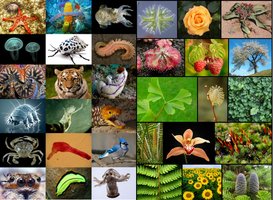
Classification and Binomial Nomenclature
Classification is essential for organizing the immense diversity of species. Binomial nomenclature, developed by Carolus Linnaeus, assigns each species a two-part scientific name: the genus and the specific epithet. This system is universally used by scientists.
Genus: The first part of the scientific name (e.g., Homo in Homo sapiens).
Specific epithet: The second part, unique to each species within the genus (e.g., sapiens).
Hierarchical Classification: Organisms are classified in a hierarchy: Domain, Kingdom, Phylum, Class, Order, Family, Genus, Species.
Taxon: Any taxonomic unit at any level of hierarchy.
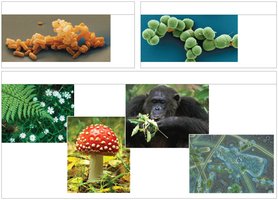
The Three-Domain System
The three-domain system is currently used to classify life, replacing the older five-kingdom system. Domains Bacteria and Archaea include prokaryotes, while Domain Eukarya includes all eukaryotic organisms. This system is supported by molecular data from sequenced genomes.
Domain Bacteria: Prokaryotic organisms.
Domain Archaea: Prokaryotes distinct from bacteria.
Domain Eukarya: All eukaryotic organisms (plants, animals, fungi, protists).
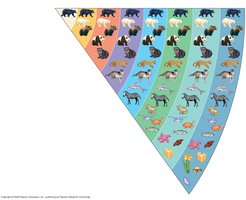
Hierarchical Classifications
The taxonomic hierarchy organizes species from broad to narrow categories. Mnemonics such as "Keep Pouring Coffee On Fred’s Green Shirt" help remember the order: Domain, Kingdom, Phylum, Class, Order, Family, Genus, Species.
Example: Ursus americanus (American black bear) is classified as follows:
Level | Example |
|---|---|
Domain | Eukarya |
Kingdom | Animalia |
Phylum | Chordata |
Class | Mammalia |
Order | Carnivora |
Family | Ursidae |
Genus | Ursus |
Species | Ursus americanus |
Phylogeny and Phylogenetic Trees
Phylogeny is the evolutionary history of a species or group. Phylogenetic trees are branching diagrams that depict evolutionary relationships, showing patterns of descent and allowing identification of similar genes in organisms. The "Tree of Life" model suggests that eukaryotes and archaea are more closely related to each other than to bacteria.
Principle: Common genetic sequences indicate common ancestry.
Phylogenetic Tree: Shows what evolved from what, in what order, and when.
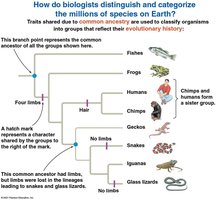
Sorting Homology from Analogy
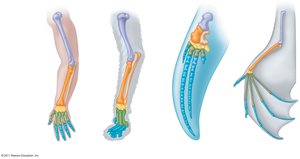
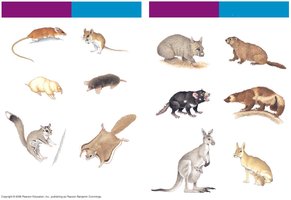
Homology refers to similarity due to shared ancestry, while analogy refers to similarity due to convergent evolution. Convergent evolution occurs when similar environmental pressures produce similar adaptations in unrelated lineages. Homology can be distinguished from analogy by comparing fossil evidence and the complexity of structures.
Homologous structures: Similar due to common ancestry (e.g., mammalian forelimbs).
Analogous structures: Similar due to convergent evolution (e.g., wings of birds and insects).
Divergent evolution: Accumulation of differences between closely related populations, leading to speciation.
Clades and Types of Groups
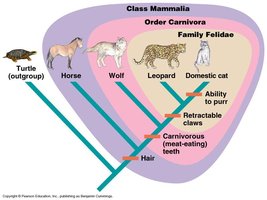
Cladistics groups organisms by common descent. A clade is a group of species that includes an ancestral species and all its descendants. Clades are monophyletic, while paraphyletic groups include the ancestor but not all descendants, and polyphyletic groups include species lacking a common ancestor.
Monophyletic group (clade): Ancestor and all descendants.
Paraphyletic group: Ancestor and some descendants.
Polyphyletic group: Species from different ancestors.
Ingroup: Group being studied.
Outgroup: Group not part of the ingroup, used for comparison.
Phylogenetic Trees as Hypotheses
Phylogenetic trees are hypotheses about evolutionary relationships. The best trees fit the most data, including morphological, molecular, and fossil evidence. Systematists use these trees to depict evolutionary relationships and test scientific hypotheses about descent.
Data sources: Morphological, molecular, and fossil evidence.
Application: Identifying evolutionary relationships and common ancestry.
Summary Table: Key Terms in Phylogeny
Term | Definition |
|---|---|
Systematics | Classifying organisms and determining evolutionary relationships |
Taxonomy | Ordered division and naming of organisms |
Phylogeny | Evolutionary history of a species or group |
Cladistics | Grouping by common descent |
Homology | Similarity due to shared ancestry |
Analogy | Similarity due to convergent evolution |
Clade | Group including ancestor and all descendants |
Additional info:
Phylogenetic trees are dynamic and may change as new data becomes available.
Molecular systematics, using DNA and protein sequences, has revolutionized classification.
