 Back
BackPhylogeny, Molecular Clocks, and Cladistics: Study Notes for Biology Students
Study Guide - Smart Notes
 Tailored notes based on your materials, expanded with key definitions, examples, and context.
Phylogeny and Evolutionary Relationships
Homology vs. Analogy
Understanding the distinction between homology and analogy is fundamental in evolutionary biology. Homology refers to similarities in traits due to shared ancestry, while analogy refers to similarities that arise from convergent evolution, where unrelated organisms independently evolve similar features.
Homologous structures: Anatomical or genetic features inherited from a common ancestor. These may serve different functions in different organisms.
Analogous structures (homoplasies): Features that serve similar functions but evolved independently in different lineages.
Both homology and analogy can be observed in morphological (anatomy, physiology) and molecular (genetic) traits.
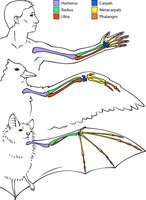
Example: The forelimbs of humans, birds, and bats are homologous, sharing a common skeletal structure but adapted for different functions.
Inferring Phylogenies
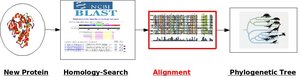
Phylogenies are inferred by analyzing similarities and differences among organisms. Molecular homologies, such as DNA, RNA, and protein sequences, are especially useful for constructing phylogenetic trees.
Molecular homologies: Genetic similarities due to shared ancestry.
Computational tools align and compare DNA sequences to assess evolutionary relationships.
High sequence similarity in complex regions suggests homology.
Molecular Sequence Alignment and Mutation
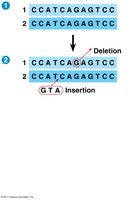
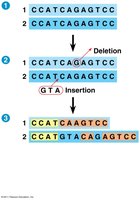
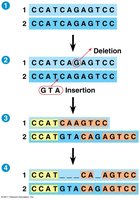
Over time, mutations accumulate in DNA sequences, causing divergence between lineages. Sequence alignment helps identify these changes and infer evolutionary relationships.
Mutations: Changes in DNA sequence, including insertions, deletions, and substitutions.
Sequence alignment reveals differences and similarities between individuals or species.

Statistical Assessment of Sequence Similarity
Computers use statistical tests to evaluate the degree of similarity between molecular sequences. A high degree of similarity in complex sequences is strong evidence for homology.
Statistical methods quantify sequence similarity and help construct accurate phylogenetic trees.
Molecular Clocks
Principles of Molecular Clocks
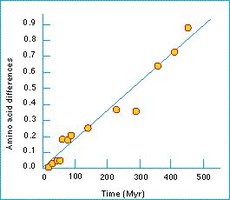
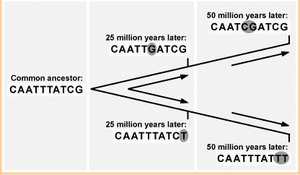
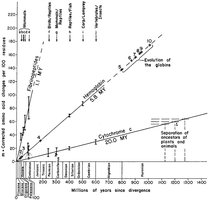
A molecular clock is a method for estimating the time of evolutionary divergence between species based on the rate of genetic mutations. Some genes and genome regions change at relatively constant rates, allowing researchers to measure evolutionary time.
Constant rate of change: Genes critical for survival are highly conserved and mutate slowly; less essential genes may mutate faster.
Neutral mutations: Most observed mutations are neutral, neither beneficial nor harmful.
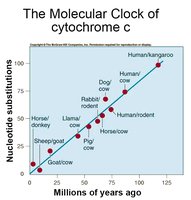
Example: Cytochrome C is a highly conserved protein used in molecular clock studies.
Calibration and Assumptions
Molecular clocks are calibrated using fossil records and radiometric dating. The number of genetic differences is matched with known evolutionary events to estimate divergence times.
Assumption: The number of mutations is proportional to the time since two lineages diverged.
Calibration: Fossil records and radiometric dating (e.g., carbon, potassium isotopes) provide reference points.
Limitations and Solutions
Molecular clocks can be affected by natural selection and may not extend beyond the fossil record. To improve reliability, researchers calibrate clocks across multiple genes and taxa.
Essential genes change slowly; less essential genes change faster.
Analyzing multiple genes increases accuracy of divergence estimates.
Cladistics and Phylogenetic Trees
Cladistics: Identifying Clades
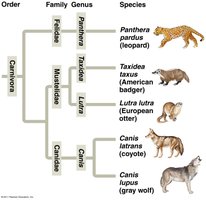
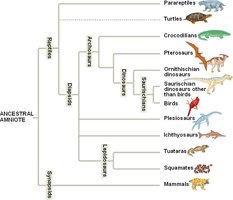
Cladistics is a method in systematics that groups organisms based on common ancestry. A clade is a group of species descended from a common ancestor.
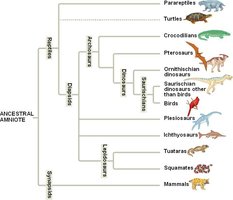
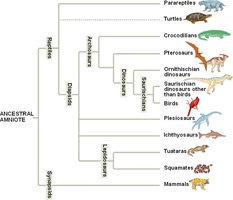
Monophyletic group: Includes an ancestor and all its descendants.
Paraphyletic group: Includes an ancestor and some, but not all, descendants.
Polyphyletic group: Composed of members with different ancestors.
Importance of Clades
Clades reveal evolutionary relationships based on descent from a common ancestor. Traits inherited from a common ancestor are used to define clades.
Shared ancestral character: Trait that predates the branching of a clade.
Shared derived character: Trait unique to a clade.
Outgroup Comparison
An outgroup is a taxon related to, but not part of, the group under study. Outgroup comparison helps determine ancestral character states and clarify evolutionary relationships.
Outgroups provide a reference for distinguishing ancestral and derived traits.
Summary Table: Types of Evolutionary Groups
Group Type | Definition | Example |
|---|---|---|
Monophyletic | Ancestor and all descendants | Dinosaurs (including birds) |
Paraphyletic | Ancestor and some descendants | Pterosaurs, Saurischians, and Birds |
Polyphyletic | Members with different ancestors | Plesiosaurs, Saurischians, and Birds |
Key Terms and Concepts
Phylogeny: The evolutionary history and relationships among species.
Cladistics: Classification based on common ancestry.
Molecular clock: Method for estimating evolutionary divergence based on mutation rates.
Homology: Similarity due to shared ancestry.
Analogy: Similarity due to convergent evolution.
Mutation: Change in DNA sequence.
Outgroup: Reference taxon for determining ancestral traits.
