 Back
BackPhylogeny, Systematics, and the Tree of Life: Classification and Evolutionary Relationships
Study Guide - Smart Notes
 Tailored notes based on your materials, expanded with key definitions, examples, and context.
Phylogeny and the Classification of Life
Traits, Common Ancestry, and Sister Groups
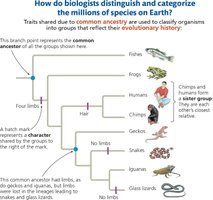
Biologists use traits shared due to common ancestry to classify organisms into groups that reflect their evolutionary history. Sister groups are groups of organisms that share a common ancestor not shared by any other group, making them each other's closest relatives.
Phylogenies and Systematics
Phylogeny is the evolutionary history of a species or group of related species. Systematics is the scientific discipline focused on classifying organisms and determining their evolutionary relationships. Phylogenies are constructed using morphological and molecular data to infer evolutionary relationships.
Binomial Nomenclature
Biologists use binomial nomenclature to assign each species a two-part Latinized name: the Genus (capitalized) and the specific epithet (lowercase). The entire binomial is italicized (e.g., Panthera pardus for the leopard).
Hierarchical Classification
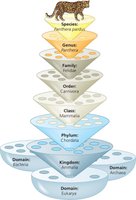
Organisms are classified in a hierarchy of increasingly inclusive categories:
Species
Genus
Family
Order
Class
Phylum
Kingdom
Domain
A taxon is a named taxonomic unit at any level. Taxa broader than genus are capitalized but not italicized.
Linking Classification and Phylogeny
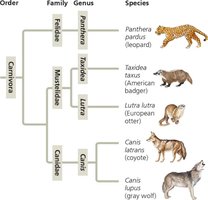
A phylogenetic tree is a branching diagram representing a hypothesis about the evolutionary history of a group. The branching pattern often matches systematic classification, but sometimes reclassification is needed when new evidence (e.g., DNA) reveals misplacement.
What We Can and Cannot Learn from Phylogenetic Trees
Key terms:
Branch point: Represents divergence of taxa from a common ancestor.
Rooted tree: Contains a branch point representing the most recent common ancestor of all taxa in the tree.
Basal taxon: A lineage that diverged early in the history of the group.
Phylogenetic trees show patterns of descent, not phenotypic similarity or the ages of taxa. The order of taxa at the tips is not significant, and one should not assume that a taxon evolved from the taxon next to it.
Applying Phylogenies
Phylogenies can be used to infer species identities by analyzing the relatedness of DNA sequences from different organisms.
Inferring Phylogenies: Morphological and Molecular Data
Morphological and Molecular Homologies
Homologies are phenotypic and genetic similarities due to shared ancestry. Morphological homologies include similar bone structures, while molecular homologies involve similar genes or DNA sequences. Organisms with similar morphologies or DNA sequences are likely more closely related.
Sorting Homology from Analogy
Analogy refers to similarity due to convergent evolution, not common ancestry. Convergent evolution produces analogous adaptations in unrelated lineages. Genetic and fossil evidence help distinguish homology from analogy. The more elements that are similar in complex structures or genes, the more likely they are homologous.
Evaluating Molecular Homologies
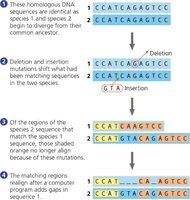
To evaluate molecular homologies:
Sequence DNA from each species.
Align comparable sequences.
Closely related species have few differences; distantly related species have more differences due to insertions and deletions over time.
Cladistics and Phylogenetic Trees
Cladistics and Clades
Cladistics groups organisms into clades based on common descent. A clade is monophyletic (includes ancestor and all descendants). Other groupings include:
Paraphyletic: Ancestor and some descendants
Polyphyletic: Distantly related organisms, not including their most recent common ancestor
Shared Ancestral and Shared Derived Characters
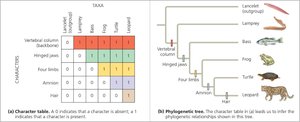
Characters can be:
Shared ancestral character: Originated in an ancestor not a member of the clade (e.g., backbone in vertebrates).
Shared derived character: Unique to a clade (e.g., hair in mammals).
Outgroups are used to distinguish ancestral from derived characters. The outgroup diverged before the lineage containing the ingroup (the group being studied).
Phylogenetic Trees with Proportional Branch Lengths
Some trees have branch lengths proportional to evolutionary change or time. For example, fewer genetic changes in one lineage indicate a slower rate of evolution.
Maximum Parsimony and Maximum Likelihood
These principles help construct phylogenetic trees:
Maximum parsimony: The simplest explanation (fewest evolutionary events or base changes) is preferred.
Maximum likelihood: The tree most likely to have produced the observed data, given certain rules about DNA change, is preferred.
Computer programs use these principles to search for the best tree.
Phylogenetic Trees as Hypotheses
Phylogenetic trees are hypotheses about relationships and may be revised with new data. Phylogenetic bracketing allows predictions about features in common ancestors based on features shared by closely related groups.
Genome Evolution and Molecular Clocks
Evolutionary History in Genomes
Molecular methods allow reconstruction of phylogenies even when the fossil record is poor. Different genes evolve at different rates, so molecular trees can represent different time scales. For example, rRNA genes change slowly (useful for ancient divergences), while mitochondrial DNA evolves rapidly (useful for recent events).
Gene Duplication and Gene Families
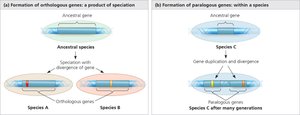
Gene families are groups of related genes within a genome. Two types of homologous genes:
Orthologous genes: Found in different species due to speciation.
Paralogous genes: Found within the same genome due to gene duplication.
Genome Evolution
Lineages that diverged long ago often share many orthologous genes, explaining shared biochemical pathways. The number of genes does not always correlate with organismal complexity due to alternative splicing and gene regulation.
Molecular Clocks
A molecular clock estimates the time required for a given amount of evolutionary change, based on the observation that some genome regions evolve at constant rates. The number of nucleotide substitutions in orthologous genes is proportional to the time since divergence. Molecular clocks are calibrated using fossil data.
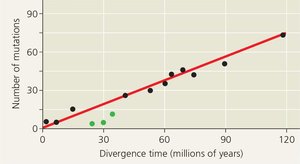
Potential problems include irregular mutation rates and natural selection. Using multiple genes and calibrating with fossil data can improve accuracy.
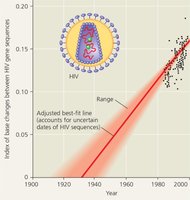
Applying a Molecular Clock: Dating the Origin of HIV
Molecular clocks have been used to estimate the origin of HIV in humans by analyzing the divergence of HIV gene sequences over time.
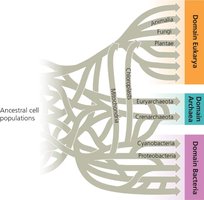
The Tree of Life and Horizontal Gene Transfer
From Two Kingdoms to Three Domains
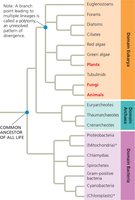
Life was once classified into two kingdoms (plants and animals), but is now divided into three domains: Bacteria, Archaea, and Eukarya. Most of life's history involves single-celled organisms; multicellular life is a relatively recent development.
Horizontal Gene Transfer
Horizontal gene transfer is the movement of genes between genomes by mechanisms such as plasmid exchange, viral activity, or fusion of organisms. This process complicates phylogenetic analysis, as genes are not always passed vertically from parent to offspring. Some biologists propose representing early life as a network rather than a tree due to extensive horizontal gene transfer.
