 Back
Phylogeny, Systematics, and the Tree of Life: Classification and Evolutionary Relationships
Study Guide - Smart Notes
 Tailored notes based on your materials, expanded with key definitions, examples, and context.
Biodiversity and Taxonomy
Introduction to Biodiversity
Biodiversity refers to the variety of life forms present on Earth, encompassing all living species. Scientists have described approximately 1.3 million species, but estimates suggest there are about 8.7 million eukaryotic species, with 6.5 million on land and 2.2 million in the ocean. This estimate does not include prokaryotes, indicating that much of Earth's biodiversity remains undiscovered.
Biodiversity: The total variety of life forms in a given area.
Importance: Understanding biodiversity is crucial for conservation, ecosystem stability, and evolutionary studies.
Binomial Nomenclature and Taxonomy
Taxonomy is the science of naming, describing, and classifying organisms. Carolus Linnaeus developed the binomial nomenclature system, which assigns each species a two-part Latin name (genus and species). This system is still used today and forms the basis for hierarchical classification.
Binomial Nomenclature: Two-part scientific naming system (e.g., Escherichia coli).
Taxonomy: The discipline of classifying and naming organisms.
Hierarchical Classification
Linnaeus introduced a hierarchical system for grouping species into increasingly inclusive categories. The main taxonomic ranks are:
Domain
Kingdom
Phylum
Class
Order
Family
Genus
Species
A group at any level is called a taxon (plural: taxa).
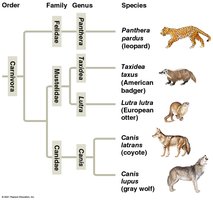
Phylogeny and Systematics
Phylogeny and Systematics
Phylogeny is the evolutionary history of a species or group of related species. Systematics is the scientific discipline focused on classifying organisms and determining their evolutionary relationships, often using morphological and molecular data.
Phylogeny: Evolutionary history and relationships among species.
Systematics: Classification based on evolutionary relationships.
Cladistics and Phylogenetic Trees
Cladistics is a method of hypothesizing evolutionary relationships among species based on shared derived characters. Visual representations of these relationships include phylogenetic trees and cladograms.
Cladogram: Diagram showing relationships based on shared derived traits.
Phylogenetic Tree: Diagram showing evolutionary relationships, sometimes with branch lengths proportional to time or genetic change.
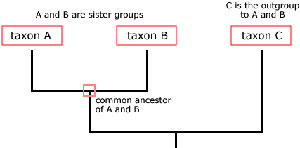
Key Terms in Phylogenetics
Taxon: Any named group of organisms at any rank.
Basal taxon: A lineage that diverges early and is near the common ancestor of the group.
Node: Represents a common ancestor in a tree.
Sister groups: Two lineages that emerge from the same node.
Outgroup: A taxon outside the group of interest, used to root the tree.
Clade: A group consisting of an ancestor and all its descendants (monophyletic group).
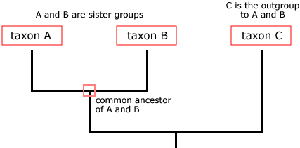
Characters and Cladistics
Characters and Character States
A character is a heritable trait that can be measured or observed. The specific form of a character is called a character state. Characters can be classified as:
Primitive (plesiomorphic): Ancestral character state.
Derived (apomorphic): Evolutionary novelty unique to a clade.
Shared characters are used to group species and infer evolutionary relationships.
Shared Ancestral vs. Shared Derived Characters
Shared ancestral character: Originated in an ancestor of the taxon.
Shared derived character: Unique to a particular clade.
For example, vertebrae are ancestral for mammals, while mammary glands are derived. The loss of features (e.g., limbs in snakes) can also be a derived character.
Inferring Phylogenies Using Derived Characters
By comparing shared derived characters among an ingroup and an outgroup, scientists can infer evolutionary relationships. The principle of parsimony suggests that the simplest explanation (fewest evolutionary changes) is preferred.
Monophyletic, Paraphyletic, and Polyphyletic Groups
Types of Groups
Monophyletic group (clade): Includes an ancestor and all its descendants.
Paraphyletic group: Includes an ancestor and some, but not all, descendants.
Polyphyletic group: Includes distantly related species but not their most recent common ancestor.
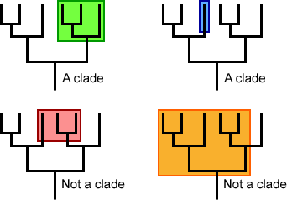
Homology vs. Analogy
Distinguishing Homology from Analogy
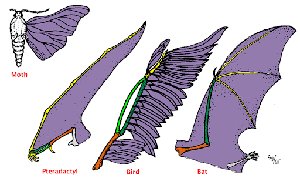
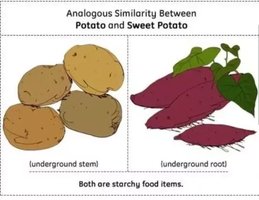
Homologous features are inherited from a common ancestor, while analogous features (homoplasies) arise independently due to similar selective pressures. The complexity of structures and genetic evidence can help distinguish between the two.
Homology: Similarity due to shared ancestry (e.g., vertebrate forelimbs).
Analogy: Similarity due to convergent evolution (e.g., wings of bats and insects).
Phylogenetic Trees: Interpretation and Construction
Tree Structure and Interpretation
Branches can be rotated around nodes without changing relationships. The order of taxa at the tips is not significant; the branching pattern shows the order of divergence. Cladograms are hypotheses, while phylogenetic trees can show evolutionary time and amount of change.
Branch Lengths and Molecular Clocks
In some phylogenetic trees, branch length reflects the number of genetic changes or the passage of time. Fossil data and molecular clocks (based on the assumption that some genes evolve at a constant rate) are used to estimate divergence times.
Maximum Parsimony and Maximum Likelihood
Maximum Parsimony: The simplest tree with the fewest evolutionary changes is preferred.
Maximum Likelihood: The tree most likely to have produced the observed data, based on probability models of DNA change.
The Three-Domain System
From Two Kingdoms to Three Domains
Historically, organisms were classified into two kingdoms (plants and animals). Modern classification recognizes three domains:
Bacteria: Most known prokaryotes.
Archaea: Diverse prokaryotes, often in extreme environments.
Eukarya: Organisms with true nuclei, including plants, fungi, and animals.
Prokaryotes are divided into Bacteria and Archaea due to significant differences. The kingdom Protista is no longer recognized because its members are not all closely related.
Summary Table: Types of Groups in Phylogenetics
Group Type | Definition | Example |
|---|---|---|
Monophyletic | Ancestor and all descendants | Mammals |
Paraphyletic | Ancestor and some descendants | Reptiles (excluding birds) |
Polyphyletic | Distantly related species, not most recent common ancestor | Marine mammals (whales, seals) |
Additional info: The notes above integrate foundational concepts from Chapter 26 (Phylogeny and the Tree of Life) and related taxonomy and systematics topics, as outlined in standard General Biology textbooks.
