 Back
Phylogeny: Understanding Evolutionary Relationships
Study Guide - Smart Notes
 Tailored notes based on your materials, expanded with key definitions, examples, and context.
Phylogeny
Overview: Investigating the Evolutionary History of Life
Phylogeny is the study of the evolutionary history and relationships among species or groups of related species. Through phylogenetic analysis, biologists can trace how different organisms are related and how evolutionary changes have shaped the diversity of life on Earth. For example, legless lizards and snakes evolved from different lineages of lizards with legs, demonstrating convergent evolution in response to similar environmental pressures.

Key Concepts in Phylogeny
Phylogeny: The evolutionary history of a species or group of related species.
Systematics: The scientific discipline focused on classifying organisms and determining their evolutionary relationships.
Taxonomy: The ordered division and naming of organisms.
Taxonomy and Classification
Binomial Nomenclature
Developed by Carolus Linnaeus in the 18th century, binomial nomenclature assigns each species a two-part scientific name: the genus and the specific epithet. The genus is capitalized, and the entire name is italicized (e.g., Panthera pardus for the leopard).
Genus: The first part of the name, always capitalized.
Specific epithet: The second part, unique within the genus.
Hierarchical Classification
Linnaeus also introduced a hierarchical system for grouping species into broader categories. The main taxonomic ranks are:
Species
Genus
Family
Order
Class
Phylum
Kingdom
Domain
A taxonomic unit at any level is called a taxon. The number of taxa at each level can vary between groups.
Linking Classification and Phylogeny
Systematists use phylogenetic trees to depict evolutionary relationships. Each branch point represents the divergence of two taxa from a common ancestor. Important terms include:
Sister taxa: Groups sharing an immediate common ancestor.
Rooted tree: Includes a branch representing the most recent common ancestor of all taxa in the tree.
Basal taxon: Diverged early in the history of the group.
Polytomy: A branch point from which more than two groups emerge.
Interpreting Phylogenetic Trees
What Phylogenetic Trees Show
Patterns of descent, not phenotypic similarity.
Do not indicate when a species evolved or the amount of change in a lineage.
Do not imply that one taxon evolved from the taxon next to it.
Applications of Phylogenies
Phylogenetic trees can help identify species, trace the origin of traits, and infer evolutionary relationships using morphological or molecular data.
Inferring Phylogenies
Morphological and Molecular Homologies
Homologies are similarities due to shared ancestry. Organisms with similar morphologies or DNA sequences are likely to be closely related. Systematists distinguish between:
Homology: Similarity due to shared ancestry.
Analogy: Similarity due to convergent evolution (independent adaptation to similar environments).
For example, bat and bird wings are homologous as forelimbs but analogous as wings.
Evaluating Molecular Homologies
Molecular homologies are determined by comparing nucleotide sequences. Shared bases in otherwise dissimilar sequences are called molecular homoplasies.
Cladistics and Clades
Cladistics
Cladistics classifies organisms by common descent. A clade is a group of species that includes an ancestral species and all its descendants. Clades can be:
Monophyletic: Consists of an ancestor and all its descendants.
Paraphyletic: Consists of an ancestor and some, but not all, descendants.
Polyphyletic: Includes taxa with different ancestors.
Group Type | Definition |
|---|---|
Monophyletic | Ancestor and all descendants |
Paraphyletic | Ancestor and some descendants |
Polyphyletic | Different ancestors |
Shared Ancestral vs. Shared Derived Characters
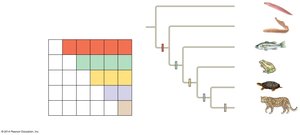
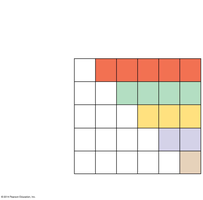
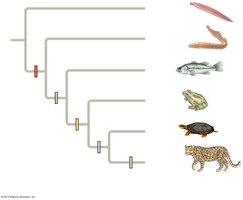
Shared ancestral character: Originated in an ancestor of the taxon.
Shared derived character: Evolutionary novelty unique to a particular clade.
Systematists use outgroups to help distinguish between ancestral and derived characters.
Building and Interpreting Phylogenetic Trees
Branch Lengths and Maximum Parsimony
Branch lengths in phylogenetic trees can represent the number of genetic changes or chronological time. The principle of maximum parsimony states that the simplest explanation (fewest evolutionary events) is preferred.
Phylogenetic Bracketing
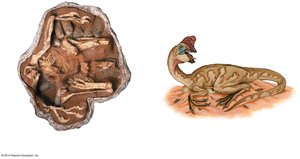
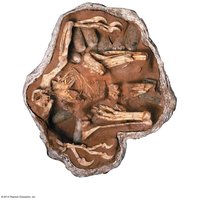
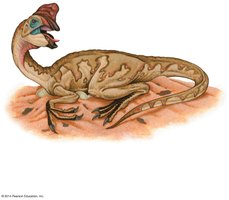
Phylogenetic bracketing allows scientists to infer characteristics of extinct ancestors based on features shared by living descendants. For example, nest building and brooding in dinosaurs are inferred from their presence in both birds and crocodiles.
Molecular Clocks
Concept and Application
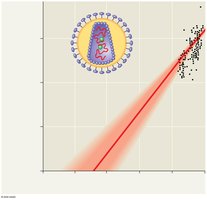
A molecular clock uses the constant rate of genetic mutations to estimate the time of evolutionary divergence. The number of nucleotide substitutions is assumed to be proportional to the time since two species shared a common ancestor. Molecular clocks are calibrated using fossil records and can be used to date events such as the origin of HIV in humans.
Revising Evolutionary History
From Two Kingdoms to Three Domains
Early classification systems recognized only two kingdoms (plants and animals), but modern taxonomy recognizes three domains: Bacteria, Archaea, and Eukarya. This system is supported by molecular data and highlights the importance of single-celled organisms in evolutionary history.
Horizontal Gene Transfer
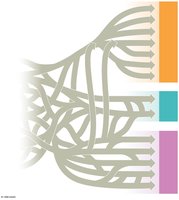
Horizontal gene transfer is the movement of genes between different genomes, complicating the construction of the tree of life. It occurs through mechanisms such as plasmid exchange, viral infection, and organismal fusion, and may have been common in early evolutionary history.
Additional info: Phylogenetic analysis is a dynamic field, with new molecular and fossil evidence continually refining our understanding of evolutionary relationships. The integration of morphological, molecular, and computational methods allows for increasingly accurate reconstructions of the tree of life.
