 Back
BackPlant Anatomy: Cells, Tissues, Organs, and Adaptations
Study Guide - Smart Notes
 Tailored notes based on your materials, expanded with key definitions, examples, and context.
Plant Anatomy Overview
Introduction to Plant Structure
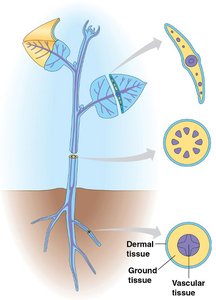
Plants are multicellular eukaryotes that photosynthesize and possess multicellular dependent embryos, distinguishing them as embryophytes. Their structure is organized into three main tissue systems—dermal, vascular, and ground tissue—which form the basic organs: roots, stems, and leaves. Understanding the alternation of generations and the function of various plant cells, tissues, and organs is fundamental to recognizing key plant characteristics.
Embryophytes: Plants with multicellular dependent embryos.
Apical meristems: Localized regions of embryonic tissue enabling continuous growth.
Three tissue systems: Dermal (protection), vascular (transport), ground (storage and support).
Alternation of Generations
Plant Life Cycle
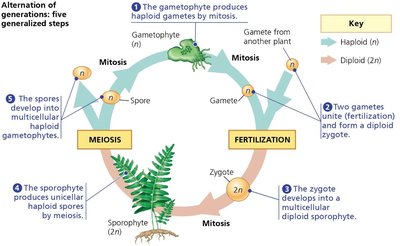
The plant life cycle alternates between multicellular haploid (gametophyte) and multicellular diploid (sporophyte) forms. Gametophytes produce gametes via mitosis in specialized organs called gametangia (antheridia for sperm, archegonia for eggs). Fertilization forms a diploid zygote, which grows into a sporophyte. Sporophytes produce spores via meiosis in sporangia, and these spores develop into gametophytes.
Gametophyte: Multicellular haploid form; produces gametes.
Sporophyte: Multicellular diploid form; produces spores.
Gametangia: Organs producing gametes (antheridia: sperm, archegonia: eggs).
Sporangia: Organs producing spores via meiosis.
Sporopollenin: Polymer in spore walls, resists harsh conditions.
Plant Cells
Types of Plant Cells
Plant cells are characterized by cell walls made of cellulose. Young cells have thin, flexible primary walls, while mature cells may develop thick secondary walls. Six major cell types are found in plants, each with distinct functions:
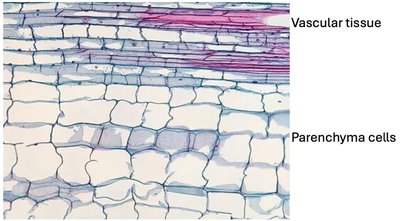
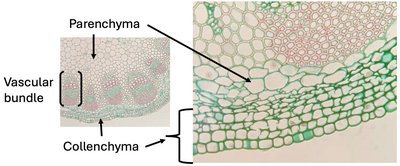
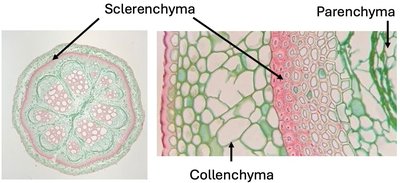
Parenchyma: Thin, flexible walls; large vacuole; metabolic functions; can differentiate.
Collenchyma: Unevenly thickened walls; flexible support; grouped in strands.
Sclerenchyma: Thick secondary walls with lignin; rigid support; often dead at maturity.
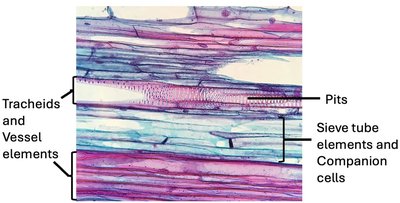
Tracheids & Vessel Elements: Xylem cells; transport water; dead at maturity; reinforced with lignin.
Sieve Tube Elements & Companion Cells: Phloem cells; transport organic materials; alive at maturity.
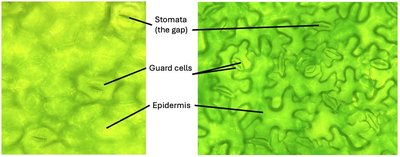
Guard Cells: Surround stomata; regulate gas exchange and water loss.
Stomata and Guard Cells
Stomata are openings in leaves for gas exchange, surrounded by guard cells that regulate their opening and closing. This process is essential for photosynthesis and transpiration.
Stomata: Openings for gas exchange.
Guard cells: Control stomatal aperture.
Gas exchange: CO2 enters, O2 exits when stomata are open.
Apical Meristems and Primary Growth
Meristematic Tissue
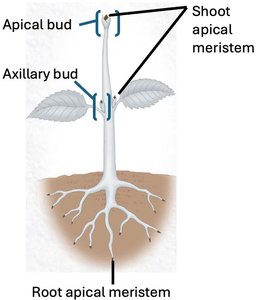
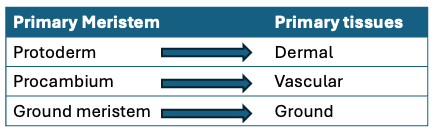
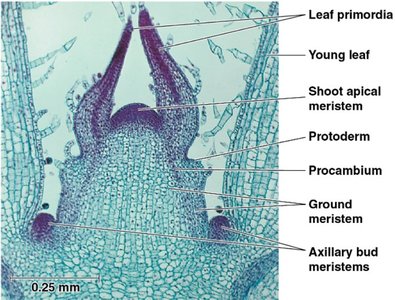
Apical meristems are regions of undifferentiated cells at the tips of roots and shoots, responsible for primary growth. They give rise to three primary meristems: protoderm (dermal tissue), procambium (vascular tissue), and ground meristem (ground tissue).
Apical meristem: Rapid cell division; growth at tips.
Primary meristems: Protoderm, procambium, ground meristem.
Axillary buds: Potential to form branches, thorns, or flowers.
Primary Meristem | Primary tissues |
|---|---|
Protoderm | Dermal |
Procambium | Vascular |
Ground meristem | Ground |
Root Apical Meristem
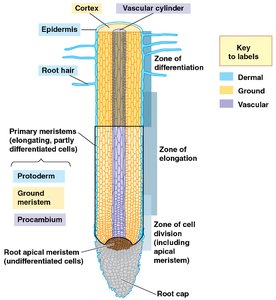
The root apical meristem is protected by the root cap and is divided into three zones: cell division, elongation, and differentiation. Each zone has distinct functions in root growth and development.
Zone of cell division: Rapid mitosis; creation of primary meristems.
Zone of elongation: Cells stretch and elongate.
Zone of differentiation: Cells mature into primary tissues.
Plant Organs and Adaptations
Roots
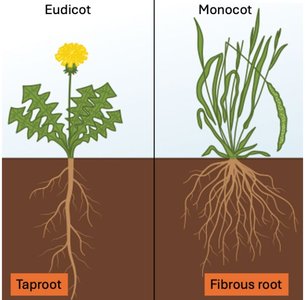
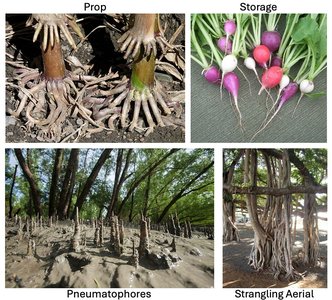
Roots anchor plants, absorb water and minerals, and can store nutrients. Angiosperms are divided into eudicots (taproot system) and monocots (fibrous root system). Roots also exhibit various adaptations for support, storage, and gas exchange.
Taproot: Deep central root (eudicots).
Fibrous root: Dense network near surface (monocots).
Root adaptations: Prop roots, storage roots, pneumatophores, aerial roots.
Stems
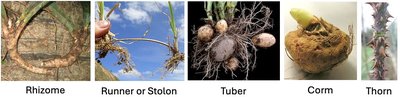
Stems support leaves, flowers, and fruit, and transport water and nutrients. Stem adaptations include rhizomes, stolons/runners, tubers, corms, and thorns.
Rhizome: Underground horizontal stem.
Stolon/Runner: Surface horizontal stem for asexual reproduction.
Tuber: Thickened storage stem.
Corm: Swollen underground stem base.
Thorn: Defensive projection.
Leaves
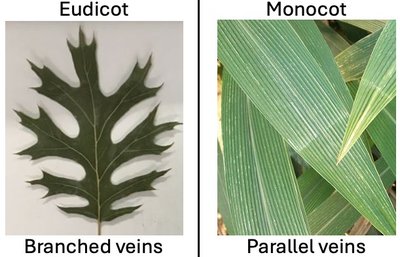
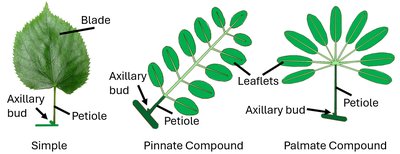
Leaves are the primary photosynthetic organs and are classified by vein arrangement and blade structure. Monocots have parallel veins; eudicots have branched veins. Leaves can be simple or compound (pinnate or palmate), and may be adapted for storage, defense, support, attraction, or asexual reproduction.
Simple leaf: Single undivided blade.
Compound leaf: Multiple leaflets; pinnate (opposite arrangement), palmate (attached at one point).
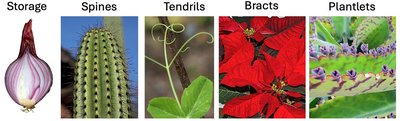
Leaf adaptations: Storage leaves, spines, tendrils, bracts, plantlets.
Summary Table: Plant Cell Types
Cell Type | Main Function | Wall Structure |
|---|---|---|
Parenchyma | Metabolic functions, storage | Thin, flexible primary wall |
Collenchyma | Flexible support | Unevenly thickened primary wall |
Sclerenchyma | Rigid support | Thick secondary wall with lignin |
Tracheids & Vessel Elements | Water transport (xylem) | Secondary wall with lignin, pits |
Sieve Tube Elements & Companion Cells | Organic transport (phloem) | Primary wall, sieve plates |
Guard Cells | Regulate stomata | Flexible wall |
Key Equations and Concepts
Photosynthesis:
Transpiration: Water loss through stomata; essential for nutrient transport.
Alternation of Generations:
Additional info:
Plant anatomy is foundational for understanding plant physiology, development, and adaptation.
Monocots and eudicots differ in root and leaf structure, which aids in plant identification.
Cell differentiation and tissue specialization are key to plant survival and function.
