 Back
BackL9b Biodiversity
Study Guide - Smart Notes
 Tailored notes based on your materials, expanded with key definitions, examples, and context.
Plant Overview and Characteristics
Introduction to Plants
Plants are a diverse group of multicellular, eukaryotic organisms that play a crucial role in Earth's ecosystems. They are primarily autotrophic, producing their own food through photosynthesis, and possess unique adaptations for life on land.
Multicellular and Eukaryotic: Plants are composed of multiple cells with membrane-bound organelles.
Autotrophic: They synthesize organic molecules from inorganic substances using sunlight (photosynthesis).
Cell Wall: Plant cells have a rigid cell wall mainly composed of cellulose.
Sessile: Most plants are stationary and do not move from place to place.
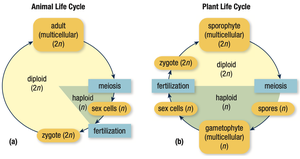
Alternation of Generations: Plants have a unique life cycle alternating between multicellular diploid (sporophyte) and haploid (gametophyte) stages.
Alternation of Generations
Plant Life Cycle
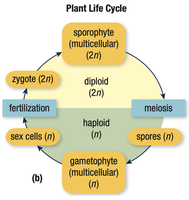
The plant life cycle alternates between two multicellular stages: the diploid sporophyte and the haploid gametophyte. This process is known as alternation of generations and is distinct from the animal life cycle, which only has a multicellular diploid stage.
Sporophyte (2n): The diploid stage that produces haploid spores via meiosis.
Gametophyte (n): The haploid stage that produces gametes (sperm and egg) via mitosis.
Fertilization: Fusion of gametes forms a diploid zygote, which grows into a new sporophyte.
Evolution and Phylogeny of Plants
Origin and Major Adaptations
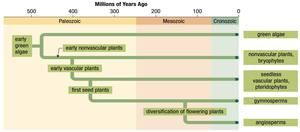
Plants are believed to have evolved from green algae, specifically charophytes. Over time, they developed several key adaptations for terrestrial life:
Waxy Cuticle: Prevents water loss and protects against desiccation.
Stomata: Pores that regulate gas exchange for photosynthesis.
Vascular Tissue (Xylem & Phloem): Specialized tissues for transporting water, minerals, and nutrients throughout the plant body.
Classification of Plants
Major Plant Groups
Plants are classified based on the presence of vascular tissue, seeds, and flowers. The main groups include bryophytes, lycophytes, pterophytes, gymnosperms, and angiosperms.
Bryophytes (Non-Vascular Plants)
Examples: Mosses, liverworts, hornworts
Characteristics: Lack vascular tissue, small size, no true roots or leaves, reproduce via spores, require water for sexual reproduction.
Dominant Generation: Gametophyte
Lycophytes and Pterophytes (Seedless Vascular Plants)
Examples: Clubmosses (lycophytes), ferns (pterophytes)
Characteristics: Have vascular tissue (xylem and phloem), reproduce via spores, contain lignin for structural support, have roots, stems, and leaves (fronds in ferns).
Symbiotic Relationships: Often form mycorrhizal associations with fungi.
Gymnosperms (Seed Plants without Flowers)
Examples: Conifers (pines, spruces, cedars), cycads, ginkgoes
Characteristics: Produce seeds not enclosed in fruit ("naked seeds"), dominant in boreal forests, cones as reproductive structures, wind pollination, seeds can remain dormant.
Angiosperms (Flowering Plants)
Characteristics: Largest group of living plants, reproductive structure is the flower, seeds enclosed within fruit, highly diverse, pollination by wind or animals.
Fruit: Develops from the ovary after fertilization, aids in seed dispersal.
Seed Structure and Types of Angiosperms
Monocots vs. Dicots (Eudicots)
Angiosperm seeds contain one or two cotyledons, which store and supply nutrients to the embryo.
Monocots: One cotyledon (e.g., grasses, lilies, orchids)
Dicots (Eudicots): Two cotyledons (e.g., beans, sunflowers, oaks)
Cotyledon Function: Provides "food supply" (starch, oils, protein) for the developing embryo before photosynthesis begins.
Plant Reproduction
Asexual Reproduction in Seed Plants
Many plants can reproduce asexually, producing genetically identical offspring (clones) through mitosis. This process is energy-efficient but reduces genetic diversity.
Methods: Rhizomes, stolons, corms, tubers, fragmentation, grafting, cuttings
Benefits: High survival rate, no need for pollinators, rapid colonization
Costs: Lack of genetic diversity, reduced adaptability
Sexual Reproduction in Seed Plants
Sexual reproduction increases genetic diversity and involves the production of seeds, which protect and nourish the embryo and aid in dispersal.
Gymnosperms: Pollination by wind, cones as reproductive organs, pollen tube delivers sperm to ovule
Angiosperms: Pollination by wind or animals, flowers as reproductive organs, double fertilization produces zygote and endosperm
Fruit: Mature ovary containing seeds, aids in dispersal
Pollination and Fertilization in Angiosperms
Anther: Produces pollen
Stigma: Sticky surface to catch pollen
Style: Stalk connecting stigma to ovary
Ovary: Contains ovules (eggs)
Double Fertilization: One sperm fertilizes the egg (zygote), another fuses with polar nuclei (endosperm)
Benefits and Costs of Reproductive Strategies
Asexual Reproduction
Benefits: Efficient, rapid, high survival rate, no need for pollinators
Costs: Low genetic diversity, less adaptability
Sexual Reproduction
Benefits: High genetic diversity, better adaptability, seeds can be dispersed and remain dormant
Costs: Requires more energy and resources
Threats to Plant Diversity
Human Impact
Climate Change: Alters habitats and growing conditions
Overharvesting: Reduces plant populations
Pollution: Can interfere with photosynthesis and plant health
Summary Table: Major Plant Groups and Adaptations
Plant Group | Vascular Tissue | Spores | Seeds | Fruit | Flowers |
|---|---|---|---|---|---|
Peatmoss (Bryophytes) | ✗ | ✓ | ✗ | ✗ | ✗ |
Ferns (Pterophytes) | ✓ | ✓ | ✗ | ✗ | ✗ |
Conifers (Gymnosperms) | ✓ | ✗ | ✓ | ✗ | ✗ |
Flowering Plants (Angiosperms) | ✓ | ✗ | ✓ | ✓ | ✓ |
Additional info: Table entries inferred from standard plant biology knowledge and the provided homework prompt.
