 Back
BackPlant Development: Embryogenesis, Morphogenesis, and Organ Formation
Study Guide - Smart Notes
 Tailored notes based on your materials, expanded with key definitions, examples, and context.
Plant Development
Fertilization and Early Embryogenesis
Plant development begins with the fusion of two gametes during fertilization, resulting in the formation of a zygote. The first mitotic division of the zygote is asymmetrical, producing an apical cell (which becomes the embryo) and a basal cell (which forms the suspensor).
Fertilization: The process by which male and female gametes fuse to form a diploid zygote.
Asymmetrical Division: The zygote divides into an apical cell and a basal cell, each with distinct developmental fates.
Suspensor: A structure derived from the basal cell that anchors the embryo and facilitates nutrient transfer.
Auxin: A plant hormone produced by the basal cell and transported to the apical cell, influencing embryonic patterning.
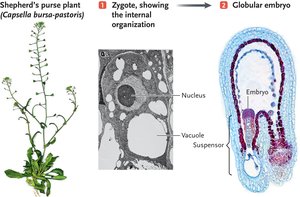
Example: In Capsella bursa-pastoris, the zygote undergoes a series of divisions leading to the formation of a globular embryo, with clear differentiation between the embryo proper and the suspensor.
Ordered Arrangements and Pattern Formation
Proper development and differentiation in plants depend on the spatial arrangement of cells. The root-shoot axis is established early, and meristems (regions of active cell division) form at opposite ends. Pattern formation ensures the correct organization of vascular, ground, and epidermal tissues.
Root-Shoot Axis: The primary axis along which plant organs are organized.
Meristems: Regions of undifferentiated cells that give rise to various tissues and organs.
Pattern Formation: The spatial and temporal arrangement of cells into tissues and organs.
Morphogenesis in Plants vs. Animals
Morphogenesis refers to the development of unique shapes and structures in different body regions. While animals rely on local cell division, growth, and cell migration, plants primarily use oriented cell division and cell expansion.
Oriented Cell Division: Directional cell division increases length (transverse planes) or girth (other planes) of plant organs.
Cell Expansion: Plant cells expand to contribute to organ growth, as cell migration is not possible due to rigid cell walls.
Note: These processes occur during morphogenesis, not secondary growth.
Development of Flowers
Flower development is regulated by homeotic genes, which determine the identity of floral organs such as sepals, petals, stamens, and carpels. Homeosis is the transformation of one organ type into another, and genes are grouped into classes (A, B, C, D) that interact to specify organ identity.
Homeotic Genes: Genes that control the identity of specific floral organs.
Gene Classes: Class A, B, C, and D genes interact to specify sepals, petals, stamens, and carpels.
B Gene Class: Critical for differentiating petals from sepals and carpels from stamens.
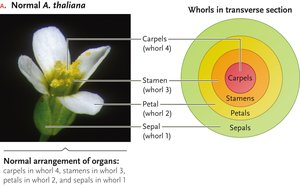
Example: In Arabidopsis thaliana, the arrangement of floral organs in concentric whorls is determined by the expression of these gene classes.
Development of Leaves
Leaf development involves the early penetration of sieve tube members into new leaf primordia, which benefits both the plant and the developing leaf. The oldest cells are found at the leaf tip, and only meristematic regions undergo mitosis. Environmental cues and gene-regulated hormone production govern the initiation and differentiation of leaves, flowers, stems, and roots.
Sieve Tube Members: Specialized phloem cells that transport nutrients and penetrate new leaf primordia early in development.
Leaf Tip: Contains the oldest cells, which are the first to photosynthesize.
Meristem: The only region where mitosis occurs; cell division ceases at the point of expansion.
Environmental Cues: External factors that influence developmental responses via hormone signaling.
Summary Table: Key Processes in Plant Development
Process | Main Features | Key Molecules/Genes |
|---|---|---|
Fertilization & Embryogenesis | Fusion of gametes, zygote formation, apical/basal cell division | Auxin, suspensor, apical cell |
Pattern Formation | Root-shoot axis, meristem formation, tissue differentiation | Meristem genes, positional signals |
Morphogenesis | Oriented cell division, cell expansion | Hormones, cytoskeletal elements |
Flower Development | Organ identity, whorl arrangement | Homeotic genes (A, B, C, D) |
Leaf Development | Sieve tube penetration, oldest cells at tip, mitosis in meristem | Hormones, environmental cues |
Additional info: The images provided reinforce the concepts of embryogenesis, floral organ arrangement, and the importance of gene regulation in plant development. The table summarizes the main developmental processes and their molecular regulators.
