 Back
BackPlant Diversity I: How Plants Colonized Land
Study Guide - Smart Notes
 Tailored notes based on your materials, expanded with key definitions, examples, and context.
Plant Diversity I: How Plants Colonized Land
Introduction
Plants are a fundamental group of organisms that have colonized terrestrial environments, shaping ecosystems and providing resources for other life forms. This chapter explores the evolutionary origins of land plants, their adaptations for terrestrial life, and the diversity of plant groups.
Evolutionary Origins of Land Plants
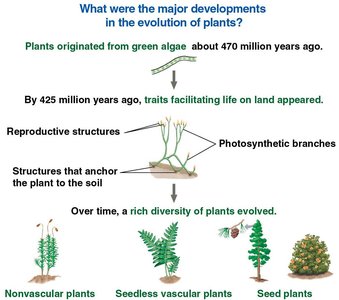
Plants Evolved from Green Algae
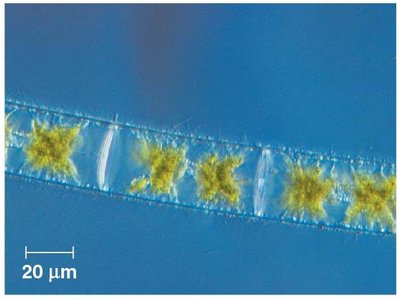
The evolutionary lineage of land plants traces back to photosynthetic protists known as green algae, specifically the charophytes.
Charophytes are the closest living relatives of land plants.
Both plants and some algae are multicellular, eukaryotic, and photosynthetic autotrophs.
They share structural features such as cellulose cell walls and chloroplasts containing chlorophyll a and b.
Phylogenetic Relationships
Land plants are not descended from modern charophytes but share a common ancestor with them.
Phylogenetic trees illustrate the evolutionary relationships among red algae, chlorophytes, charophytes, and embryophytes (land plants).
Adaptations for Life on Land
Key Adaptations
The transition from aquatic to terrestrial environments required several adaptations:
Sporopollenin: A durable polymer coating that prevents zygotes from drying out.
Benefits of land: Unfiltered sunlight, abundant CO2, and nutrient-rich soil.
Challenges: Scarcity of water and lack of structural support against gravity.
Derived Traits of Land Plants
Four key traits distinguish land plants from their algal ancestors:
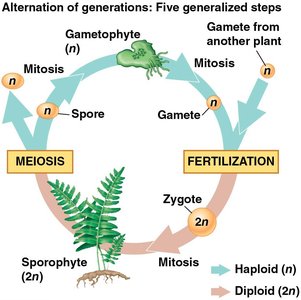
Alternation of generations
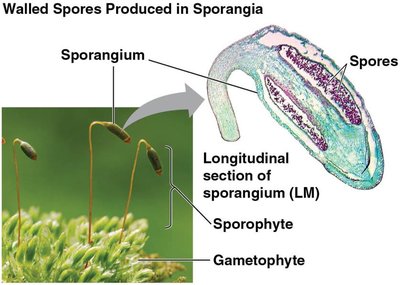
Walled spores produced in sporangia
Apical meristems
Cuticle and stomata
Alternation of Generations
Land plants alternate between two multicellular generations:
Gametophyte (haploid, n): Produces gametes by mitosis.
Sporophyte (diploid, 2n): Produces spores by meiosis.
Fertilization produces a zygote, which develops into a sporophyte.

Walled Spores Produced in Sporangia
Sporangia: Multicellular organs where sporophytes produce spores.
Sporopollenin in spore walls makes them resistant to harsh environments.
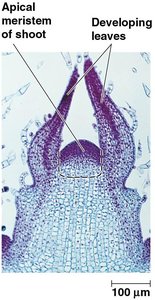
Apical Meristems
Regions of cell division at the tips of roots and shoots.
Enable elongation and resource acquisition.
Cuticle and Stomata
Cuticle: Waxy covering that reduces water loss.
Stomata: Pores for gas exchange.
Origin and Diversification of Plants
Fossil Evidence
Microorganisms colonized land ~3.2 billion years ago.
Plant spores first appear in the fossil record ~470 million years ago.
Fossilized spores and sporophyte tissue extracted from ancient rocks.
Major Plant Groups
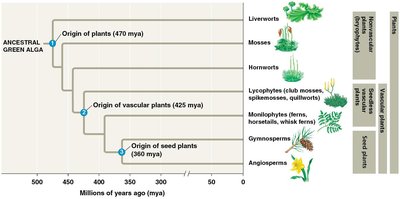
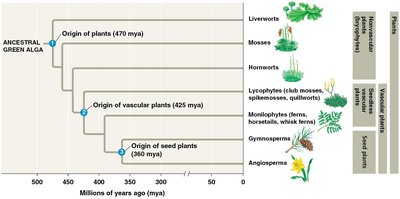
Vascular plants: Have complex vascular tissue for water and nutrient transport.
Nonvascular plants (bryophytes): Lack extensive transport systems; include liverworts, mosses, and hornworts.
Seedless vascular plants: Have vascular tissue but do not produce seeds; include lycophytes and monilophytes.
Seed plants: Vascular plants that produce seeds; divided into gymnosperms and angiosperms.

Bryophytes: Nonvascular Plants
Bryophyte Diversity
Bryophytes are represented by three phyla:
Liverworts (Phylum Hepatophyta)
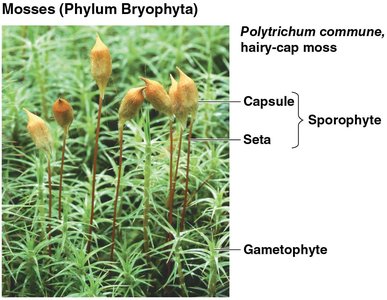
Mosses (Phylum Bryophyta)
Hornworts (Phylum Anthocerophyta)
Bryophyte Life Cycle
Dominant gametophyte generation (larger and longer-living than sporophytes).
Sporophytes are dependent on gametophytes for nutrition.
Sexual reproduction requires water for sperm motility.
Asexual reproduction occurs via brood bodies.

Bryophyte Structures
Protonema: Early stage of moss gametophyte development.
Rhizoids: Root-like structures for anchorage, not absorption.
Gametangia: Archegonia (female, produces eggs) and antheridia (male, produces sperm).
Bryophyte Sporophytes
Sporophytes are attached to and dependent on gametophytes.
Smallest sporophytes among extant plant groups.
Bryophyte Diversity and Examples
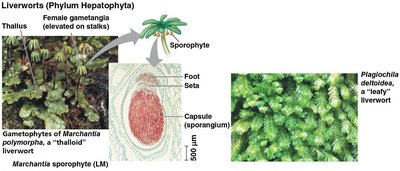
Liverworts
Liver-shaped gametophytes; some have elevated gametangia.
Hornworts
Horn-shaped sporophytes; symbiosis with nitrogen-fixing bacteria.
Mosses
Gametophytes range from 1 mm to 60 cm tall.
Sporophytes are visible and photosynthetic when young.

Ecological and Economic Importance of Mosses
Common in moist forests and wetlands; can survive extreme conditions.
Help retain nitrogen in soils.
Sphagnum (peat moss) forms peat, used as fuel and for soil carbon storage.
Peatlands cover 3% of Earth's land surface but contain one-third of the world's soil carbon.
Overharvesting and climate change threaten peatlands, releasing stored CO2.
Seedless Vascular Plants
Origins and Traits
Earliest vascular plant fossils date to 425 million years ago.
Vascular tissue enabled plants to grow tall and compete for sunlight.
Seedless vascular plants are restricted to moist habitats.
Characteristics of Living Vascular Plants
Life cycles with dominant sporophytes
Transport in vascular tissues (xylem and phloem)
Well-developed roots and leaves
Sporophylls (spore-bearing leaves)
Life Cycles with Dominant Sporophytes
Sporophytes are larger and more complex than gametophytes.
Example: Ferns have leafy sporophytes; gametophytes are tiny and grow on or below soil.
Transport in Xylem and Phloem
Xylem: Conducts water and minerals; contains lignified, dead tracheids.
Phloem: Transports organic materials; cells are alive at maturity.
Vascular tissue provides structural support and enables tall growth.
Evolution of Roots and Leaves
Roots: Anchor plants and absorb water/nutrients; may have evolved from belowground stems.
Leaves: Increase surface area for photosynthesis; two types: microphylls (single vein, lycophytes) and megaphylls (branched veins, other groups).
Sporophylls and Spore Variations
Sporophylls: Modified leaves with sporangia.
Sori: Clusters of sporangia on fern sporophylls.
Strobili: Cone-like clusters of sporophylls in lycophytes and gymnosperms.
Carpels and stamens: Sporophylls of angiosperms.
Homosporous: One type of spore, produces bisexual gametophytes.
Heterosporous: Two types of spores, produce male and female gametophytes.
Classification of Seedless Vascular Plants
Phylum Lycophyta: Club mosses, spike mosses, quillworts.
Phylum Monilophyta: Ferns, horsetails, whisk ferns.
Lycophytes
Grow in diverse habitats; some gametophytes are photosynthetic, others form symbioses with fungi.
Sporophytes have upright and ground-hugging stems.
Spikemosses and quillworts are heterosporous; clubmosses are homosporous.
Strobili are common.
Monilophytes
Include ferns, horsetails, whisk ferns.
Ferns are the most widespread seedless vascular plants.
Fern sporophytes have large fronds divided into leaflets; most are homosporous.
Horsetails have gritty stems; only 15 species remain.
Whisk ferns have dichotomously branching stems and no roots; all are homosporous.
Significance of Seedless Vascular Plants
Formed extensive forests during the Devonian and Carboniferous periods.
Tree roots broke down rocks, reducing atmospheric CO2 and causing global cooling.
Slow decay in swamps led to peat formation, which eventually became coal.
Summary Table: Major Plant Groups
Group | Vascular Tissue | Seeds | Examples |
|---|---|---|---|
Bryophytes (Nonvascular) | No | No | Liverworts, Mosses, Hornworts |
Seedless Vascular Plants | Yes | No | Lycophytes, Monilophytes (Ferns, Horsetails, Whisk Ferns) |
Seed Plants | Yes | Yes | Gymnosperms, Angiosperms |
Conclusion
The colonization of land by plants was a pivotal event in Earth's history, leading to the diversification of terrestrial life. Adaptations such as alternation of generations, walled spores, apical meristems, and vascular tissues enabled plants to thrive in a variety of environments and form the basis of terrestrial ecosystems. Additional info: Some details and explanations were expanded for academic completeness and clarity.
