 Back
BackPlant Diversity I: How Plants Colonized Land
Study Guide - Smart Notes
 Tailored notes based on your materials, expanded with key definitions, examples, and context.
Plant Diversity I: How Plants Colonized Land
Introduction to Plant Diversity
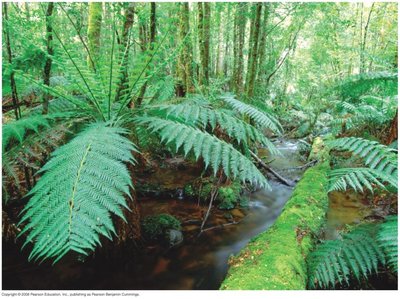
Plants are a diverse group of organisms with over 325,000 recognized species, most of which inhabit terrestrial environments. The colonization of land by plants was a pivotal event in Earth's history, enabling the development of terrestrial ecosystems. This transition required significant evolutionary adaptations to overcome challenges such as water scarcity and lack of structural support.
Key Point: Most plants are terrestrial, but some, like sea grasses, have returned to aquatic habitats.
Key Point: The move to land provided advantages such as unfiltered sunlight, abundant CO2, and nutrient-rich soils, but also posed challenges including desiccation and gravity.
Evolutionary Origins of Land Plants
Aquatic Ancestors: Green Algae
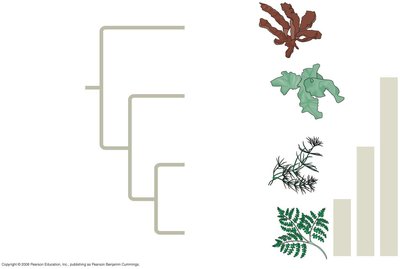
Land plants (embryophytes) evolved from green algae, specifically a group called charophytes. This evolutionary relationship is supported by several shared characteristics.
Key Point: Both groups have cell walls made of cellulose and chlorophyll a and b in chloroplasts.
Key Point: Rosette cellulose-synthesizing complexes are present in plasma membranes, synthesizing cellulose microfibrils.
Key Point: Peroxisomes associated with chloroplasts help minimize photorespiration losses.
Key Point: Similarities in flagellated sperm and cell division (formation of a phragmoplast) are observed.
Adaptations for Terrestrial Life
Challenges and Solutions
Transitioning to land required adaptations for water acquisition, transport, conservation, structural support, reproduction, and UV protection.
Water Conservation: The cuticle, a waxy layer on the epidermis, prevents water loss and protects against pathogens.
Gas Exchange: Stomata are pores that regulate gas exchange and water loss by opening and closing in response to environmental conditions.
Structural Support: Lignin, a phenolic polymer, strengthens cell walls, allowing plants to grow tall and withstand gravity.
Secondary Compounds: Alkaloids, terpenes, tannins, and flavonoids provide defense against herbivores and pathogens, and flavonoids also absorb harmful UV radiation.
Structural Specialization: Roots and Shoots
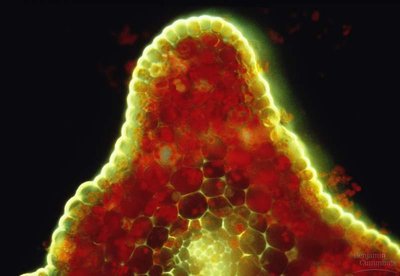
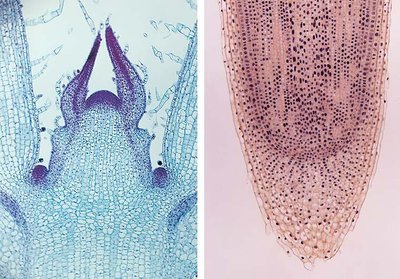
Plants evolved specialized organs to access resources in different environments: shoots for light and CO2 above ground, and roots for water and minerals below ground. Growth and branching are driven by apical meristems, regions of active cell division at organ tips.
Key Point: Apical meristems produce cells that differentiate into various tissues, supporting continuous growth.
Vascular Tissues
Except for bryophytes, land plants possess true roots, stems, and leaves, defined by the presence of vascular tissues. Vascular tissues enable efficient transport of water, minerals, and nutrients throughout the plant body.
Xylem: Transports water and minerals from roots to shoots; composed of dead, tube-shaped cells.
Phloem: Transports sugars, amino acids, and other organic products; composed of living cells arranged in tubes.
Reproductive Adaptations
Alternation of Generations
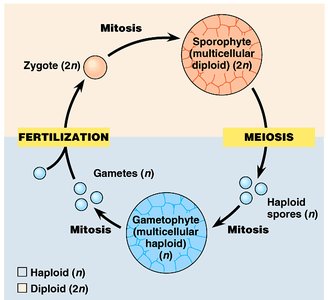
Land plants exhibit alternation of generations, a life cycle alternating between multicellular haploid (gametophyte) and diploid (sporophyte) stages.
Key Point: In bryophytes, the gametophyte is dominant; in vascular plants, the sporophyte is dominant.
Key Point: Spores are haploid reproductive cells with tough walls made of sporopollenin, resistant to harsh environments.
Sporangia and Spores
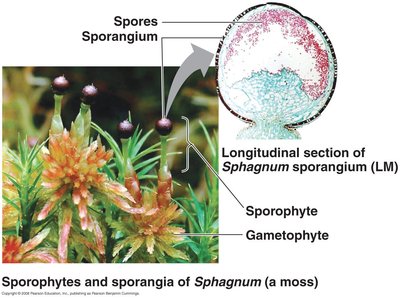
Sporophytes produce spores in multicellular organs called sporangia. Spores germinate to form gametophytes.
Key Point: Sporangia protect spores and aid in their dispersal.
Key Point: Sphagnum mosses are an example of plants with distinct sporangia and gametophyte structures.
Gametangia: Archegonia and Antheridia
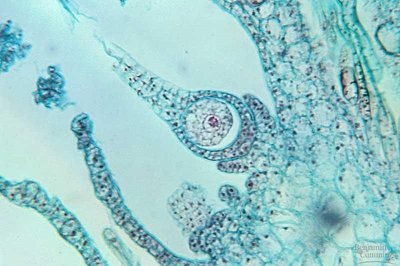
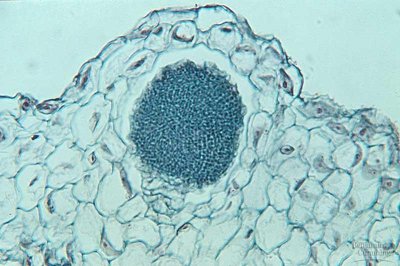
Gametophytes produce gametes in multicellular organs called gametangia. The archegonium is the female organ, producing a single egg, while the antheridium is the male organ, producing many sperm.
Key Point: Eggs are retained within the archegonium, where fertilization and embryo development occur.
Key Point: Sperm are often flagellated and require water to reach the egg.
Major Groups of Land Plants
Classification of Land Plants
Land plants are classified into four major evolutionary groups based on the presence or absence of vascular tissue and seeds.
Nonvascular Plants (Bryophytes): Liverworts, hornworts, and mosses; lack vascular tissue.
Seedless Vascular Plants: Lycophytes and monilophytes (ferns and relatives); have vascular tissue but no seeds.
Gymnosperms: Seed plants with "naked" seeds not enclosed in fruit (e.g., conifers).
Angiosperms: Flowering plants with seeds enclosed in fruit.
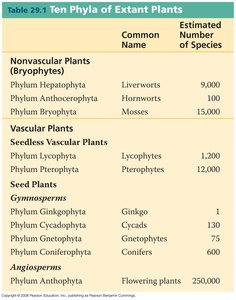
Summary Table: Ten Phyla of Extant Plants
Group | Phylum | Common Name | Estimated Number of Species |
|---|---|---|---|
Nonvascular Plants (Bryophytes) | Hepatophyta | Liverworts | 9,000 |
Anthocerophyta | Hornworts | 100 | |
Bryophyta | Mosses | 15,000 | |
Seedless Vascular Plants | Lycophyta | Lycophytes | 1,200 |
Pterophyta | Pterophytes | 12,000 | |
Seed Plants (Gymnosperms) | Ginkgophyta | Ginkgo | 1 |
Cycadophyta | Cycads | 130 | |
Gnetophyta | Gnetophytes | 75 | |
Coniferophyta | Conifers | 600 | |
Angiosperms | Anthophyta | Flowering plants | 250,000 |
Conclusion
The colonization of land by plants was enabled by a suite of evolutionary adaptations for water conservation, structural support, and reproduction. These innovations allowed plants to diversify into the major groups seen today, profoundly shaping terrestrial ecosystems.
