 Back
BackPlant Diversity II: The Evolution of Seed Plants – Study Notes
Study Guide - Smart Notes
 Tailored notes based on your materials, expanded with key definitions, examples, and context.
Plant Diversity II: The Evolution of Seed Plants
Introduction to Seed Plants
Seed plants represent a major evolutionary innovation in the plant kingdom, dominating most terrestrial ecosystems today. Their success is attributed to several key adaptations that allow them to thrive in diverse and sometimes harsh environments.
Key Adaptations of Seed Plants
Seeds: Structure and Function
Seed Definition: A seed consists of an embryo and a nutrient supply, surrounded by a protective coat.
Dispersal: Seeds can be dispersed over long distances by wind, water, or animals, increasing the plant's range and survival chances.
Example: Fireweed seeds were dispersed by wind to the Mount St. Helens blast zone after the volcanic eruption, facilitating rapid recolonization of the area.
Major Adaptations in Seed Plants
Reduced Gametophytes: Seed plants have microscopic gametophytes that develop within the tissues of the parent sporophyte, providing protection and nourishment.
Heterospory: Seed plants produce two types of spores: megaspores (female) and microspores (male), leading to separate male and female gametophytes.
Ovules: Structures that contain the female gametophyte and, after fertilization, develop into seeds.
Pollen: Male gametophytes enclosed within a pollen wall, allowing fertilization without water.

Seed Plant Life Cycles and Adaptations
Reduced Gametophytes
Seed plant life cycles are dominated by the sporophyte generation, with gametophytes being highly reduced and dependent on the sporophyte for nutrition and protection from environmental stress.
Protection: Gametophytes develop from spores retained within the sporangia of the sporophyte, shielding them from drought and UV radiation.
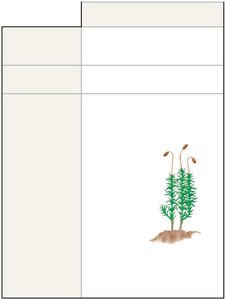
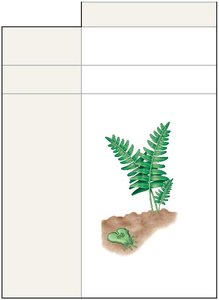
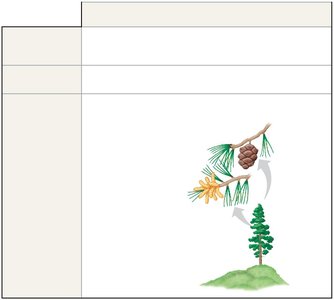
Comparison: In nonvascular plants, the gametophyte is dominant; in seedless vascular plants, both generations are independent; in seed plants, the sporophyte is dominant and the gametophyte is reduced.
Heterospory
Seed plants are heterosporous, producing two distinct types of spores:
Megaspores: Develop into female gametophytes.
Microspores: Develop into male gametophytes.
Contrast: Homosporous plants (e.g., most ferns) produce one type of spore that develops into a bisexual gametophyte.
Ovules and Egg Production
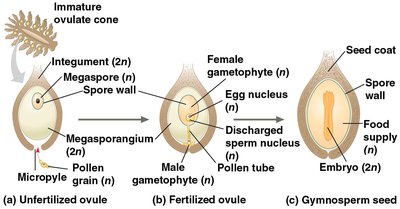
Ovule Structure: Consists of a megasporangium, megaspore, and one or more protective integuments.
Gymnosperms: Typically have one integument.
Angiosperms: Generally have two integuments.
Pollen and Sperm Production
Pollen Grain: Each microspore develops into a male gametophyte enclosed within a pollen wall.
Pollination: The transfer of pollen to the part of a seed plant containing the ovules, often by wind or animals.
Water Independence: Fertilization does not require water, unlike in seedless plants.
Fertilization and Seed Formation
Pollen Tube: After pollination, the pollen grain germinates and produces a pollen tube that delivers sperm to the female gametophyte.
Seed Formation: Following fertilization, the ovule develops into a seed containing the embryo, food supply, and protective coat.
Evolutionary Advantages of Seeds
Protection: Seeds protect the embryo from harsh conditions.
Dormancy: Seeds can remain dormant until conditions are favorable for germination.
Nourishment: Seeds contain stored food to support the developing seedling.
Dispersal: Seeds can be transported long distances, increasing the plant's range.
Comparison with Spores: Seeds are multicellular and longer-lived, while spores are single-celled and shorter-lived.
Summary Table: Comparison of Plant Groups
Plant Group | Dominant Generation | Gametophyte | Sporophyte | Key Features |
|---|---|---|---|---|
Nonvascular (Bryophytes) | Gametophyte | Large, independent | Small, dependent | No seeds, no vascular tissue |
Seedless Vascular | Sporophyte | Small, independent | Large, independent | No seeds, vascular tissue present |
Seed Plants | Sporophyte | Microscopic, dependent | Large, independent | Seeds, pollen, ovules, heterospory |
Conclusion
Seed plants have evolved a suite of adaptations—including seeds, pollen, reduced gametophytes, and heterospory—that have enabled them to dominate terrestrial ecosystems. These features provide protection, facilitate dispersal, and allow survival in a wide range of environments, making seed plants a cornerstone of terrestrial biodiversity.
