 Back
BackPlant Diversity II: The Evolution of Seed Plants – Structured Study Notes
Study Guide - Smart Notes
 Tailored notes based on your materials, expanded with key definitions, examples, and context.
Plant Diversity II: The Evolution of Seed Plants
Seed Plant Overview
Seed plants are a major group of land plants, comprising angiosperms and gymnosperms. They are characterized by a dominant sporophyte generation, microscopic gametophytes, and the production of seeds. Seed plants are heterosporous, producing microspores (male) and megaspores (female) within specialized structures called sporangia.
Sporophyte-dominant life cycle: The diploid sporophyte is the main plant body, with gametophytes reduced and often microscopic.
Heterospory: Seed plants produce two types of spores: microspores (male, become pollen grains) and megaspores (female, develop into ovules).
Ovule: Structure containing the megasporangium and megaspore, which develops into a seed after fertilization.
Integument: Protective layer of sporophyte tissue surrounding the ovule; the micropyle is an opening at its apex.
Pollen grain: Male gametophyte covered by a pollen wall, produced by microspores.
Pollination: Transfer of pollen to the ovule, often facilitated by wind, insects, or animals (pollination syndrome).
Seed: Develops from a fertilized ovule, containing an embryonic plant and a protective coat.
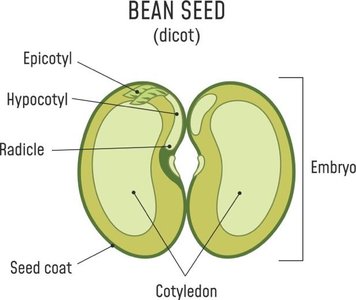
Cotyledon: Embryonic leaves within the seed; monocots have one, eudicots have two.
Endosperm: Nutritive tissue surrounding the embryo, providing starch, protein, and oil.
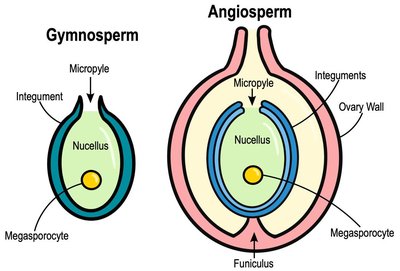
Gymnosperms
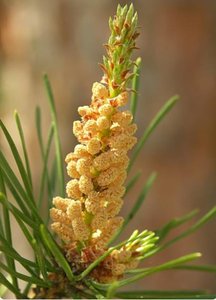
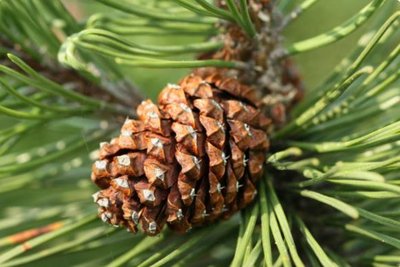
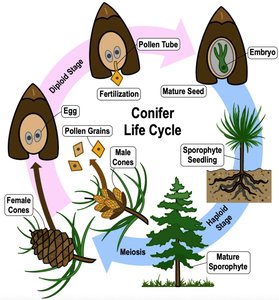
Gymnosperms are seed plants that produce "naked seeds" not enclosed by an ovary. Their sporangia are typically packed into cones (strobili), and they include groups such as conifers, cycads, ginkgo, and gnetophytes.
Monoecious: Male and female sporangia are found on the same plant.
Dioecious: Male and female sporangia are found on different plants.
Conifers: A major group of gymnosperms with needle-like leaves and cones. Cones are modified leaves (sporophylls).
Pine needles: Modified leaves with a thick cuticle to prevent water loss.
Fertilization process: Pollen grain germinates on the ovule, forming a pollen tube that digests through the megasporangium. The megasporocyte undergoes meiosis, producing four haploid cells; one becomes the megaspore, which develops into the female gametophyte containing multiple eggs. Fertilization occurs when sperm and egg nuclei unite, and the ovule becomes a seed.
Angiosperms
Angiosperms are the most diverse group of seed-producing land plants. They are distinguished by the presence of flowers and fruits, which surround the seeds. Angiosperms are classified based on the number of cotyledons in their seeds: monocots (one cotyledon), eudicots (two cotyledons), basal angiosperms, and magnoliids.
Flower structure: Flowers contain sepals, petals, stamens, and carpels.
Sepal: Protective structure for the flower bud, usually green.
Petals: Modified leaves that attract pollinators.
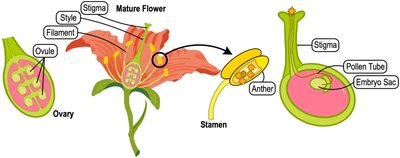
Stamen: Pollen-producing part of the flower, consisting of a filament (stalk) and anther (microsporangia).
Carpel: Female reproductive structure; includes stigma (receives pollen), style (connects stigma to ovary), and ovary (contains ovules).
Embryo sac: Female gametophyte contained within the ovule.
Fruit: Formed from the ovary after fertilization, enclosing the seeds.
Flower Types and Reproduction
Flowers can be classified as complete or incomplete, perfect or imperfect, monoecious or dioecious, based on the presence and arrangement of reproductive organs. Angiosperms exhibit both self-pollination and cross-pollination, with double fertilization being a unique feature.
Complete flowers: Contain sepals, petals, stamens, and pistils.
Incomplete flowers: Missing one or more of the above components.
Perfect flowers: Bisexual, with both male and female structures in the same flower.
Monoecious: Unisexual flowers, but both male and female organs on the same plant.
Dioecious: Unisexual flowers, male and female organs on different plants.
Cross-pollination: Pollen transfers from the anther of one plant to the stigma of another.
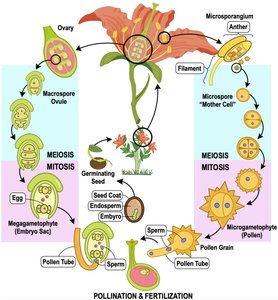
Double fertilization: Pollen tube releases two sperm; one fertilizes the egg (forms embryo), the other fuses with two nuclei to form endosperm.
Seed Structure and Germination
Seeds contain an embryo, cotyledons, and a protective seed coat. Germination is the process by which the seed develops into a new plant, with cotyledons providing initial nutrition.
Embryo: Young plant within the seed, consisting of epicotyl, hypocotyl, and radicle.
Cotyledon: Seed leaves; monocots have one, eudicots have two.
Seed coat: Protective outer layer.
Germination: The process of sprouting and growth of the embryo into a seedling.
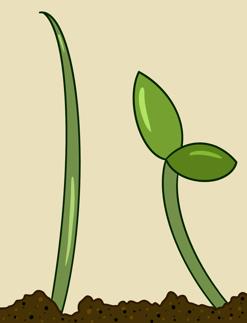
Table: Comparison of Gymnosperms and Angiosperms
Feature | Gymnosperms | Angiosperms |
|---|---|---|
Seed Enclosure | Naked (not enclosed by ovary) | Enclosed within fruit (ovary) |
Reproductive Structure | Cones (strobili) | Flowers |
Fertilization | Single fertilization | Double fertilization |
Leaf Type | Needle-like, thick cuticle | Varied, often broad |
Dominant Groups | Conifers, cycads, ginkgo | Monocots, eudicots, basal angiosperms, magnoliids |
Key Equations and Concepts
Meiosis in Megasporocyte:
Double Fertilization:
Additional info:
Basal angiosperms and magnoliids are less common lineages but important for understanding evolutionary relationships.
Pollination syndromes describe adaptations in flowers for specific pollinators (e.g., wind, bees, birds).
