 Back
BackPlant Diversity II: The Evolution of Seed Plants
Study Guide - Smart Notes
 Tailored notes based on your materials, expanded with key definitions, examples, and context.
Plant Diversity II: The Evolution of Seed Plants
Introduction to Seed Plants
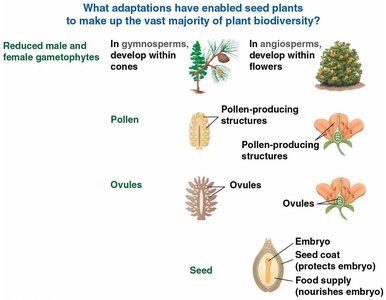
Seed plants represent a major evolutionary innovation in the plant kingdom, enabling plants to colonize a wide range of terrestrial environments. The evolution of seeds, pollen, reduced gametophytes, ovules, and other adaptations has allowed seed plants to dominate modern terrestrial ecosystems.
Key Adaptations of Seed Plants
Seeds: Consist of an embryo and nutrients surrounded by a protective coat. Seeds can disperse over long distances by wind or animals, increasing the range and survival of plant species.
Reduced Gametophytes: Gametophytes are microscopic and develop within the tissues of the sporophyte, providing protection from environmental stress and nourishment from the parent plant.
Heterospory: Seed plants produce two types of spores—megaspores (female) and microspores (male)—leading to the formation of distinct male and female gametophytes.
Ovules: Structures that contain the female gametophyte and, after fertilization, develop into seeds.
Pollen: Male gametophytes enclosed within a pollen wall, allowing fertilization without the need for water.
Seed Plant Life Cycles
Seed plant life cycles are dominated by the sporophyte generation. Gametophytes are reduced, microscopic, and dependent on the sporophyte for nutrition and protection.

Heterospory and the Evolution of Ovules and Pollen
Homosporous plants produce one type of spore, while heterosporous plants produce two types: megaspores (female) and microspores (male).
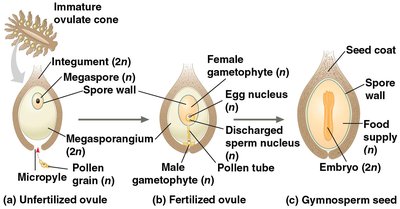
Ovule: Consists of a megasporangium, megaspore, and one or more protective integuments. Gymnosperms typically have one integument; angiosperms have two.
Pollen grains: Microspores develop into male gametophytes enclosed within a pollen wall. Pollination is the transfer of pollen to the part of the seed plant containing the ovules.

Seed Evolution and Advantages
Seeds are multicellular, can remain dormant for years, and contain stored food for the embryo.
Seeds can be transported long distances, increasing the potential for colonization.
Gymnosperms: "Naked Seed" Plants
Gymnosperms bear seeds exposed on sporophylls, usually in cones. They include conifers, cycads, ginkgos, and gnetophytes.
Life Cycle of a Pine: Pine trees are sporophytes that produce male and female cones. Male cones produce pollen; female cones produce ovules. Fertilization leads to seed development and dispersal.
Gymnosperm Diversity
Phylum Cycadophyta: Large cones, palmlike leaves, flagellated sperm. Most endangered plant group.
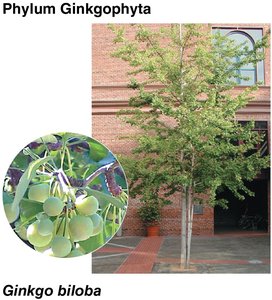
Phylum Ginkgophyta: Only one living species, Ginkgo biloba. Tolerant of air pollution, produces fleshy seeds.
Phylum Gnetophyta: Includes Gnetum, Ephedra, and Welwitschia. Diverse habitats and forms.
Phylum Coniferophyta: Largest gymnosperm phylum. Includes pines, firs, redwoods, and junipers. Most are evergreen.


Angiosperms: Flowering Plants
Angiosperms are seed plants with reproductive structures called flowers and fruits. They are the most diverse and widespread group of plants.
Flowers: Specialized shoots with four types of modified leaves (floral organs): sepals, petals, stamens (male), and carpels (female).
Stamens: Consist of a filament and anther, where pollen is produced.
Carpels: Consist of ovary, style, and stigma. The ovary contains ovules, which develop into seeds after fertilization.

Fruits and Seed Dispersal
Fruits develop from the ovary after fertilization and aid in seed protection and dispersal.
Fruits can be fleshy (e.g., tomatoes, plums) or dry (e.g., beans, nuts).
Dispersal mechanisms include wind, water, attachment to animals, and ingestion by animals.
Angiosperm Life Cycle
Male gametophytes are contained within pollen grains; female gametophytes (embryo sacs) develop within ovules.
Pollination transfers pollen to the stigma. Double fertilization occurs: one sperm fertilizes the egg (zygote), the other forms endosperm (nutritive tissue).
The fertilized ovule becomes a seed, containing the embryo and endosperm.
Angiosperm Diversity
Monocots: One cotyledon, parallel leaf veins, scattered vascular tissue. Includes grasses, orchids, palms.
Eudicots: Two cotyledons, netlike leaf veins, vascular tissue in a ring. Includes legumes, roses, most trees.
Basal Angiosperms: Oldest lineages, such as Amborella, water lilies, star anise.
Magnoliids: Woody and herbaceous plants, spirally arranged floral organs.
Seed Plants and Human Welfare
Seed plants provide food, fuel, wood, and medicine.
Most human calories come from six crops: wheat, rice, maize, potatoes, cassava, and sweet potatoes.
Artificial selection has shaped modern crops.
Medicinal compounds are derived from seed plants.
Threats to Plant Diversity
Habitat destruction, especially in the tropics, threatens plant diversity and the animals that depend on them.
Loss of forests contributes to global warming and the extinction of species, including those with potential medicinal value.
