 Back
BackL1: Plant Evolution and Adaptations: From Aquatic Algae to Land Plants
Study Guide - Smart Notes
 Tailored notes based on your materials, expanded with key definitions, examples, and context.
Plant Evolution and Adaptations: From Aquatic Algae to Land Plants
Introduction to Plant Evolution
Understanding how plants evolved from aquatic ancestors to colonize terrestrial environments is a central theme in biology. This process involved a series of key adaptations that enabled plants to survive and thrive on land, leading to the vast diversity of plant life observed today.
Gradual Evolution of Plants to Land
From Aquatic Ancestors to Land Plants
Plants evolved from green algal ancestors, gradually acquiring traits that allowed them to survive on land. The transition from aquatic to terrestrial life required overcoming several challenges and exploiting new opportunities.
Challenges on Land:
Dehydration (risk of drying out)
Lack of structural support against gravity
Need for efficient water and nutrient transport
Gas exchange for photosynthesis
Advantages on Land:
Abundant sunlight
Easier access to atmospheric CO2
Reduced predation in early stages
Rich soil nutrients
Potential for upright growth and branching
Key Evolutionary Adaptations
Waxy Cuticle: Prevents water loss but limits gas exchange.
Stomata: Pores for controlled CO2 intake and water vapor regulation.
Apical Meristems: Regions of cell division allowing roots and shoots to grow for anchorage and resource acquisition.
Vascular Tissues: Xylem (water transport) and phloem (nutrient transport).
Embryo Protection: Multicellular dependent embryos and alternation of generations.
Symbiotic Associations: Partnerships with fungi (mycorrhizae) for nutrient uptake.
Phylogeny and Plant Relationships
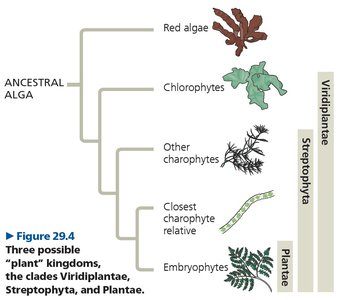
Viridiplantae and Charophytes
The clade Viridiplantae includes all green plants, encompassing both green algae and land plants. Charophytes are the closest living relatives to land plants, sharing several key traits.
Traits Inherited from Charophytes:
Chlorophyll a and b
Cellulose-synthesizing protein complexes
Flagellated sperm
Genetic similarities in nuclear, chloroplast, and mitochondrial DNA
Early Solutions to Life on Land
Genetic and Structural Innovations
Early land plants developed a basic gene toolkit for cell division and multicellularity. In aquatic environments, there was no need for structures to resist gravity or prevent desiccation, nor for complex nutrient transport systems.
Gene Families: KNOX, WOX, HD-ZIP, and early auxin-related components contributed to plant development and adaptation.
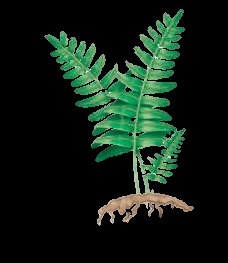
First True Land Plants: Bryophytes (nonvascular plants) such as liverworts, mosses, and hornworts.
Bryophyte Features:
Small, low to the ground
Depend on water for sperm motility
Non-vascular (no xylem or phloem)
Produce rhizoids (not true roots)
Cuticle and stomata present
Key Innovations in Plant Life Cycles
Alternation of Generations
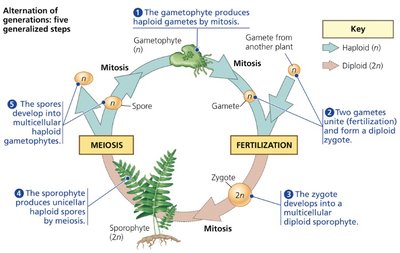
All land plants exhibit an alternation of generations, a two-stage life cycle involving multicellular haploid (gametophyte) and diploid (sporophyte) phases.
Gametophyte: The haploid stage that produces gametes by mitosis.
Sporophyte: The diploid stage that produces haploid spores by meiosis.
Zygote: The diploid cell formed by the fusion of two gametes.
Ploidy: Refers to the number of chromosome sets (haploid = n, diploid = 2n).
Steps in the Alternation of Generations
The gametophyte produces haploid gametes by mitosis.
Fertilization forms a diploid zygote.
The zygote develops into a multicellular diploid sporophyte.
The sporophyte produces haploid spores by meiosis.
These spores develop into multicellular haploid gametophytes.
Bryophytes: Nonvascular Land Plants
Bryophytes represent the earliest diverging group of land plants. Their life cycle is dominated by the gametophyte stage, and they lack true vascular tissues.
Dominant Gametophyte: The multicellular haploid stage is more prominent than the sporophyte.
Simple Apical Meristem: Allows limited growth and differentiation.
Multicellular Dependent Embryos: Embryos are retained and nourished by the parent gametophyte.
Walled Spores: Produced in sporangia (capsules) for air dispersal.
Cuticle and Stomata: Present for water retention and gas exchange.
Summary Table: Major Plant Groups and Key Features
Group | Vascular Tissue | Seeds | Dominant Generation | Key Innovations |
|---|---|---|---|---|
Bryophytes | No | No | Gametophyte | Cuticle, stomata, embryo protection |
Seedless Vascular Plants | Yes | No | Sporophyte | Vascular tissue, true roots/leaves |
Gymnosperms | Yes | Yes | Sporophyte | Seeds, pollen |
Angiosperms | Yes | Yes | Sporophyte | Flowers, fruits |
Additional info:
This summary integrates content from the course syllabus, lecture notes, and textbook images, focusing on the evolution and adaptation of plants to terrestrial life (Chapters 29, 30, 35, 36, 37, 38, 39, 32, 33, 34, 40, 41, 42, 44, 51).
Key diagrams and phylogenetic trees are included to reinforce understanding of evolutionary relationships and life cycles.
