 Back
BackPlant Evolution and the Move to Land: Origins, Adaptations, and Major Groups
Study Guide - Smart Notes
 Tailored notes based on your materials, expanded with key definitions, examples, and context.
Plant Evolution and the Move to Land
Origin of Plants and Algal Relatives
Plants are believed to have evolved from green algae, specifically a group called charophytes. This evolutionary relationship is supported by similarities in cell structure, biochemistry, and genetic sequences.
Key Shared Traits: Multicellularity, eukaryotic cells, photosynthetic autotrophy, cellulose in cell walls, and chloroplasts with chlorophyll a and b.
Unique Shared Traits with Charophytes: Cellulose-synthesizing protein rings, similar flagellated sperm structure, and DNA sequence similarities.
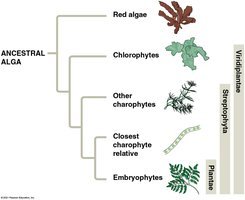
Additional info: The transition from aquatic to terrestrial life required significant adaptations for survival outside water.
Adaptations for Terrestrial Life
The colonization of land by plants provided access to unfiltered sunlight, abundant CO2, and nutrient-rich soils, but also posed challenges such as water scarcity and lack of structural support.
Sporopollenin: A durable polymer that protects zygotes and spores from desiccation.
Embryophytes: Land plants with multicellular, dependent embryos retained within female tissues.
Derived Traits of Land Plants
Key Innovations in Plant Evolution
Four major derived traits distinguish land plants from their closest algal relatives:
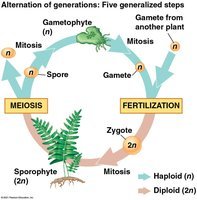
Alternation of Generations: Life cycle alternates between multicellular haploid gametophyte and multicellular diploid sporophyte.
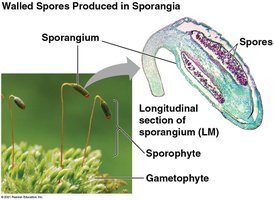
Walled Spores in Sporangia: Protective structures for spore production and dispersal.
Multicellular, Dependent Embryos: Embryos are nourished and protected by parent tissues.
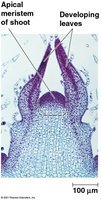
Apical Meristems: Regions of active cell division at shoot and root tips, enabling growth.
Alternation of Generations
Plants alternate between two multicellular stages: the haploid gametophyte and the diploid sporophyte. This cycle involves mitosis and meiosis, ensuring genetic diversity and adaptation to terrestrial environments.
Gametophyte (n): Produces gametes by mitosis.
Sporophyte (2n): Produces spores by meiosis.
Fertilization: Fusion of gametes forms a diploid zygote, which develops into a sporophyte.
Walled Spores Produced in Sporangia
Sporangia are multicellular organs where sporophytes produce spores. The spore walls contain sporopollenin, making them resistant to harsh conditions.
Apical Meristems
Apical meristems are regions at the tips of roots and shoots where cells divide rapidly, allowing plants to grow and explore new environments for resources.
Additional Derived Traits
Cuticle: A waxy covering that reduces water loss.
Stomata: Pores for gas exchange.
Vascular Tissue: Specialized cells for transport of water (xylem) and nutrients (phloem).
Major Groups of Land Plants
Classification Overview
Land plants are classified based on the presence or absence of vascular tissue and seeds.
Nonvascular plants (Bryophytes): Liverworts, mosses, hornworts
Seedless vascular plants: Lycophytes (club mosses, spike mosses, quillworts), Monilophytes (ferns, horsetails, whisk ferns)
Seed plants: Gymnosperms and angiosperms
Bryophytes: Nonvascular Plants
Life Cycle and Structure
Bryophytes are small, herbaceous plants with life cycles dominated by the gametophyte stage. They lack true vascular tissue and are limited in size by the absence of supportive and conductive tissues.
Dominant Gametophyte: The main, photosynthetic stage of the life cycle.
Sporophyte: Remains attached to and dependent on the gametophyte.
Rhizoids: Root-like structures for anchorage, not absorption.
Bryophyte Diversity
Liverworts (Phylum Hepatophyta): Gametophytes may be thalloid or leafy; sporophytes have a foot, seta, and capsule.
Hornworts (Phylum Anthocerophyta): Sporophytes are horn-shaped and grow from the gametophyte; form symbioses with nitrogen-fixing bacteria.
Mosses (Phylum Bryophyta): Gametophytes are leafy and upright; sporophytes consist of a capsule, seta, and foot.
Ecological and Economic Importance of Mosses
Mosses play crucial roles in ecosystems by retaining moisture, stabilizing soils, and contributing to nutrient cycling. They can survive extreme desiccation and help retain nitrogen in soils.
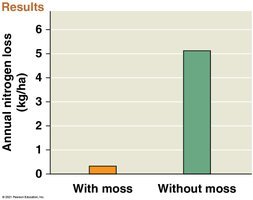
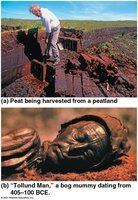
Peat Moss (Sphagnum): Forms peat, a partially decayed organic material used as fuel and for soil conditioning. Peatlands preserve organic remains for thousands of years due to low decomposition rates.
Seedless Vascular Plants
Evolution and Characteristics
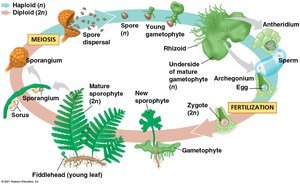
Seedless vascular plants were the first to develop vascular tissues, allowing them to grow taller and colonize new habitats. Their life cycles are dominated by the sporophyte stage.
Vascular Tissues: Xylem (water and minerals) and phloem (organic nutrients).
Roots: Anchor plants and absorb water/nutrients.
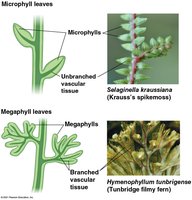
Leaves: Increase surface area for photosynthesis; classified as microphylls (single vein) or megaphylls (branched veins).
Life Cycle of Seedless Vascular Plants
In these plants, the sporophyte is the dominant, conspicuous stage. Gametophytes are small and often independent.
Classification of Seedless Vascular Plants
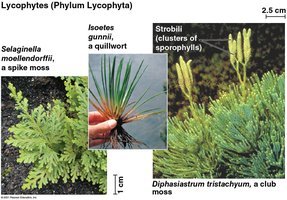
Lycophytes (Phylum Lycophyta): Includes club mosses, spike mosses, and quillworts. Some are homosporous, others heterosporous.
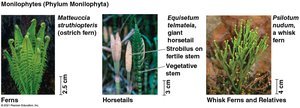
Monilophytes (Phylum Monilophyta): Includes ferns, horsetails, and whisk ferns.
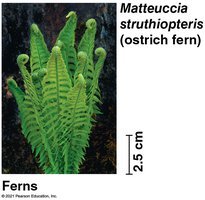
Ferns
Ferns have large, divided leaves called fronds. Most are homosporous and disperse spores using specialized mechanisms.
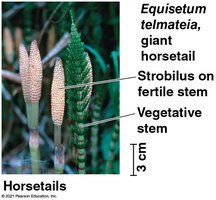
Horsetails
Horsetails have jointed stems and small leaves arranged in whorls. They were once diverse but now are represented by a single genus, Equisetum.
Whisk Ferns and Relatives
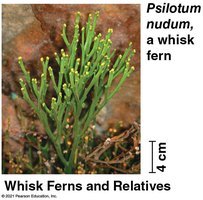
Whisk ferns lack true roots and leaves, with dichotomously branching stems and fused sporangia at stem tips.
Summary Table: Major Plant Groups
This table summarizes the key differences among major plant groups, focusing on vascular tissue, seeds, and dominant life cycle stage.
Group | Vascular Tissue | Seeds | Dominant Generation |
|---|---|---|---|
Bryophytes | No | No | Gametophyte |
Seedless Vascular Plants | Yes | No | Sporophyte |
Gymnosperms | Yes | Yes | Sporophyte |
Angiosperms | Yes | Yes | Sporophyte |
Additional info: This table provides a concise comparison of the major evolutionary innovations in land plants.
