 Back
BackPlant Metabolism: Synthesis of Organic Molecules and Secondary Metabolites
Study Guide - Smart Notes
 Tailored notes based on your materials, expanded with key definitions, examples, and context.
Synthesis of Organic Molecules in Plants
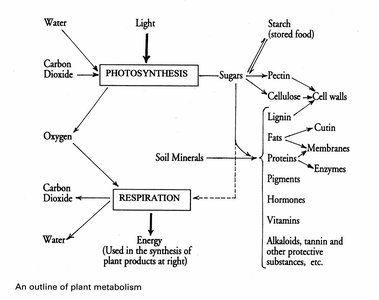
Photosynthesis and Respiration: Central Metabolic Pathways
Photosynthesis and respiration are the foundational metabolic processes in plants, responsible for the synthesis and breakdown of organic molecules. These pathways are interconnected, providing energy and carbon skeletons for the biosynthesis of primary and secondary metabolites.
Photosynthesis: Converts carbon dioxide and water into sugars using light energy.
Respiration: Breaks down sugars to release energy, carbon dioxide, and water.
Intermediates: Sugars produced in photosynthesis serve as precursors for various biosynthetic pathways.
Example: Sugars from photosynthesis can be used to synthesize starch for storage or cellulose for cell wall structure.
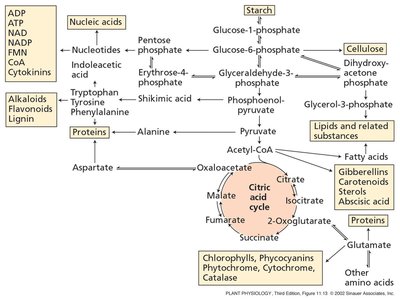
Alternate Fates of Glucose and Respiratory Intermediates
Not all carbon from glucose is respired to CO2; many intermediates branch off to form essential biomolecules. These include amino acids, nucleotides, fatty acids, and precursors for secondary metabolites.
Amino acids: Used for protein synthesis and as precursors for other compounds.
Pentoses: Contribute to cell wall structure and nucleic acid synthesis.
Nucleotides: Essential for DNA and RNA synthesis.
Porphyrins: Precursors for chlorophyll and other pigments.
Fatty acids: Used in membrane and hormone synthesis.
Lignin precursors: Important for cell wall rigidity.
Carotenoid and hormone precursors: Involved in signaling and protection.
Plant Primary and Secondary Metabolites
Primary Metabolites
Primary metabolites are compounds directly involved in growth, development, and reproduction. They include carbohydrates, proteins, lipids, and chlorophyll.
Carbohydrates: Energy storage (starch), structural (cellulose).
Proteins: Enzymes, structural proteins, signaling molecules.
Lipids: Membrane structure, energy storage.
Chlorophyll: Essential for photosynthesis.
Secondary Metabolites
Secondary metabolites are compounds not directly involved in primary metabolic processes but play crucial roles in plant defense, signaling, and adaptation. Their biosynthesis often involves modification of primary metabolic pathways.
Terpenoids: Includes paclitaxel, taxol, cannabinoids; roles in defense and signaling.
Alkaloids: Nitrogen-containing compounds like caffeine, nicotine, morphine; often toxic to herbivores.
Phenolic compounds: Flavonoids, anthocyanins, tannins, lignin; contribute to pigmentation, defense, and structural integrity.
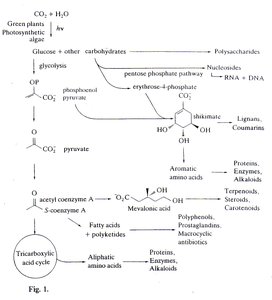
Key Precursors and Biosynthetic Pathways
Secondary metabolites originate from key metabolic intermediates:
Phosphoenol pyruvate (PEP): Shikimate pathway for aromatic compounds.
Acetyl CoA: Acetate and mevalonate pathways for terpenoids and fatty acids.
Amino acids: Nitrogen-containing alkaloids.
Example: The shikimate pathway produces aromatic amino acids, which are precursors for many phenolic compounds.
Classification and Examples of Secondary Metabolites
Types and Functions
Secondary metabolites are classified based on their chemical structure and biological function. They often serve as defense compounds, attractants, or signaling molecules.
Terpenoids: Isoprene (C5) is the basic unit; produced in flowers, leaves, and fruit. Functions include flavor, fragrance, antibiotics, insect attractants, and antifeedants.
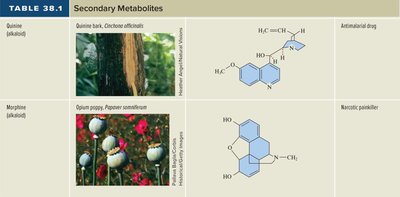
Alkaloids: Caffeine, nicotine, cocaine, quinine, morphine; often toxic and used as drugs.
Phenolic compounds: Flavonoids, anthocyanins, tannins, lignin; roles in pigmentation, defense, and structure.
Biological Role and Synthesis of Terpenoids
Terpenoids are synthesized via the mevalonate and methylerythritol phosphate pathways. Their biological roles include acting as volatile compounds for plant communication and defense.
Production sites: Flowers, leaves, fruit.
Roles: Flavor, fragrance, scent, antibiotics, insect attractants, antifeedants.
Example: Paclitaxel (taxol) is a terpenoid used as an anticancer drug.
Summary Table: Secondary Metabolites
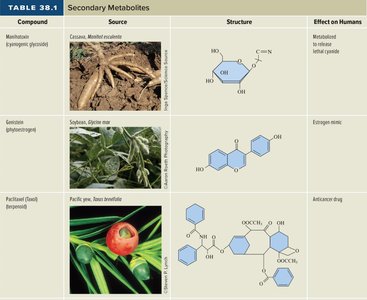
The following table summarizes key secondary metabolites, their sources, structures, and effects on humans:
Compound | Source | Structure | Effect on Humans |
|---|---|---|---|
Manihotoxin (cyanogenic glycoside) | Cassava, Manihot esculenta | See image_4 | Metabolized to initiate lethal cyanide |
Genistein (phytoestrogen) | Soybean, Glycine max | See image_4 | Estrogen mimic |
Paclitaxel (taxol) | Pacific yew, Taxus brevifolia | See image_4 | Anticancer drug |
Quinine (alkaloid) | Quinine bark, Cinchona officinalis | See image_5 | Antimalarial drug |
Morphine (alkaloid) | Opium poppy, Papaver somniferum | See image_5 | Narcotic painkiller |
Key Equations and Pathways
Photosynthesis Equation
The overall reaction for photosynthesis is:
Respiration Equation
The overall reaction for cellular respiration is:
Shikimate Pathway (Simplified)
The shikimate pathway produces aromatic amino acids:
Mevalonate Pathway (Simplified)
The mevalonate pathway produces terpenoids:
Conclusion
Plant metabolism integrates primary and secondary pathways to produce a diverse array of organic molecules. These compounds are essential for plant structure, function, defense, and interaction with the environment. Understanding these pathways is fundamental to plant biology, biotechnology, and pharmacology.
Additional info: Academic context was added to clarify the biosynthetic pathways and the classification of metabolites, as well as to provide self-contained explanations suitable for exam preparation.
