 Back
BackPlant Nutrition and Transport: Uptake, Movement, and Soil Interactions
Study Guide - Smart Notes
 Tailored notes based on your materials, expanded with key definitions, examples, and context.
Plant Nutrition and Transport
Overview of Plant Nutrient Uptake
Plants require a variety of nutrients to grow, which they acquire from the air, water, and soil. The process of nutrient uptake and transport is essential for plant survival, growth, and reproduction. This section explores the mechanisms by which plants absorb, transport, and utilize nutrients, as well as the role of soil and symbiotic relationships in plant nutrition.
Uptake and Transport of Plant Nutrients
Sources of Plant Nutrients
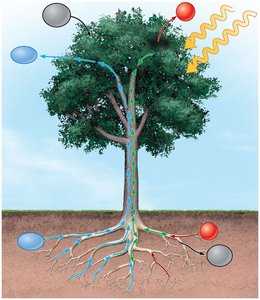
Carbon and Oxygen: Absorbed from the atmosphere as CO2 and O2.
Hydrogen: Obtained from water (H2O).
Minerals: Absorbed from the soil as inorganic ions.
Photosynthesis uses carbon, oxygen, and hydrogen to produce sugars, which are then used to construct other organic molecules. Cellular respiration breaks down some sugars to release energy, consuming oxygen in the process.
Transport Pathways in Plants
Xylem: Transports water and dissolved minerals from roots to shoots.
Phloem: Transports sugars and other organic products throughout the plant.
Water and minerals move upward from roots to leaves, while sugars can move both upward and downward between shoots and roots.
Root Structure and Solute Uptake
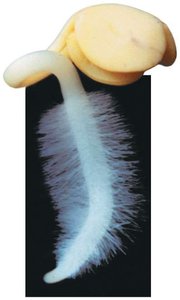
Root Hairs: Increase the absorptive surface area of roots.
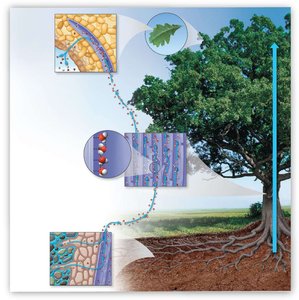
Pathways: Water and solutes can move through the root epidermis and cortex either through cells (symplastic route) or between cells (apoplastic route).
Endodermis: All water and solutes must pass through the selectively permeable plasma membranes of endodermal cells to enter the xylem.
Transport Routes Between Cells
Symplast: The cytoplasmic continuum connected by plasmodesmata.
Apoplast: The continuum of cell walls and extracellular spaces.
Transmembrane Route: Movement out of one cell, across a cell wall, and into another cell.

Casparian Strip and Selective Uptake
Casparian Strip: A band of suberin in the endodermal cell walls that blocks the passive flow of substances into the vascular cylinder, ensuring selective uptake.
Transport of Water and Minerals
Transpiration and Xylem Transport
Transpiration is the evaporation of water from plant leaves, creating a negative pressure that pulls water upward through the xylem. This process is aided by the cohesion of water molecules and their adhesion to xylem walls, requiring no energy expenditure by the plant.
Guard Cells and Stomatal Regulation
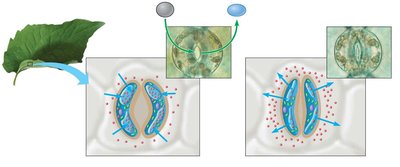
Guard Cells: Regulate the opening and closing of stomata, controlling transpiration and gas exchange.
Stomata are generally open during the day (allowing transpiration) and closed at night (preventing water loss).
Phloem Transport: Movement of Sugars
Phloem Structure and Function
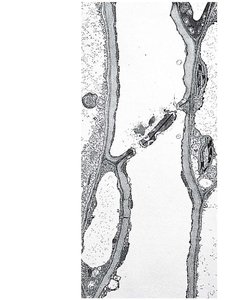
Sieve-Tube Elements: Specialized cells in angiosperms arranged end to end, with perforated sieve plates for efficient transport.
Phloem Sap: Contains sugars (mainly sucrose), amino acids, and other organic molecules.
Pressure Flow Mechanism
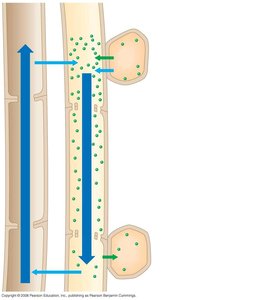
The pressure flow hypothesis explains how phloem sap moves from a sugar source (e.g., leaves) to a sugar sink (e.g., roots or fruits):
Sugar is actively loaded into sieve tubes at the source, reducing water potential.
Water enters from the xylem, creating positive pressure that pushes sap toward the sink.
At the sink, sugar is unloaded, relieving pressure.
Water returns to the xylem.
Transport Mechanisms at the Cellular Level
Diffusion and Active Transport
Diffusion: Passive movement of molecules from high to low concentration.
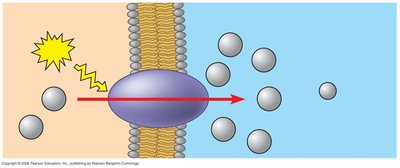
Active Transport: Movement of solutes against their concentration gradient, requiring energy (ATP).
Transport Proteins: Embedded in cell membranes, facilitate both passive and active transport.

Proton Pumps and Cotransport
Proton Pumps: Create a hydrogen ion gradient and membrane potential, which can be used to drive the transport of other solutes (cations, anions, and neutral molecules) via cotransport mechanisms.
Cotransport: The coupled movement of one solute with another, such as the uptake of sucrose with H+.
Soil and Plant Nutrition
Soil Composition and Structure
Soil Horizons: Layers of soil, including topsoil (rich in organic material) and subsoil.
Soil Texture: Determined by the proportions of sand, silt, and clay.
Humus: Decaying organic material that improves soil structure and nutrient retention.
Inorganic and Organic Components
Cations (K+, Ca2+, Mg2+): Adhere to negatively charged soil particles and are exchanged with H+ ions for plant uptake.
Anions (NO3-, SO42-, PO43-): Less tightly bound and can be lost by leaching.
Essential Nutrients
Macronutrients: Required in large amounts (C, H, O, N, K, Ca, Mg, P, S).
Micronutrients: Required in trace amounts (Cl, Fe, B, Mn, Zn, Cu, Mo, Ni).
Macronutrient | Function |
|---|---|
Carbon (C) | Major component of organic molecules |
Oxygen (O) | Major component of organic molecules |
Hydrogen (H) | Major component of organic molecules |
Nitrogen (N) | Component of nucleic acids, proteins, chlorophyll |
Potassium (K) | Regulates stomatal opening/closing |
Calcium (Ca) | Cell wall formation, membrane function |
Magnesium (Mg) | Component of chlorophyll |
Phosphorus (P) | Component of nucleic acids, ATP |
Sulfur (S) | Component of proteins |
Fertilizers and Soil Fertility
Inorganic Fertilizers: Contain minerals in readily available forms.
Organic Fertilizers: Derived from organic matter, release nutrients slowly.
Soil Fertility: Depends on the presence of essential nutrients, humus, and proper soil structure.
Plant Nutrition and Symbiosis
Nitrogen-Fixing Bacteria
Nitrogen Fixation: Conversion of atmospheric N2 to ammonia (NH3) by bacteria, making nitrogen available to plants.
Ammonifying and Nitrifying Bacteria: Convert organic nitrogen to ammonium (NH4+) and nitrate (NO3-).
Mycorrhizae and Plant-Fungal Mutualism
Mycorrhizae: Symbiotic associations between plant roots and fungi, enhancing nutrient and water absorption.
Legumes and Rhizobium: Bacterial mutualists that fix atmospheric nitrogen in root nodules.
Specialized Plant Nutrition Strategies
Epiphytes: Grow on other plants, obtaining water and minerals from rain.
Parasitic Plants: Absorb sugars and minerals from host plants.
Carnivorous Plants: Photosynthetic but obtain nitrogen by digesting insects.
Plant Type | Nutritional Strategy |
|---|---|
Epiphyte | Grows on other plants, non-parasitic |
Parasitic Plant | Extracts nutrients from host plant |
Carnivorous Plant | Obtains nitrogen from insects |
