 Back
BackPlant Reproduction and Development: From Gametogenesis to Seed Germination
Study Guide - Smart Notes
 Tailored notes based on your materials, expanded with key definitions, examples, and context.
Plant Reproduction and Development
Sporogenesis and Gametogenesis
Plant reproduction involves two main processes: sporogenesis (formation of spores by the sporophyte) and gametogenesis (formation of gametes by the gametophyte). These processes occur in distinct plant generations, reflecting the alternation of generations in the plant life cycle.
Gametophytes produce gametes via mitosis in specialized structures called gametangia (archegonia for eggs, antheridia for sperm).
Sporophytes produce spores via meiosis in sporangia.
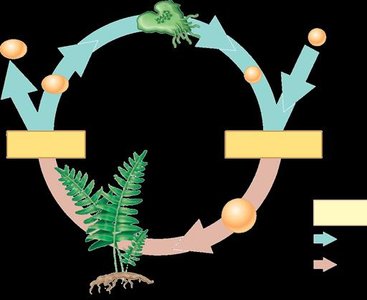
Example: In ferns, the leafy plant is the diploid sporophyte, while the small, heart-shaped structure is the haploid gametophyte.
Development of Male Gametophytes (Pollen Grains)
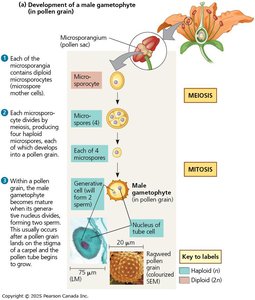
Male gametophytes in seed plants develop within the anthers of flowers. The process begins with microspores, which undergo mitosis to form the two-celled pollen grain (generative cell and tube cell).
Microspores are produced in the microsporangia (pollen sacs) of anthers.
Each microspore divides mitotically to form a generative cell (which will later divide to form two sperm) and a tube cell (which forms the pollen tube).
The mature pollen grain is the male gametophyte, encased in a protective spore wall.
Development of Female Gametophytes (Embryo Sacs)
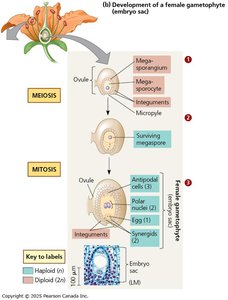
The female gametophyte, or embryo sac, develops within the ovule of the ovary. This process involves meiosis and mitosis:
Within the ovule, two integuments surround a megasporangium.
One cell in the megasporangium undergoes meiosis, producing four megaspores; only one survives.
The surviving megaspore undergoes mitosis to form the multicellular embryo sac (female gametophyte).
Meiosis in the Haplodiplontic Lifecycle
Meiosis in plants does not directly produce gametes, but rather haploid spores. These spores develop into gametophytes, which then produce gametes by mitosis.
Homospory: All spores are morphologically identical.
Heterospory: Two types of spores are produced: megaspores (develop into female gametophytes) and microspores (develop into male gametophytes).
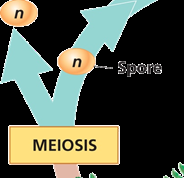
Additional info: In seed plants, heterospory is the rule, with microspores and megaspores giving rise to pollen grains and embryo sacs, respectively.
Gametogenesis
Gametogenesis in plants always occurs by mitosis within the gametophyte generation. Specialized organs called gametangia produce the gametes:
Antheridia: Produce multiple sperm cells.
Archegonia: Produce a single egg cell.
In seed plants, sperm are contained within pollen grains, and eggs are within ovules.
Gamete Transfer and Fertilization
Plants have evolved various strategies for gamete transfer, reflecting their sessile nature:
Dependence on water: Seen in mosses and ferns, where sperm swim to the egg.
Independence from water: Seed plants rely on pollination (by wind or animals) for gamete transfer.
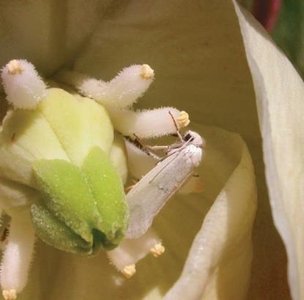
Example: Many flowering plants use insects, birds, or bats for pollination, while others rely on wind.
Anthophyta Pollination and Double Fertilization
In flowering plants (Anthophyta), pollination is indirect, and fertilization involves a unique process called double fertilization:
One sperm fertilizes the egg, forming the zygote (2n).
The other sperm fuses with two polar nuclei, forming the endosperm (3n), which nourishes the developing embryo.
The seed develops inside a fruit, which aids in protection and dispersal.
Embryo Development
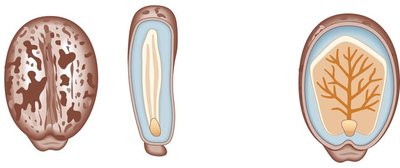
After fertilization, the zygote develops into an embryo within the seed. This process involves several stages:
Cleavage: The zygote divides to form a terminal cell (proembryo) and a basal cell (suspensor).
Embryonic organs: Cotyledons (seed leaves), epicotyl (shoot apical meristem), hypocotyl, and radicle (root apical meristem) are established.
Fruit and Seed Dispersal
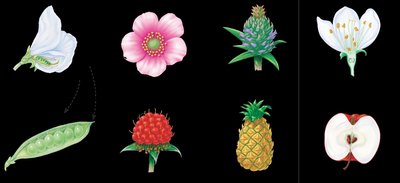
Fruits are mature ovaries that aid in seed protection and dispersal. There are several types of fruits:
Simple fruits: Develop from a single ovary (e.g., pea pod).
Aggregate fruits: Develop from multiple ovaries of one flower (e.g., raspberry).
Multiple fruits: Develop from ovaries of multiple flowers (e.g., pineapple).
Accessory fruits: Contain other floral parts in addition to the ovary (e.g., apple).
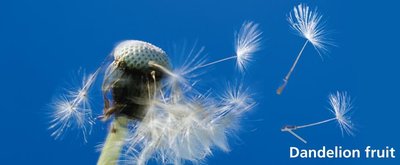
Seed dispersal mechanisms include wind, water, and animals, which help plants colonize new areas.
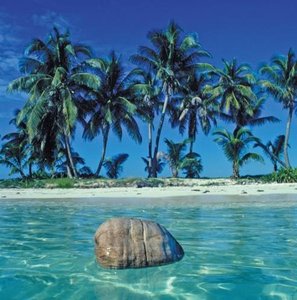
Seed Dormancy and Germination
Seeds often enter a dormant state, allowing them to survive unfavorable conditions. Dormancy is broken by environmental cues such as water, oxygen, and temperature.
Embryo (2n): Contains primary tissues and meristems (SAM, RAM).
Endosperm (3n): Stores nutrients for the embryo (in angiosperms).
Seed coat: Protective outer layer derived from parent tissue.
Germination: Begins with imbibition (water uptake), leading to rupture of the seed coat, emergence of the radicle (root), and shoot.
Plant Development and Growth
After germination, plants grow and develop through the activity of meristems, which are regions of continuous cell division.
Primary growth: Increase in length via apical meristems (shoot and root).
Secondary growth: Increase in girth via lateral meristems (vascular cambium and cork cambium).
Vascular Plant Structure
Vascular plants have three main organs (roots, stems, leaves) and three tissue systems (dermal, ground, vascular).
Roots: Anchor the plant, absorb water and nutrients, store food, and transport substances.
Stems: Support leaves and flowers, transport fluids, and sometimes store food.
Leaves: Major site of photosynthesis, gas exchange, and transpiration.
Root Structure and Growth
Roots grow through zones of division, elongation, and differentiation. The root cap protects the growing tip, and lateral roots arise from the pericycle.
Dicot roots: Have a central vascular cylinder with xylem and phloem.
Monocot roots: Have a ring of vascular bundles.
Stem and Leaf Structure
Stems and leaves are organized into tissues that support growth, transport, and photosynthesis.
Stems: Contain vascular bundles (xylem and phloem), ground tissue (pith, cortex), and dermal tissue (epidermis).
Leaves: Composed of blade, petiole, and sometimes stipules; contain vascular tissue, mesophyll, and epidermis with guard cells.
Secondary Growth and Tissue Formation
Woody plants undergo secondary growth, increasing girth through the activity of the vascular cambium (producing secondary xylem and phloem) and cork cambium (producing cork for protection).
Vascular cambium: Produces wood (secondary xylem) inward and secondary phloem outward.
Cork cambium: Produces cork, which protects against water loss and pathogens.
Additional info: Annual growth rings in wood result from seasonal variation in xylem cell size.
