 Back
BackPlant Reproduction and Development: Sporogenesis, Gametogenesis, and Plant Structure
Study Guide - Smart Notes
 Tailored notes based on your materials, expanded with key definitions, examples, and context.
Plant Reproduction and Development
Sporogenesis and Gametogenesis
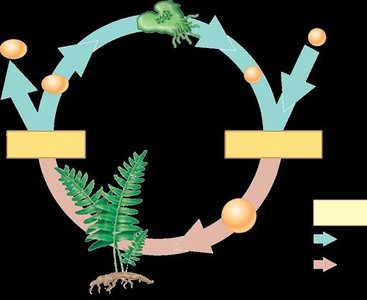
Plant reproduction involves two main processes: sporogenesis (formation of spores by the sporophyte) and gametogenesis (formation of gametes by the gametophyte). These processes occur in distinct generations within the plant life cycle, known as the haplodiplontic lifecycle.
Gametophytes produce gametes in specialized organs called gametangia:
Archegonia: Female gametangia, produce eggs
Antheridia: Male gametangia, produce sperm
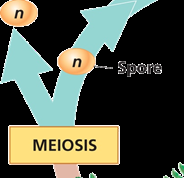
Sporophytes produce spores in sporangia by meiosis.
Key Concepts:
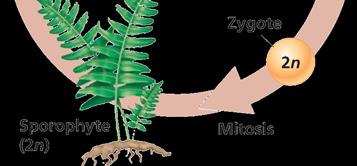
Haplodiplontic lifecycle: Alternation between multicellular diploid (sporophyte) and haploid (gametophyte) generations.
Meiosis in sporangia produces haploid spores, not gametes.
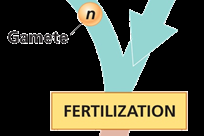
Gametogenesis always occurs by mitosis in the gametophyte.
Development of Male Gametophytes (Pollen Grains)
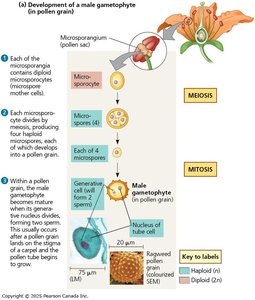
Male gametophytes develop from microspores within the microsporangia (pollen sacs) of anthers. Each microspore undergoes mitosis to produce two cells: the generative cell and the tube cell. Together, these form the pollen grain, which is the male gametophyte surrounded by a protective spore wall.
Microsporangium contains diploid microsporocytes.
Microsporocytes undergo meiosis to produce four haploid microspores.
Each microspore divides mitotically to form a two-celled pollen grain.
Development of Female Gametophytes (Embryo Sacs)
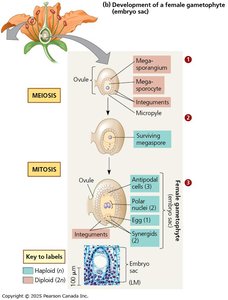
The female gametophyte, or embryo sac, develops within the ovule. Two integuments surround the megasporangium. One cell in the megasporangium undergoes meiosis, producing four megaspores, but only one survives. This megaspore undergoes mitosis to form the embryo sac.
Ovule contains the diploid megasporocyte.
Megasporocyte undergoes meiosis to produce four haploid megaspores (one survives).
The surviving megaspore divides mitotically to form the embryo sac (female gametophyte).
Homospory vs. Heterospory
Plants may produce one type of spore (homospory) or two distinct types (heterospory):
Homospory: All spores are identical in size and type.
Heterospory: Two types of spores are produced:
Megaspores → Female gametophytes
Microspores → Male gametophytes
Gametogenesis
Gametogenesis is the process by which gametes are formed by mitosis in the gametophyte generation. In seed plants, sperm are contained within pollen grains, and eggs are contained within ovules.
Antheridia produce multiple sperm cells.
Archegonia produce a single egg cell.
Gamete Transfer and Pollination
Plants are sessile and must rely on external mechanisms for gamete transfer. Non-seed plants (e.g., mosses, ferns) depend on water for sperm motility, while seed plants have evolved pollination mechanisms that do not require water.
Pollination: Transfer of pollen from anther to stigma, often by wind or animals.
Seed plants are independent of water for fertilization.
Anthophyta Pollination and Double Fertilization
In flowering plants (Anthophyta), pollination is indirect, and double fertilization occurs. One sperm fertilizes the egg, forming the zygote, while another sperm fuses with two polar nuclei to form the triploid endosperm, which serves as a nutritional source for the developing embryo. The seed develops inside a fruit.
Embryo Development
After fertilization, the zygote develops into an embryo within the seed. The embryo consists of embryonic organs such as cotyledons, epicotyl (shoot apical meristem), hypocotyl, and radicle (root apical meristem). The process involves cleavage, formation of the proembryo, and differentiation of the embryo proper and suspensor.
Cotyledons: Seed leaves, may be thin or thick.
Epicotyl: Gives rise to the shoot system.
Hypocotyl: Region below the cotyledons, above the radicle.
Radicle: Embryonic root.
Fruit and Seed Dispersal
Fruits are expanded flower parts that aid in seed dispersal. Types of fruits include simple, aggregate, multiple, and accessory fruits. Seed dispersal mechanisms vary between gymnosperms and angiosperms and may involve wind, water, or animals.
Gymnosperms: Seeds dispersed by wind, often with seed coat extensions.
Angiosperms: Seeds dispersed by fruit, water, wind, or animals.
Seed Dormancy and Germination
Seed dormancy ensures that germination occurs under favorable conditions. Dormancy is induced by dehydration or temperature and is broken by water uptake (imbibition), oxygen, and suitable temperature. The radicle emerges first, followed by the shoot.
Embryo (2N): Contains primary dermal, ground, and vascular tissues; SAM and RAM established.
Endosperm (3N): Nutrient storage tissue in angiosperms.
Seed coat: Protective outer layer derived from parent tissue.
Plant Development and Meristems
After germination, plants grow through the activity of meristems—regions of undifferentiated cells capable of division. Primary growth increases length, while secondary growth increases girth.
Primary growth: Occurs at shoot and root apical meristems.
Secondary growth: Occurs at vascular and cork cambia, producing wood and bark.
Vascular Plant Structure
Vascular plants have three main organs (roots, stems, leaves) and three tissue systems (dermal, ground, vascular).
Roots: Anchorage, absorption, storage, transport.
Stems: Support, transport, photosynthesis.
Leaves: Major photosynthetic organ, gas exchange, transpiration.
Root Structure and Growth
Roots grow through zones of division, elongation, and differentiation. The root cap protects the apical meristem. Root systems can be fibrous or taproot. Modified roots serve specialized functions such as support, storage, or aeration.
Stem Structure and Growth
Stems contain vascular bundles (xylem and phloem), ground tissue (pith and cortex), and dermal tissue (epidermis). Growth occurs at the shoot apical meristem, producing stems, leaves, and axillary buds. Modified stems include rhizomes and tubers.
Leaf Structure and Growth
Leaves are composed of a blade, petiole, and sometimes stipules. Internal structure includes vascular tissue (xylem and phloem), ground tissue (palisade and spongy mesophyll), and dermal tissue (epidermis, guard cells). Modified leaves serve roles in attachment, defense, storage, reproduction, or advertisement.
Secondary Growth
Secondary growth increases the girth of woody plants through the activity of the vascular cambium (producing secondary xylem and phloem) and cork cambium (producing cork for protection). Annual rings in wood reflect seasonal growth patterns.
Vascular cambium: Produces secondary xylem (wood) inward and secondary phloem (inner bark) outward.
Cork cambium: Produces cork, which prevents water loss and protects the stem.
Summary Table: Comparison of Plant Reproductive Structures
Structure | Generation | Process | Product |
|---|---|---|---|
Sporangium | Sporophyte (2N) | Meiosis | Spore (N) |
Gametangium | Gametophyte (N) | Mitosis | Gamete (N) |
Ovule | Sporophyte (2N) | Meiosis/Mitosis | Embryo sac (N) |
Anther | Sporophyte (2N) | Meiosis/Mitosis | Pollen grain (N) |
Additional info: This guide integrates content from Chapters 35 and 38, covering plant reproduction, development, and structure, and is suitable for college-level biology students preparing for exams.
