 Back
BackPlant Resource Acquisition and Transport: Adaptations, Mechanisms, and Soil Interactions
Study Guide - Smart Notes
 Tailored notes based on your materials, expanded with key definitions, examples, and context.
Adaptations for Acquiring Resources in Vascular Plants
Evolutionary Adaptations for Resource Acquisition
Vascular plants have evolved specialized structures and physiological mechanisms to acquire water, minerals, and carbon dioxide from their environment, enabling successful colonization of terrestrial habitats.
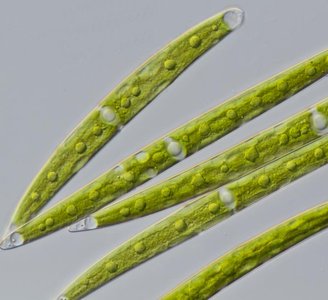
Algal ancestors absorbed water, minerals, and CO2 directly from surrounding water.
Early nonvascular land plants lived in shallow water and developed aerial shoots.
Natural selection favored taller plants with flat appendages, multicellular branching roots, and efficient transport systems.
Evolution of Vascular Tissue
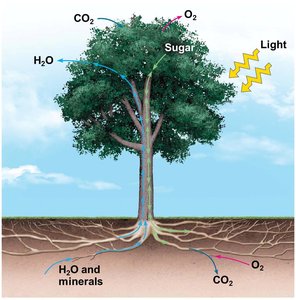
The development of vascular tissue was a key innovation, allowing plants to transport water, minerals, and photosynthetic products over long distances.
Xylem: Transports water and minerals from roots to shoots.
Phloem: Transports photosynthetic products (sugars) from sources (leaves) to sinks (roots, fruits, etc.).
Shoot Architecture and Light Capture
Adaptations for Photosynthesis
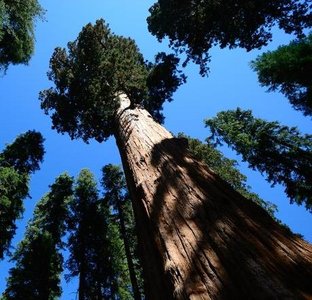
Plant success is closely tied to efficient photosynthesis, which depends on shoot architecture and leaf arrangement.
Stems act as conduits for water and nutrients and provide support for leaves.
Stem length, width, and branching patterns influence light capture and energy trade-offs.
Adaptations balance maximizing photosynthesis and minimizing water loss.
Phyllotaxy and Leaf Orientation
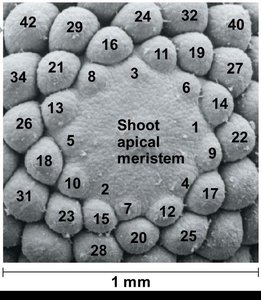
Phyllotaxy is the arrangement of leaves on a stem, which is species-specific and affects light absorption.
Most angiosperms have alternate phyllotaxy with leaves arranged in a spiral, minimizing shading (angle ≈ 137.5°).
Leaf orientation adapts to light conditions: horizontal leaves maximize light in low-light, vertical leaves reduce sun damage in high-light.
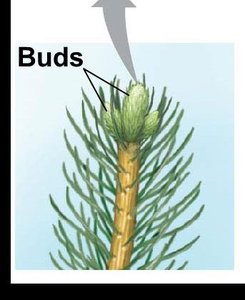
Root Architecture and Acquisition of Water and Minerals
Root System Adaptations
Roots are specialized for efficient acquisition of water and minerals from the soil, with growth patterns responsive to local nutrient conditions.
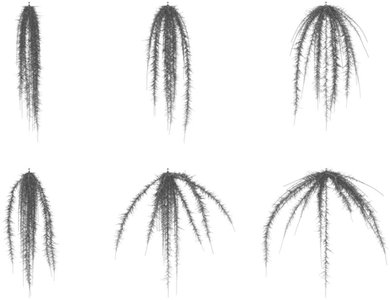
Roots branch more extensively in nutrient-rich soil patches (e.g., high nitrate).
Competition is reduced within the root system of individual plants; roots of the same plant avoid overlapping more than roots of different plants.
Mutualistic Relationships
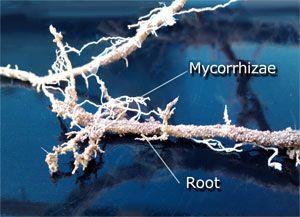
Roots form mutually beneficial relationships with soil microorganisms, such as mycorrhizal fungi, enhancing nutrient uptake and aiding in land colonization.
Mycorrhizae increase surface area for absorption and facilitate phosphorus uptake.
Transport Mechanisms in Plants
Apoplast and Symplast Pathways
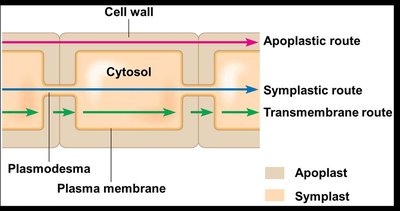
Plants transport substances via two main pathways: the apoplast (cell walls and extracellular spaces) and the symplast (cytosol and plasmodesmata).
Apoplastic route: Through cell walls and extracellular spaces.
Symplastic route: Through the cytosol, connected by plasmodesmata.
Transmembrane route: Across cell walls and plasma membranes.
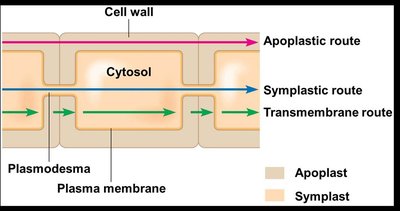
Short-Distance Transport of Solutes
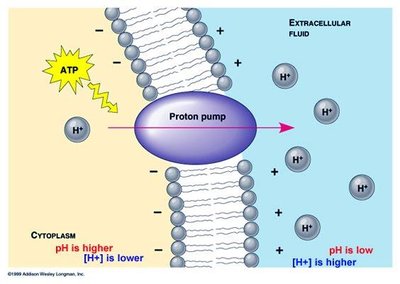
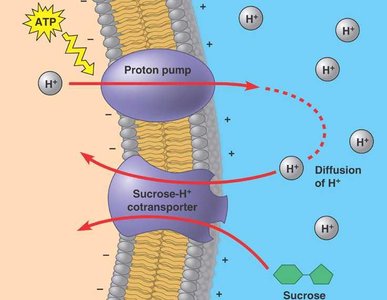
Plasma membrane permeability regulates solute movement. Plants use both active and passive transport, with membrane potential established by proton pumps (H+), unlike animals which use sodium-potassium pumps.
H+ gradients drive cotransport of other solutes.
Calcium-activated anion channels regulate ion passage in plant cells.
Short-Distance Transport of Water (Osmosis and Water Potential)
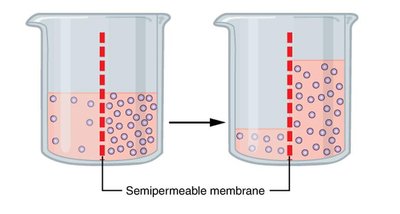
Osmosis determines water movement across membranes, governed by water potential (Ψ), which combines solute concentration and pressure.
Water moves from regions of higher to lower water potential.
Water potential equation:
Solute potential (ΨS): Proportional to molarity; also called osmotic potential.
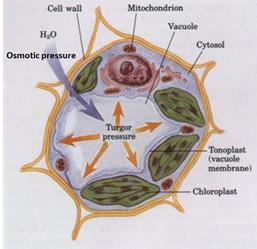
Pressure potential (ΨP): Physical pressure on a solution; turgor pressure maintains plant rigidity.
Effects of Water Potential on Plant Cells
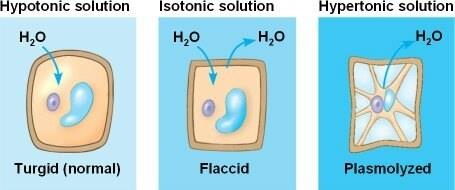
Water potential influences whether plant cells become turgid, flaccid, or plasmolyzed, affecting plant health and structure.
In hypertonic solutions, cells lose water and undergo plasmolysis.
In hypotonic solutions, cells gain water and become turgid.
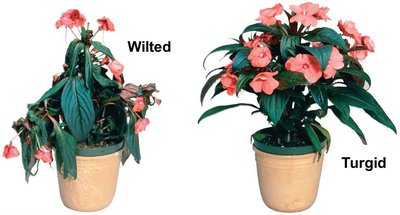
Turgor loss leads to wilting, reversible with water uptake.
Aquaporins
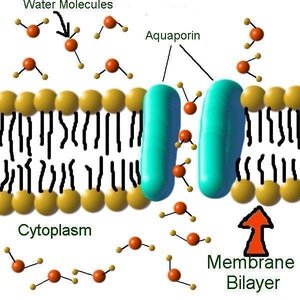
Aquaporins are membrane proteins that facilitate rapid water movement across cell membranes, adjusting the rate of osmosis as needed.
Long-Distance Transport: Bulk Flow
Bulk flow is the movement of fluid driven by pressure gradients, enabling rapid long-distance transport in xylem and phloem.
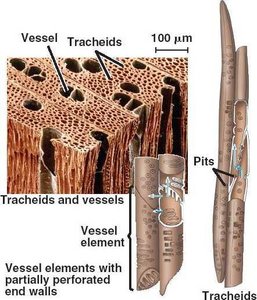
Xylem: Tracheids and vessel elements (dead cells) allow efficient water and mineral flow.
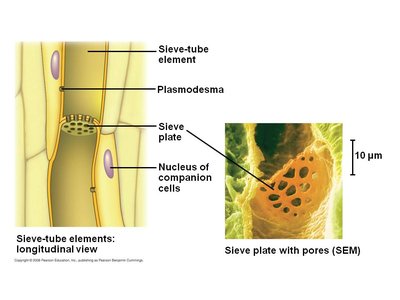
Phloem: Sieve-tube elements (living cells) transport sugars and other organic compounds.
Plant Nutrition and Soil Interactions
Essential Elements and Plant Growth
Plants require water, air, and soil minerals for growth. Most of a plant's mass comes from water and carbohydrates derived from CO2, with a small fraction from inorganic soil nutrients.
17 essential elements are required for a plant to complete its life cycle.
Macronutrients (needed in large amounts): N, P, K, Ca, Mg, S, etc.
Micronutrients (needed in trace amounts): Cl, Fe, Mn, B, Zn, Cu, Ni, Mo.
Nitrogen is the most important nutrient for plant growth and crop yields.
Symptoms of Mineral Deficiency
Deficiency symptoms depend on the mineral's function and mobility within the plant.
Mobile nutrient deficiencies affect older organs first; less mobile nutrient deficiencies affect younger organs.
Common deficiencies: nitrogen, potassium, phosphorus.
Soil Management and Fertilization
Soil management practices, including fertilization, are essential for maintaining soil fertility and supporting agriculture.
Fertilization replaces nutrients lost from soil due to harvesting.
Commercial fertilizers supply N, P, K; organic fertilizers release nutrients gradually.
Excess fertilizer can cause environmental issues, such as algal blooms.
Soil pH and Mineral Availability
Soil pH affects cation exchange and the chemical form of minerals, influencing their availability to plants.
Cations are more available in slightly acidic soils.
Different minerals are available at different pH levels (e.g., Ca at pH 8, Fe at lower pH).
Soil Texture and Composition
Soil texture (proportion of sand, silt, clay) and composition (inorganic and organic components) determine fertility and water retention.
Loams: Most fertile, balanced sand, silt, clay; retain water and allow air diffusion.
Sandy soils: Poor water retention; clayey soils: Poor drainage.
Organic matter (humus) improves soil structure and nutrient content.
Cation Exchange in Soil
Cation exchange is the process by which root hairs exchange H+ ions for mineral cations (K+, Ca2+, Mg2+) adsorbed to soil particles, making them available for uptake.
H+ ions displace mineral cations from clay particles, especially in slightly acidic soils.
