 Back
BackPlant Responses to Internal and External Signals: Plant Hormones and Light Responses
Study Guide - Smart Notes
 Tailored notes based on your materials, expanded with key definitions, examples, and context.
Plant Responses to Internal and External Signals
Introduction
Plants, as sessile organisms, rely on complex signaling mechanisms to adapt to their environment. These mechanisms include the action of plant hormones and responses to light, which together coordinate growth, development, and adaptation to internal and external stimuli.
Plant Hormones: Coordinating Growth and Development
Definition and General Role of Plant Hormones
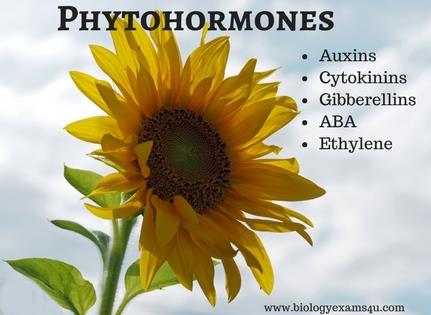
Plant hormones (phytohormones) are chemical signals produced in low concentrations that regulate physiological processes in plants. They influence nearly every aspect of plant growth and development, often acting together or in opposition to fine-tune responses.
Hormone effects are concentration-dependent and often rely on the balance between different hormones.
Most plant processes, including cell division, elongation, differentiation, and responses to environmental cues, are under hormonal control.
Major Classes of Plant Hormones
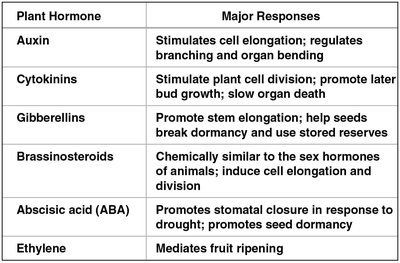
Plant Hormone | Major Responses |
|---|---|
Auxin | Stimulates cell elongation; regulates branching and organ bending |
Cytokinins | Stimulate plant cell division; promote lateral bud growth; slow organ death |
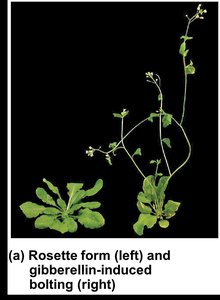
Gibberellins | Promote stem elongation; help seeds break dormancy and use stored reserves |
Brassinosteroids | Chemically similar to animal sex hormones; induce cell elongation and division |
Abscisic acid (ABA) | Promotes stomatal closure in response to drought; promotes seed dormancy |
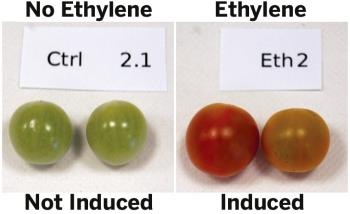
Ethylene | Mediates fruit ripening |
Auxin
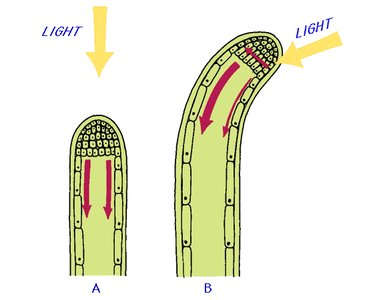
Auxin refers to any chemical that promotes elongation of coleoptiles and is primarily produced in shoot tips. It is transported down the stem and plays a central role in cell elongation, apical dominance, and organ bending (tropisms).
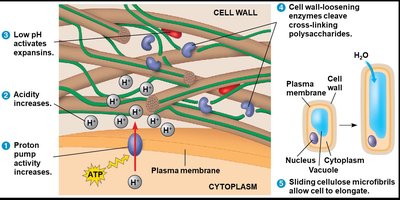
Acid Growth Hypothesis: Auxin stimulates proton pumps, lowering cell wall pH and activating expansins—enzymes that loosen the cell wall, allowing elongation.
Auxin also alters gene expression, stimulating sustained growth responses and influencing leaf arrangement (phyllotaxy).
Cytokinins
Cytokinins stimulate cytokinesis (cell division) and influence cell differentiation, apical dominance, and aging. They are produced in actively growing tissues such as roots, embryos, and fruits.
Work together with auxin to control cell division and differentiation.
Slow aging by inhibiting protein breakdown, stimulating RNA and protein synthesis, and mobilizing nutrients.
Gibberellins
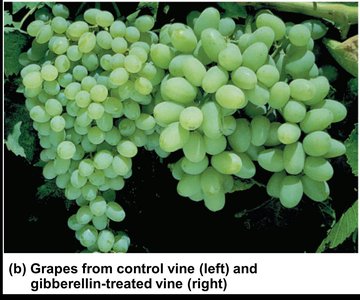
Gibberellins (GAs) have diverse effects, including stem elongation, fruit growth, and seed germination. They are produced in young roots and leaves.
Stimulate stem and leaf growth by enhancing cell elongation and division.
Induce bolting (rapid floral stalk growth) and, together with auxin, promote fruit development.
Trigger seed germination by signaling the breakdown of stored food reserves.
Brassinosteroids
Brassinosteroids are structurally similar to animal steroid hormones. They induce cell elongation and division, slow leaf abscission, and promote xylem differentiation.
Abscisic Acid (ABA)
Abscisic acid (ABA) slows plant growth, promotes seed dormancy, and enhances drought tolerance.
ABA accumulation causes stomata to close rapidly, reducing water loss during drought.
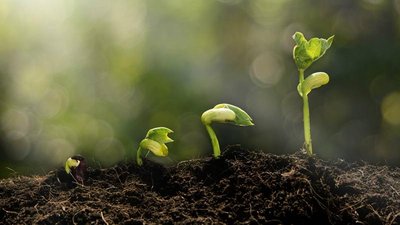
Maintains seed dormancy until conditions are optimal for germination.
Ethylene
Ethylene is a gaseous hormone produced in response to stress (drought, flooding, mechanical pressure, insect damage, infection). It regulates:
Triple response: Slowing of stem elongation, thickening of the stem, and horizontal growth to avoid obstacles.
Senescence: Programmed cell and organ death.
Leaf abscission: Shedding of leaves, especially in autumn, controlled by the balance of auxin and ethylene.
Fruit ripening: Ethylene triggers and accelerates ripening, which in turn stimulates more ethylene production.
Responses to Light: Photomorphogenesis and Photoreceptors
Photomorphogenesis
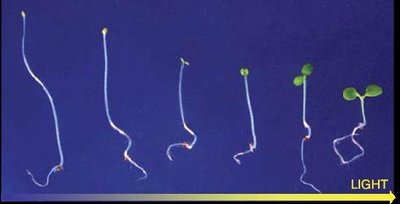
Photomorphogenesis refers to the growth and developmental responses of plants to light. Light not only triggers germination and growth but also influences the direction, intensity, and quality of plant development.
Plants detect light direction, intensity, and wavelength using specialized photoreceptors.
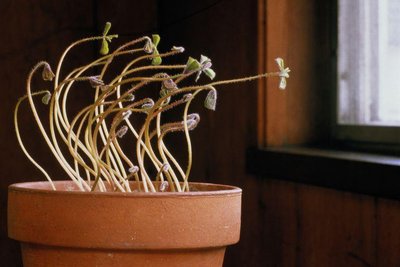
Etiolation is the morphological adaptation to darkness, characterized by elongated stems and underdeveloped leaves and roots.
De-etiolation (greening) occurs when a plant is exposed to light, leading to normal shoot and root development.
Photoreceptors: Blue-Light Receptors and Phytochromes
Plants use two major classes of photoreceptors:
Blue-light photoreceptors: Control phototropism (growth toward light), stomatal opening, and inhibition of hypocotyl elongation.
Phytochromes: Regulate seed germination, shade avoidance, and other developmental processes by detecting red and far-red light.
Phytochrome System
Phytochromes exist in two interconvertible forms: Pr (absorbs red light) and Pfr (absorbs far-red light).
Red light converts Pr to Pfr, which triggers developmental responses such as seed germination and inhibition of vertical growth.
Far-red light converts Pfr back to Pr, inhibiting these responses.
The ratio of Pr to Pfr provides information about light quality, influencing shade avoidance and other responses.
Example: Seeds exposed to red light germinate, while those exposed to far-red light do not. The last light exposure determines the response.
Summary Table: Plant Hormones and Their Major Responses
Plant Hormone | Major Responses |
|---|---|
Auxin | Stimulates cell elongation; regulates branching and organ bending |
Cytokinins | Stimulate plant cell division; promote lateral bud growth; slow organ death |
Gibberellins | Promote stem elongation; help seeds break dormancy and use stored reserves |
Brassinosteroids | Chemically similar to the sex hormones of animals; induce cell elongation and division |
Abscisic acid (ABA) | Promotes stomatal closure in response to drought; promotes seed dormancy |
Ethylene | Mediates fruit ripening |
Key Equations and Concepts
Acid Growth Hypothesis:
Phytochrome Photoreversibility:
Additional info: This guide integrates foundational concepts from plant physiology and developmental biology, providing a comprehensive overview suitable for exam preparation.
