 Back
BackPlant Roots and Nutrient Acquisition: Soil, Essential Elements, and Symbiotic Relationships
Study Guide - Smart Notes
 Tailored notes based on your materials, expanded with key definitions, examples, and context.
Plant Roots and Nutrient Acquisition
Soil as a Living Ecosystem
Soil is a dynamic, living ecosystem that supports plant growth by providing essential nutrients, water, and a habitat for beneficial organisms. The interaction between soil components and living organisms is crucial for nutrient cycling and plant health.
Texture: Refers to the proportion of sand, silt, and clay in soil, affecting water retention and aeration.
Composition: Includes mineral particles, organic matter, water, air, and living organisms.
Topsoil: The uppermost layer, rich in organic material and nutrients, is where most plant roots absorb minerals.
Soil solution: Water and dissolved minerals found in soil pores, available for plant uptake.
Loams: Fertile soils with balanced sand, silt, and clay, optimal for plant growth.
Essential Elements for Plant Growth
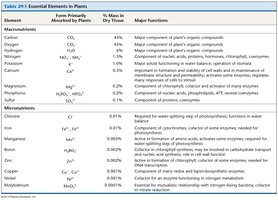
Plants require a variety of essential elements, which are classified as macronutrients and micronutrients. These elements are absorbed primarily through roots and are vital for cell structure, function, and overall growth.
Macronutrients: Needed in large amounts (e.g., nitrogen, phosphorus, potassium).
Micronutrients: Required in trace amounts (e.g., iron, zinc, copper).
Functions: Elements play roles in photosynthesis, enzyme activity, cell wall structure, and ion balance.
Example: Nitrogen is essential for amino acid and protein synthesis, while potassium regulates osmotic balance and enzyme activation.
Plant Nutrient Deficiencies
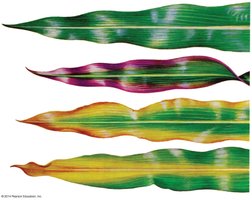
Deficiencies in essential minerals can lead to visible symptoms in plants, such as discoloration, stunted growth, or abnormal leaf development. Identifying these symptoms helps diagnose and correct nutrient imbalances.
Nitrogen deficiency: Causes yellowing of leaves (chlorosis).
Phosphorus deficiency: Results in stunted growth and dark green or purplish leaves.
Potassium deficiency: Leads to leaf edge browning and weak stems.
Soil Management and Fertilization
Proper soil management is essential for sustainable agriculture. Fertilization replenishes nutrients lost through harvesting and supports healthy plant growth. Both organic and commercial fertilizers are used, but excess application can lead to environmental issues.
Organic fertilizers: Derived from manure, compost, or fishmeal; release nutrients slowly as they decompose.
Commercial fertilizers: Enriched in N, P, and K; provide rapid nutrient availability but can cause leaching and algal blooms if overused.
Soil pH: Influences nutrient availability; slightly acidic soils enhance cation exchange and mineral uptake.
Cation Exchange and Mineral Uptake
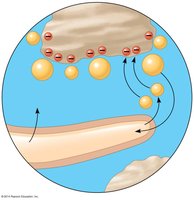
Cation exchange is a process by which plant roots acquire mineral cations from soil particles. Hydrogen ions released by roots displace mineral cations, making them available for absorption.
Cations: Positively charged ions (e.g., K+, Ca2+, Mg2+).
Process: H+ ions from roots replace mineral cations on clay particles, allowing roots to absorb them.
Soil Bacteria and Plant Nutrition
Soil bacteria play a critical role in nutrient cycling, decomposition, and enhancing plant nutrient availability. The rhizosphere, the soil region near roots, is rich in microbial activity due to root exudates.
Rhizobacteria: Thrive in the rhizosphere, exchanging chemicals with roots and promoting growth.
Decomposition: Bacteria break down organic matter, releasing nutrients for plant uptake.
The Nitrogen Cycle
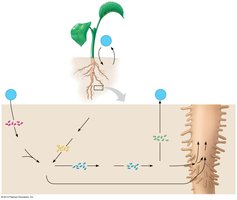
Nitrogen is a limiting nutrient for many plants. The nitrogen cycle involves several types of bacteria that transform atmospheric nitrogen into forms usable by plants (NO3− and NH4+).
Nitrogen-fixing bacteria: Convert atmospheric N2 to ammonia (NH3).
Ammonifying bacteria: Decompose organic matter to release NH4+.
Nitrifying bacteria: Convert NH4+ to NO3−.
Denitrifying bacteria: Return N2 to the atmosphere.
Rhizobium and Root Nodules
Some plants, especially legumes, form symbiotic relationships with Rhizobium bacteria, which fix atmospheric nitrogen in specialized root nodules. This enhances nitrogen availability for the plant and improves soil fertility.
Root nodules: Swellings on roots where nitrogen fixation occurs.
Mutualism: Plant provides carbohydrates; bacteria supply fixed nitrogen.
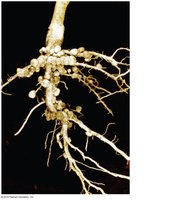
Fungi and Plant Nutrition: Mycorrhizae
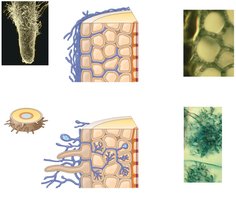
Mycorrhizae are mutualistic associations between fungi and plant roots. The fungus increases the root's surface area for water and mineral absorption, while the plant supplies carbohydrates to the fungus.
Ectomycorrhizae: Fungal sheath surrounds the root, hyphae grow between root cells.
Arbuscular mycorrhizae: Fungal hyphae penetrate root cells, forming arbuscules for nutrient exchange.
Evolutionary significance: Mycorrhizae helped early land plants colonize terrestrial environments.
Specialized Plant Nutritional Strategies
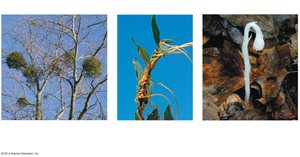
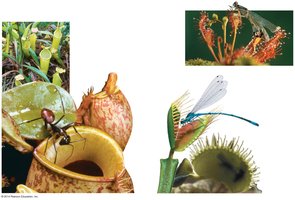
Some plants have evolved unique strategies to obtain nutrients, including parasitism and carnivory. These adaptations allow survival in nutrient-poor environments.
Parasitic plants: Obtain nutrients from other plants (e.g., mistletoe, dodder, Indian pipe).
Carnivorous plants: Trap and digest insects to supplement nutrient intake (e.g., pitcher plants, Venus flytraps, sundew).
Summary Table: Essential Elements in Plants
The following table summarizes the major essential elements, their forms, and functions in plants:
Element | Form Absorbed | % Mass in Dry Tissue | Major Functions |
|---|---|---|---|
Carbon | CO2 | 45% | Major component of organic compounds |
Oxygen | O2, H2O | 45% | Component of organic compounds, respiration |
Nitrogen | NO3−, NH4+ | 1.5% | Component of amino acids, nucleic acids, chlorophyll |
Phosphorus | H2PO4−, HPO42− | 0.2% | Component of nucleic acids, phospholipids, ATP |
Potassium | K+ | 1.0% | Enzyme activation, osmotic regulation |
Calcium | Ca2+ | 0.5% | Cell wall structure, signaling |
Magnesium | Mg2+ | 0.2% | Chlorophyll component, enzyme activation |
Sulfur | SO42− | 0.1% | Component of proteins |
Iron | Fe2+, Fe3+ | 0.01% | Chlorophyll synthesis, electron transport |
Zinc | Zn2+ | 0.002% | Enzyme activation |
Copper | Cu+, Cu2+ | 0.001% | Enzyme activation, electron transport |
Manganese | Mn2+ | 0.005% | Enzyme activation, photosynthesis |
Boron | BO3−, B4O72− | 0.002% | Cell wall formation |
Molybdenum | MoO42− | 0.0001% | Nitrogen fixation, nitrate reduction |
Chlorine | Cl− | 0.01% | Photosynthesis, water splitting |
Nickel | Ni2+ | 0.001% | Enzyme activation |
Key Equations
Important equations related to plant nutrient acquisition:
Cation Exchange:
Nitrogen Fixation:
----------------------------------------
