 Back
BackPlant Senses & Hormones – Guided Study Notes
Study Guide - Smart Notes
 Tailored notes based on your materials, expanded with key definitions, examples, and context.
Q1. What information do plant hormones help distribute throughout the plant?
Background
Topic: Plant Hormones and Signaling
This question explores the role of plant hormones as chemical messengers that coordinate responses to internal and external cues.
Key Terms:
Hormones: Chemical signals produced in one part of the plant and transported to other parts to regulate growth, development, and responses to stimuli.
Stimuli: Environmental or internal factors that trigger a response in the plant (e.g., light, water, damage).
Step-by-Step Guidance
Consider the types of information a plant needs to coordinate across its tissues (e.g., growth, defense, resource allocation).
Think about how environmental changes (like sunlight, water, or temperature) might require a plant-wide response.
Recall that hormones can move from cell to cell or through vascular tissue to communicate these needs.
Try solving on your own before revealing the answer!
Q2. Match each environmental condition to the correct plant response system.
Background
Topic: Plant Tropisms and Responses
This question tests your understanding of how plants sense and respond to different environmental cues through specialized mechanisms.
Key Terms:
Phototropism: Growth response to light.
Gravitropism: Growth response to gravity.
Thigmotropism: Response to touch.
Hydrotropism: Response to water.
Chemical defense signaling: Response to herbivory or attack.
Step-by-Step Guidance
List each environmental condition (light, touch, herbivory, gravity, water).
Recall the definition of each tropism or response system.
Draw lines or mentally connect each condition to the most logical response (e.g., light to phototropism).
Try solving on your own before revealing the answer!
Q3. Match examples of plant responses to the correct stimuli.
Background
Topic: Plant Response Examples
This question asks you to apply your knowledge of plant responses to specific real-world examples.
Key Terms:
Tendril coiling: Response to touch (thigmotropism).
Stem bending toward window: Response to light (phototropism).
Stomatal closure: Often a response to drought.
Production of noxious chemicals: Defense against herbivory.
Root growth downward: Response to gravity (gravitropism).
Step-by-Step Guidance
Review each example and recall which stimulus typically triggers that response.
Match each example to the correct environmental cue (e.g., tendril coiling to touch).
Double-check your matches by considering the definitions of each response.
Try solving on your own before revealing the answer!
Q4. What happens to a plant when the apical meristem is pruned off?
Background
Topic: Apical Dominance and Hormonal Control
This question examines how the removal of the apical meristem affects hormone levels and plant growth patterns.
Key Terms:
Apical meristem: The growing tip of a plant shoot.
Auxin: Hormone produced in the apical meristem that suppresses lateral bud growth.
Cytokinins: Hormones that promote cell division and lateral growth.
Apical dominance: The phenomenon where the main, central stem of the plant is dominant over (i.e., grows more strongly than) other side stems.
Step-by-Step Guidance
Recall the role of auxin in maintaining apical dominance.
Consider what happens to auxin levels when the apical meristem is removed.
Think about how cytokinins act when auxin is no longer present to inhibit them.
Predict the resulting growth pattern (e.g., increased lateral or axillary growth).
Try solving on your own before revealing the answer!
Q5. Fruit ripening and hormone regulation
Background
Topic: Hormonal Control of Fruit Ripening
This question explores the role of hormones in fruit ripening and how this knowledge is applied in agriculture.
Key Terms:
Ethylene: Plant hormone that promotes fruit ripening.
Auxin: Also involved in fruit and seed development.
Receptor proteins: Proteins on cell surfaces that bind hormones and trigger responses.
Step-by-Step Guidance
Identify which hormone is most closely associated with fruit ripening.
Consider how blocking the hormone or its receptor could delay ripening.
Think about practical applications for fruit storage and ripening in agriculture.
Apply this knowledge to the scenario with bananas (using ethylene to synchronize ripening).
Try solving on your own before revealing the answer!
Q6. Research plant growth regulators: Ethephon, GA4+7, HarvistaTM, ReTain, Chlormequat
Background
Topic: Plant Growth Regulators in Agriculture
This question asks you to research and summarize the function and use of various plant growth regulators.
Key Terms:
Ethephon: Ethylene agonist, ripens fruit.
GA4+7: Gibberellin agonist, breaks dormancy.
HarvistaTM: Blocks ethylene receptors, delays ripening.
ReTain: Inhibits ethylene production, delays ripening.
Chlormequat: Gibberellin inhibitor, stunts elongation for stronger stalks.
Step-by-Step Guidance
Look up each compound and note its main effect on plant physiology.
Identify which crops or situations each regulator is used for (e.g., fruit ripening, grain strength).
Summarize why farmers or agricultural companies would use each one.
Try solving on your own before revealing the answer!
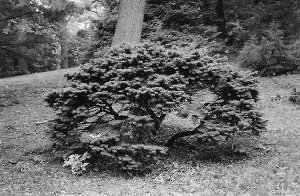
Q7. Hypothesize why the Douglas fir in the image has its particular size and shape.
Background
Topic: Plant Morphology and Herbivory
This question asks you to generate hypotheses about how environmental factors (like herbivory) can influence plant form and hormone signaling.
Key Terms:
Herbivory: Consumption of plant parts by animals (e.g., deer).
Apical dominance: Suppression of lateral growth by the apical meristem.
Auxin: Hormone produced in the apical meristem that inhibits lateral bud growth.
Step-by-Step Guidance
Observe the plant's shape in the image (bushy, lacking a tall central leader).
Recall what happens when the apical meristem is repeatedly removed (e.g., by deer browsing).
Connect the loss of apical dominance to increased lateral (sideways) growth.
Formulate a hypothesis about the relationship between herbivory, hormone signaling, and plant morphology.
Try solving on your own before revealing the answer!
