 Back
Backch 44
Study Guide - Smart Notes
 Tailored notes based on your materials, expanded with key definitions, examples, and context.
Plant Structure and Organization
Overview of Plant Body Organization
Flowering plants are composed of two main organ systems: the root system and the shoot system. Each system contains specialized structures that perform essential functions for plant survival and reproduction.
Root System: Anchors the plant, absorbs water and minerals, stores nutrients, and interacts with soil organisms.
Shoot System: Includes stems, leaves, buds, flowers, and fruits; responsible for photosynthesis, reproduction, and transport of materials.
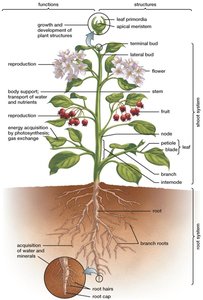
Principal Structures of the Shoot System
Stems: Support leaves and reproductive structures; contain nodes (where leaves attach) and internodes (spaces between nodes).
Buds: Embryonic shoots that can develop into branches or flowers.
Leaves: Main sites of photosynthesis; consist of a blade and petiole.
Flowers and Fruits: Flowers produce seeds; fruits protect and help disperse seeds.
Monocots vs. Dicots
Flowering plants are classified as monocots or dicots based on structural differences:
Monocots: One cotyledon, long thin leaves, fibrous roots (e.g., grasses, lilies).
Dicots: Two cotyledons, broad leaves, taproot system (e.g., beans, roses).
Plant Growth and Meristems
Types of Plant Cells and Growth
Plant growth is indeterminate, meaning most plants grow throughout their lives. Growth is driven by meristem cells (unspecialized, capable of division) and differentiated cells (specialized for specific functions).
Types of Meristems
Apical Meristems: Located at tips of roots and shoots; responsible for primary growth (lengthening).
Lateral Meristems: Found in concentric cylinders in stems and roots (mainly in dicots); responsible for secondary growth (thickening).
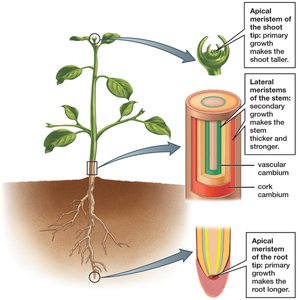
Plant Tissues and Tissue Systems
Ground Tissue System
The ground tissue system forms the bulk of young plants and consists of three main cell types:
Parenchyma: Thin-walled, living cells; perform photosynthesis, storage, and secretion.
Collenchyma: Living cells with unevenly thickened, flexible walls; provide support in young stems and leaves.
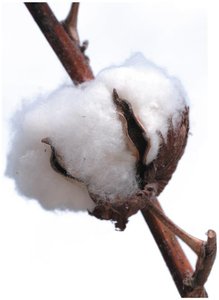
Sclerenchyma: Dead at maturity, with thick, lignified walls; provide rigid support (e.g., nut shells, gritty texture in pears).
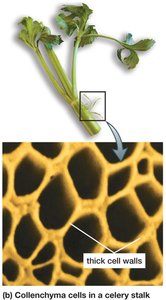
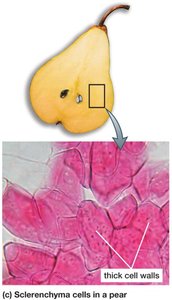
Dermal Tissue System
The dermal tissue system covers and protects the plant body:
Epidermis: Outermost layer; secretes a waxy cuticle to reduce water loss; may have trichomes (hair-like projections).
Periderm: Replaces epidermis in woody plants during secondary growth.
Vascular Tissue System
The vascular tissue system transports water, minerals, and organic molecules:
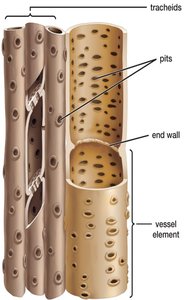
Xylem: Conducts water and minerals from roots to shoots; composed of tracheids and vessel elements (both dead at maturity).
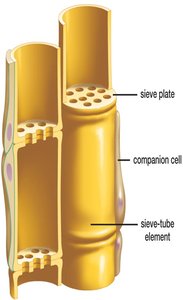
Phloem: Transports sugars and other organics; composed of sieve-tube elements (alive but lack nuclei) and companion cells (provide metabolic support).
Leaf Structure and Function
Leaf Anatomy
Leaves are specialized for photosynthesis and gas exchange:
Blade: Flat, broad portion for light capture.
Petiole: Stalk connecting blade to stem.
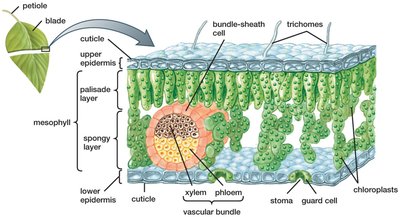
Veins: Vascular bundles containing xylem and phloem.
Epidermis: Transparent, with a waxy cuticle and stomata (pores for gas exchange, regulated by guard cells).
Mesophyll: Parenchyma cells with chloroplasts; divided into palisade (upper) and spongy (lower) layers.
Leaf Adaptations
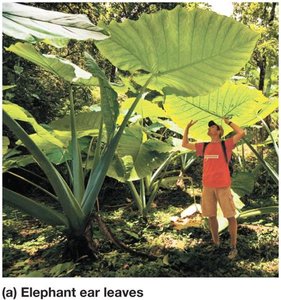
Large leaves: Found in plants from shady, moist environments (e.g., elephant ear leaves).
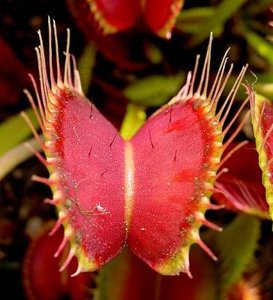
Carnivorous leaves: Modified to trap insects (e.g., Venus flytrap).
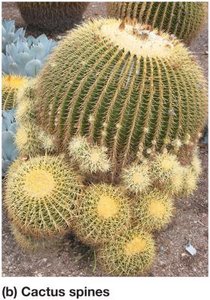
Spines: Modified leaves in cacti to reduce water loss and deter herbivores.
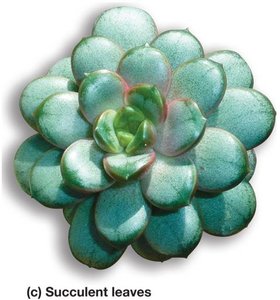
Succulent leaves: Store water in arid environments.
Bulbs: Thick, fleshy leaves for food storage (e.g., onion).
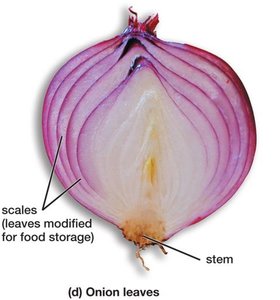
Stem Structure and Function
Stem Anatomy and Growth
Nodes: Points where leaves attach.
Internodes: Stem segments between nodes.
Primary Growth: Lengthening from apical meristems.
Secondary Growth: Thickening from lateral meristems (vascular cambium and cork cambium).
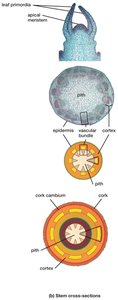
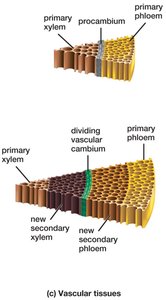
Woody Stems and Bark
Vascular Cambium: Produces secondary xylem (wood) and secondary phloem.
Cork Cambium: Produces cork cells for protection.
Bark: All tissues outside the vascular cambium (phloem, cork cambium, cork).
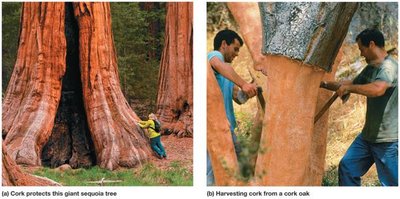
Specialized Stems
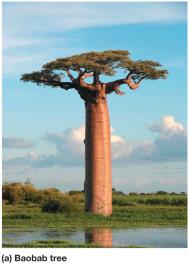
Water storage: Baobab tree trunk stores water.
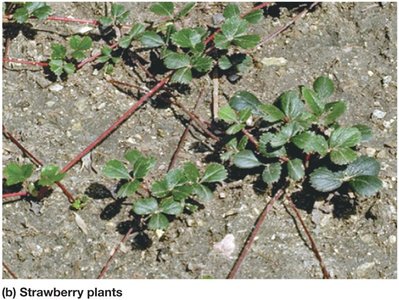
Runners: Horizontal stems for asexual reproduction (e.g., strawberry).
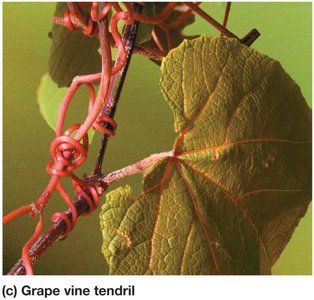
Tendrils: Climbing structures (e.g., grapevine).
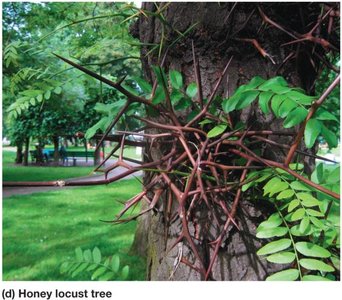
Thorns: Defensive structures (e.g., honey locust).
Root Structure and Function
Root Systems
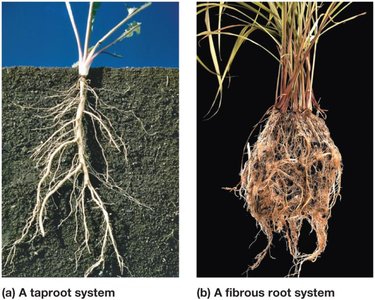
Taproot System: Single main root with lateral branches (common in dicots).
Fibrous Root System: Many similarly sized roots (common in monocots).
Root Anatomy
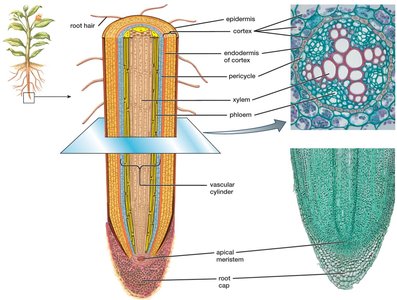
Root Cap: Protects apical meristem as root grows through soil.
Zones: Cell division (apical meristem), elongation, and maturation.
Epidermis: Absorbs water and minerals; root hairs increase surface area.
Cortex: Stores food and regulates mineral entry.
Vascular Cylinder: Contains xylem and phloem for transport.
Plant Nutrition and Transport
Acquisition of Water and Minerals
Roots absorb water and minerals from soil; only dissolved minerals can be taken up.
Water and minerals move through extracellular (cell wall) and intracellular (through cells) pathways to the vascular cylinder.
The Casparian strip in the endodermis forces water and minerals to cross cell membranes, allowing selective uptake.
Transport in Xylem: Cohesion-Tension Mechanism
Water moves upward due to transpiration (evaporation from leaves), cohesion (water molecules stick together), and tension (pull from above).
Minerals are carried with water in the xylem.
Stomatal Regulation
Stomata control gas exchange and water loss; opening and closing is regulated by guard cells in response to environmental cues (CO2 levels, light, dehydration).
Water movement in guard cells is driven by osmosis, regulated by potassium ion (K+) concentration.
Transport in Phloem: Pressure-Flow Mechanism
Sugars produced in leaves (sources) are transported to areas of use or storage (sinks) via phloem.
Water follows sugar into sieve tubes by osmosis, creating pressure that drives flow toward sinks.
Symbiotic Relationships for Nutrient Acquisition
Nitrogen-fixing bacteria in root nodules convert atmospheric nitrogen to usable forms for plants (e.g., legumes).
Mycorrhizal fungi enhance water and mineral absorption.
Summary Table: Major Plant Tissue Systems
Tissue System | Main Cell Types | Functions |
|---|---|---|
Ground | Parenchyma, Collenchyma, Sclerenchyma | Photosynthesis, storage, support |
Dermal | Epidermis, Periderm | Protection, water retention, gas exchange |
Vascular | Xylem (tracheids, vessel elements), Phloem (sieve-tube elements, companion cells) | Transport of water, minerals, and sugars |
Additional info: This guide integrates foundational concepts from plant anatomy, physiology, and adaptations, suitable for college-level biology students preparing for exams or coursework.
