 Back
Plants and the Conquest of Land: Gymnosperms, Angiosperms, and Evolutionary Innovations
Study Guide - Smart Notes
 Tailored notes based on your materials, expanded with key definitions, examples, and context.
Plants and the Conquest of Land
Introduction to the Age of Gymnosperms
The transition from aquatic to terrestrial environments marked a significant evolutionary step for plants. During the Carboniferous period, the removal of atmospheric CO2 by lycophytes and pteridophytes led to global climate changes, favoring the rise of seed plants, particularly gymnosperms. Gymnosperms dominated Earth's vegetation during the Mesozoic era, adapting to cooler and drier climates.
Key Point: Gymnosperms diversified as a result of environmental changes that led to the decline of earlier plant groups.
Key Point: Seed plants, including gymnosperms, possess adaptations that allow them to thrive in terrestrial habitats.
Evolutionary Relationships Among Land Plants
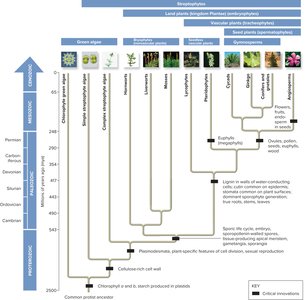
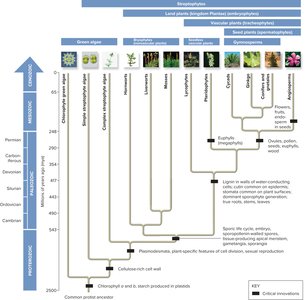
Understanding the evolutionary relationships among land plants reveals the critical innovations that enabled their success on land. The phylogenetic tree highlights the divergence of major plant groups and the appearance of key adaptations such as seeds, vascular tissue, and flowers.
Critical Innovations: Development of vascular tissue, seeds, pollen, and flowers.
Descent with Modification: Seed plants did not replace spores but added ovules and seeds to their life cycle, enhancing reproductive success.
Gymnosperms
Characteristics and Diversity
Gymnosperms are seed plants that reproduce using both spores and seeds. Their seeds are termed "naked" because they are not enclosed by fruit. Major gymnosperm groups include cycads, ginkgos, conifers, and gnetophytes.
Key Features: Seeds provide protection and nourishment for the developing sporophyte.
Reproductive Adaptation: Pollen grains (male gametophytes) produce nonmotile sperm, allowing fertilization without water.
Phylum Coniferophyta (Conifers)
Includes pines, spruces, and firs.
Woody reproductive cones; most are evergreen with needle-like leaves.
Produce resin for protection.
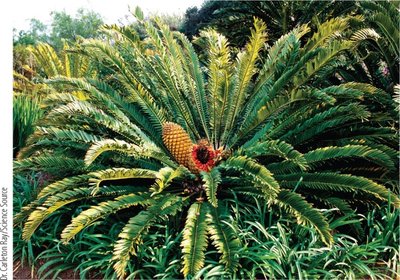
Phylum Cycadophyta (Cycads)
Shrubby or treelike plants with palmlike leaves.
Large, cone-shaped strobili; restricted to warmer climates.
Phylum Ginkgophyta (Ginkgoes)
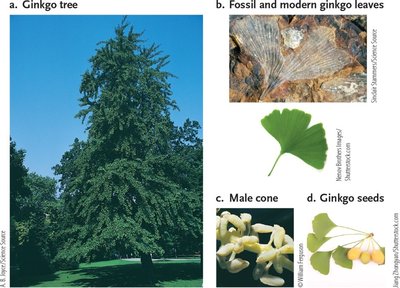
Only one living species: Ginkgo biloba.
Fan-shaped leaves; unique among seed plants.
Seedless Vascular Plants vs. Seed Plants
Most seedless vascular plants are homosporous, producing one type of spore. Some are heterosporous, producing microspores and megaspores, which develop into protected gametophytes within the spore wall (endosporic development). Heterospory increases the likelihood of cross-fertilization.
Gymnosperm Reproduction and Seed Development
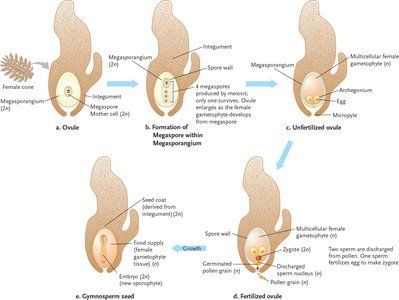
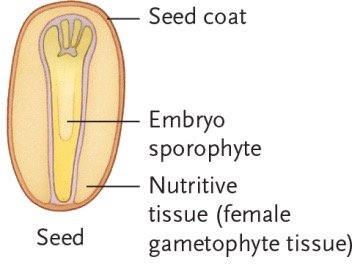
Gymnosperms retain haploid spores within reproductive structures. Pollination involves the transfer of pollen to female reproductive parts, eliminating the need for water. The ovule contains the egg, which is protected by integument and megasporangial tissues. Upon fertilization, the ovule becomes a seed, containing the embryo, nutritive tissue, and a protective seed coat.
Pollination: Transfer of pollen to ovule; does not require water.
Seed Advantages: Protection, nourishment, dormancy, and dispersal.
Angiosperms
Characteristics and Diversity
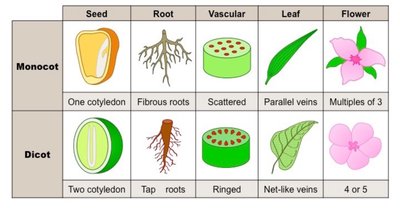
Angiosperms, or flowering plants, are distinguished by their flowers and fruits. Their seeds are enclosed within a fruit, which develops from the carpel. Angiosperms are divided into two major groups: monocots and eudicots.
Monocots: One cotyledon, parallel-veined leaves, scattered vascular bundles (e.g., grasses, lilies).
Eudicots: Two cotyledons, net-veined leaves, vascular bundles in a ring (e.g., roses, beans).
Reproductive Adaptations
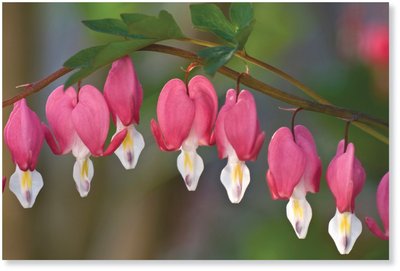
Flowers are specialized reproductive structures that facilitate pollination, often involving animal pollinators. Fruits develop from flowers and aid in seed dispersal. Angiosperms also possess endosperm, a nutritive tissue that supports embryo development.
Seed Development in Angiosperms
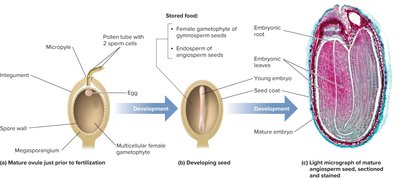
Angiosperms undergo double fertilization: one sperm fertilizes the egg to form the embryo, while another fuses with gametophyte tissue to form the endosperm. The ovule's integument becomes the seed coat, providing protection.
Angiosperm Adaptations
Efficient water and nutrient transport via vessel elements and phloem.
Double fertilization increases storage efficiency.
Ovary protects ovule and develops into fruit.
Co-evolution with Animal Pollinators
Many angiosperms have evolved specific relationships with animal pollinators, resulting in co-evolution. Changes in one partner drive adaptations in the other, leading to highly specialized flowers and pollination mechanisms.
Pollinators include insects, bats, birds, etc.
Co-evolution enhances reproductive success and diversity.
Evolutionary Innovations in Land Plants
Key Differences from Charophycean Ancestors
Land plants evolved several critical innovations absent in their green algal ancestors (charophyceans), including multicellular embryos, retention of embryos in maternal tissue, and specialized placental transfer tissues for nutrient supply.
Impact of Land Plants on Earth
The origin and diversification of land plants transformed Earth's surface and atmosphere, leading to the development of soils, increased atmospheric oxygen, and the evolution of modern ecosystems. The colonization of land by plants paved the way for animal life on land.
Summary Table: Comparison of Monocots and Dicots
Seed | Root | Vascular | Leaf | Flower | |
|---|---|---|---|---|---|
Monocot | One cotyledon | Fibrous roots | Scattered | Parallel veins | Multiples of 3 |
Dicot | Two cotyledons | Tap roots | Ringed | Net-like veins | 4 or 5 |
Key Terms and Concepts
Gymnosperm: Seed plant with "naked" seeds not enclosed by fruit.
Angiosperm: Flowering plant with seeds enclosed in fruit.
Ovule: Structure in seed plants where the female gametophyte develops.
Pollination: Transfer of pollen to the ovule for fertilization.
Double Fertilization: Unique to angiosperms; produces both embryo and endosperm.
Endosperm: Nutritive tissue in angiosperm seeds.
Heterospory: Production of two types of spores (microspores and megaspores).
Co-evolution: Reciprocal evolutionary changes between interacting species.
Formulas and Equations
Meiosis in Sporophyte Generation:
Double Fertilization in Angiosperms: (embryo formation) (endosperm formation)
Additional info: This guide integrates evolutionary, anatomical, and reproductive innovations that enabled the success of seed plants on land, with emphasis on gymnosperms and angiosperms.
