 Back
Plasma Membrane Structure and Function
Study Guide - Smart Notes
 Tailored notes based on your materials, expanded with key definitions, examples, and context.
Plasma Membrane Structure
Overview of the Plasma Membrane
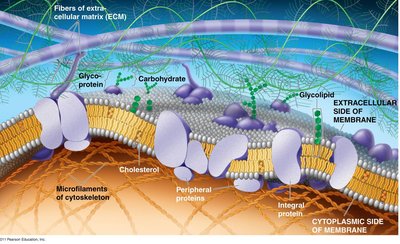
The plasma membrane is a fundamental structure found in all cells, including plant, animal, and bacterial cells. It serves as a selective barrier, mediating the transport of molecules into and out of the cell, and is essential for maintaining cellular homeostasis. The plasma membrane is organized according to the Fluid Mosaic Model, which describes its flexible, dynamic nature and the diverse components that move within it.
Key Functions: Regulates molecular traffic, maintains internal environment, and facilitates communication with the external environment.
Main Components: Lipids, proteins, and carbohydrates.
Phospholipids: The Main Membrane Component
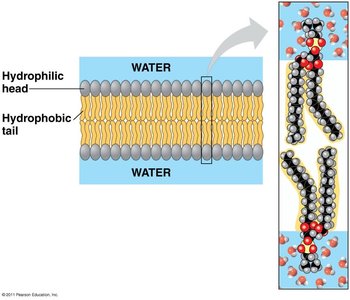
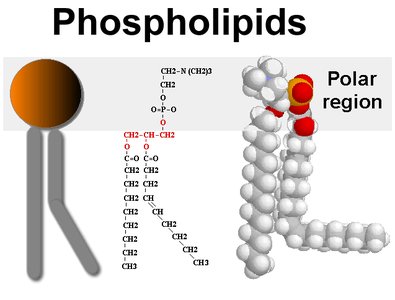
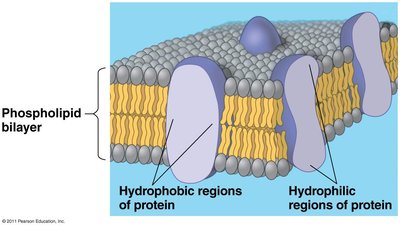
Phospholipids are the primary structural molecules of the plasma membrane. Each phospholipid is amphipathic, containing both a hydrophilic (water-attracting) head and hydrophobic (water-repelling) tails. This dual nature drives the formation of a bilayer, with hydrophobic tails facing inward and hydrophilic heads facing outward toward aqueous environments.
Bilayer Formation: Creates a semi-permeable barrier that restricts the passage of most water-soluble substances.
Role in Transport: Controls the movement of many substances across the membrane.
Membrane Proteins
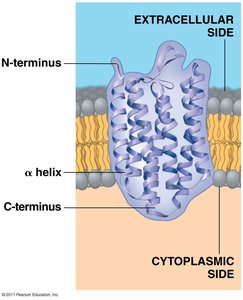
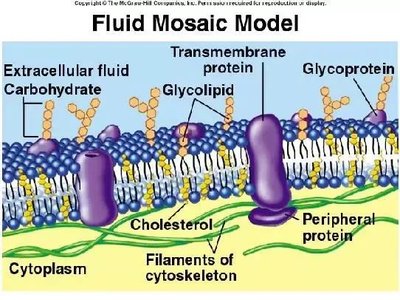
Proteins are interspersed throughout the plasma membrane and serve a variety of functions. They can be classified as integral (spanning the membrane) or peripheral (attached to one side of the membrane).
Integral Proteins: Usually span the entire bilayer, with regions exposed on both the extracellular and cytoplasmic sides. These proteins are often amphipathic, with hydrophobic regions embedded in the bilayer and hydrophilic regions exposed to the aqueous environment.
Peripheral Proteins: Loosely attached to the membrane surface, often interacting with integral proteins or the cytoskeleton.
Functions of Membrane Proteins
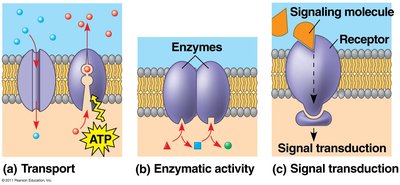
Transport: Facilitate the movement of substances across the membrane (channels, carriers).
Enzymatic Activity: Catalyze specific reactions at the membrane surface.
Signal Transduction: Relay signals from the external environment to the cell's interior.
Cell-Cell Recognition: Allow cells to identify each other via glycoproteins.
Intercellular Joining: Connect adjacent cells.
Attachment to Cytoskeleton and ECM: Maintain cell shape and stabilize membrane location.
Carbohydrates in the Plasma Membrane
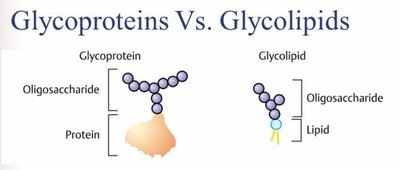
Carbohydrates are present as short chains attached to lipids (glycolipids) or proteins (glycoproteins) on the extracellular surface of the membrane. These structures are crucial for cell recognition, signaling, and interactions with the extracellular matrix (ECM).
Glycolipids: Carbohydrate chains attached to lipids.
Glycoproteins: Carbohydrate chains attached to proteins.
Function: Serve as cellular fingerprints (e.g., blood types, organ recognition).
The Fluid Mosaic Model
Concept and Evidence
The Fluid Mosaic Model describes the plasma membrane as a mosaic of various molecules (phospholipids, proteins, carbohydrates, cholesterol) that are able to move laterally within the layer, giving the membrane its fluid nature. This model replaced earlier models that depicted the membrane as a static structure.
Mosaic: Refers to the diverse array of molecules embedded in the lipid bilayer.
Fluidity: Components are not fixed in place and can move within the plane of the membrane.
Experimental Evidence: Freeze-Fracture Technique
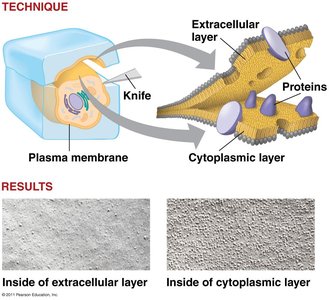
The freeze-fracture technique involves freezing and splitting the membrane to reveal the distribution of proteins within the bilayer. Electron microscopy shows proteins scattered throughout the membrane, supporting the fluid mosaic concept.
Membrane Fluidity
Phospholipid Movement
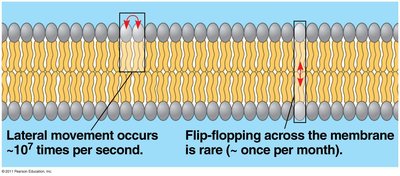
Phospholipids can move laterally within the same layer of the bilayer, which occurs frequently, while flip-flop movement (between layers) is rare. This lateral movement is essential for membrane flexibility and function.
Lateral Movement: Occurs rapidly and frequently.
Flip-Flop: Rare, energetically unfavorable without enzymes (flippases).
Protein Mobility
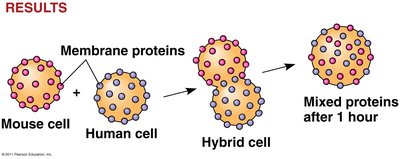
Membrane proteins can also move within the bilayer, contributing to the dynamic nature of the membrane. Experiments with hybrid cells demonstrate the mixing of membrane proteins over time.
Factors Affecting Fluidity
Temperature: Lower temperatures decrease fluidity as phospholipids pack more tightly; higher temperatures increase fluidity.
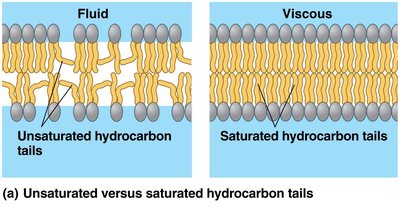
Lipid Composition: Unsaturated hydrocarbon tails (with double bonds) prevent tight packing, increasing fluidity; saturated tails pack closely, making the membrane more viscous.
Role of Cholesterol
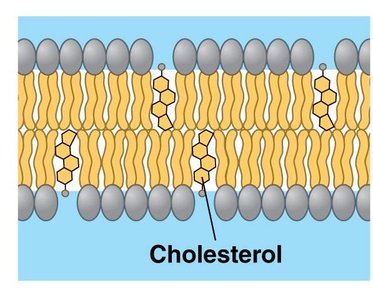
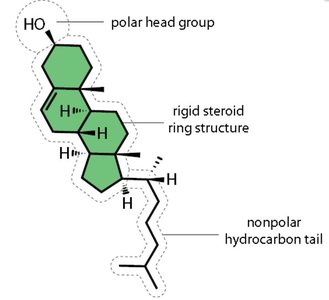
Cholesterol acts as a fluidity buffer in animal cell membranes. At body temperature, it restrains phospholipid movement, making the membrane less fluid. At lower temperatures, it prevents tight packing, thus maintaining fluidity and preventing solidification.
Buffering Effect: Maintains optimal membrane consistency across temperature changes.
Lipid Bilayer Sidedness and Membrane Asymmetry
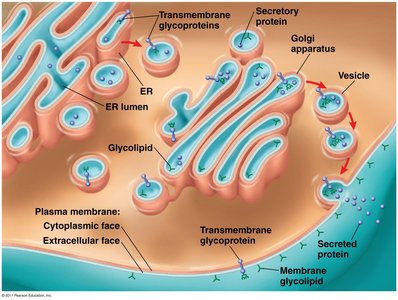
Each side of the lipid bilayer has a unique composition of lipids, proteins, and carbohydrates. The orientation of these molecules is established during membrane synthesis in the endoplasmic reticulum (ER) and Golgi apparatus and is maintained as vesicles fuse with the plasma membrane.
Asymmetry: Essential for specific membrane functions, such as cell signaling and recognition.
Membrane Synthesis: The inside of the ER, Golgi, and vesicles corresponds to the outside of the plasma membrane after fusion.
Summary Table: Major Components of the Plasma Membrane
Component | Structure | Main Function |
|---|---|---|
Phospholipids | Amphipathic molecules forming a bilayer | Barrier, fluidity, selective permeability |
Proteins (Integral & Peripheral) | Embedded or attached to the bilayer | Transport, signaling, structure, enzymatic activity |
Carbohydrates (Glycolipids & Glycoproteins) | Sugar chains attached to lipids or proteins | Cell recognition, signaling, protection |
Cholesterol | Steroid molecule interspersed in bilayer | Regulates fluidity and stability |
Key Terms
Amphipathic: Molecule with both hydrophilic and hydrophobic regions.
Fluid Mosaic Model: Describes the dynamic and heterogeneous structure of the plasma membrane.
Integral Protein: Protein that spans the membrane.
Peripheral Protein: Protein attached to one side of the membrane.
Glycolipid: Lipid with a carbohydrate chain attached.
Glycoprotein: Protein with a carbohydrate chain attached.
Cholesterol: Steroid that modulates membrane fluidity.
