 Back
BackPlasma Membrane Structure and Transport Mechanisms
Study Guide - Smart Notes
 Tailored notes based on your materials, expanded with key definitions, examples, and context.
Plasma Membrane: Structure and Function
Composition of the Plasma Membrane
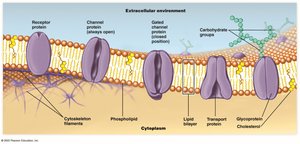
The plasma membrane is the outermost envelope of a cell, maintaining its integrity and providing organized metabolic areas. It is approximately 3.5 nanometers thick and is primarily composed of a phospholipid bilayer, which allows interaction between the intracellular and extracellular environments. The three main components of the plasma membrane are:
Phospholipids: Lipids with a polar head and two non-polar tails, forming the bilayer structure.
Cholesterol: Increases the strength and rigidity of the membrane.
Proteins: Embedded in the membrane, these assist with movement of materials and communication between cells.
Functions of the Plasma Membrane
The plasma membrane acts as a selectively permeable barrier, regulating the movement of substances in and out of the cell. It also facilitates communication between cells and maintains distinct metabolic environments.
Selective permeability: Allows certain substances to pass while restricting others.
Cell communication: Embedded proteins transmit signals and facilitate recognition.
Structural support: Cholesterol and cytoskeletal elements provide stability.
Embedded Proteins in the Plasma Membrane
Types and Roles of Embedded Proteins
Various proteins are embedded within the plasma membrane, each serving specific functions:
Receptor proteins: Extend through the membrane and transmit information by binding signaling molecules, triggering internal cellular responses.
Channel proteins: Form open or gated channels for the movement of ions and water. Gated channels open only in response to specific signals.
Transport proteins: Facilitate the movement of specific molecules by changing shape to transport them across the membrane.
Glycoproteins: Proteins with carbohydrate groups attached, important for cell-to-cell recognition and communication.
Movement Across the Plasma Membrane
Overview of Transport Methods
The plasma membrane is selectively permeable and polar, allowing multiple methods for moving materials across it. The method used depends on the properties of the substance.
Passive transport: No energy required; includes diffusion and osmosis.
Active transport: Requires energy (ATP) to move substances against their concentration gradient.
Bulk transport: Includes endocytosis and exocytosis for moving large or multiple molecules.
Passive Transport Mechanisms
Diffusion
Diffusion is the movement of molecules from an area of high concentration to low concentration until equilibrium is achieved.
Simple diffusion: Small, uncharged, non-polar molecules (e.g., O2, CO2, urea) pass freely through the lipid bilayer.
Diffusion through channels: Water and ions move through protein channels; some channels are always open, others are gated.
Facilitated diffusion: Molecules bind to transport proteins, which change shape to move them across the membrane. Highly selective; glucose enters cells this way.
Osmosis
Osmosis is the diffusion of water across a selectively permeable membrane. Water moves from an area of high concentration to low concentration, often in the opposite direction of solute movement.
Highly permeable to water: Plasma membrane allows water to move freely.
Effect of solute concentration: Higher solute concentration means lower water concentration.
Active Transport Mechanisms
Active transport moves substances against their concentration gradient, requiring energy from ATP.
Membrane proteins act as pumps: Example: Sodium-potassium pump moves Na+ out and K+ into the cell.
Energy coupling: Passive transport of one molecule can power active transport of another.
Bulk Transport: Endocytosis and Exocytosis
Endocytosis
Endocytosis moves materials into the cell by forming a vesicle from the plasma membrane.
Selective and non-selective forms: Used for large molecules or bulk transport.
Examples: Insulin and certain enzymes enter cells via endocytosis.
Exocytosis
Exocytosis moves materials out of the cell by fusing a vesicle with the plasma membrane and releasing its contents.
Removes products and wastes: Products formed in the cell and toxic wastes are expelled this way.
Tonicity and Its Effects on Cells
Definition and Importance
Tonicity refers to the concentration of solutes in two fluids (inside and outside the cell). It determines the movement of water and the maintenance of cell volume.
Isotonic: Equal solute concentrations inside and outside; water movement is balanced.
Hypertonic: Higher solute concentration outside; water moves out, causing cell crenation (shrinking).
Hypotonic: Higher solute concentration inside; water moves in, causing cell lysis (bursting).
Effects on Red Blood Cells
Isotonic solution: Red blood cells maintain normal shape.
Hypertonic solution: Red blood cells lose water and shrink.
Hypotonic solution: Red blood cells gain water and may burst.
Summary Table: Transport Mechanisms Across the Plasma Membrane
Transport Method | Energy Required | Direction | Examples |
|---|---|---|---|
Simple Diffusion | No | High to Low | O2, CO2, urea |
Facilitated Diffusion | No | High to Low | Glucose, amino acids |
Osmosis | No | High to Low (water) | Water |
Active Transport | Yes (ATP) | Low to High | Na+/K+ pump |
Endocytosis | Yes | Into cell | Insulin, enzymes |
Exocytosis | Yes | Out of cell | Cellular products, wastes |
Key Equations
Diffusion Rate
The rate of diffusion can be described by Fick's Law: Where:
J: Diffusion flux
D: Diffusion coefficient
C: Concentration
x: Distance
Osmosis
Osmotic pressure is given by: Where:
\Pi: Osmotic pressure
i: van 't Hoff factor
M: Molarity
R: Gas constant
T: Temperature (Kelvin)
References
Johnson, M.D. (2017). Human biology: Concepts and current issues (8th ed). Pearson Education Inc.
Johnson, M.D. & Long, S (2021). Human biology: Concepts and current issues (9th ed). Pearson Education Inc.
