 Back
BackPoint Mutations and Their Effects on Protein Synthesis
Study Guide - Smart Notes
 Tailored notes based on your materials, expanded with key definitions, examples, and context.
Point Mutations in Protein Synthesis
Definition and Types of Point Mutations
Point mutations are genetic alterations that involve changes in a single nucleotide base pair within a gene. These mutations can significantly impact the process of protein synthesis, leading to various outcomes depending on the nature of the change.
Base–pair substitutions: Replacement of one nucleotide and its partner with another pair.
Base–pair insertions or deletions: Addition or loss of nucleotide pairs in a gene.
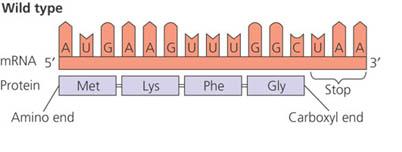
Base–Pair Substitution
A base–pair substitution occurs when one nucleotide and its complementary partner are replaced by another pair. The effects of such mutations depend on how the change alters the codon and, consequently, the amino acid sequence of the protein.
Silent mutation: The altered codon codes for the same amino acid, resulting in no change to the protein.
Missense mutation: The altered codon codes for a different amino acid, potentially affecting protein function.
Nonsense mutation: The altered codon becomes a stop codon, causing premature termination of translation.
Little effect: The new amino acid may have similar properties or be located in a non-essential region of the protein.
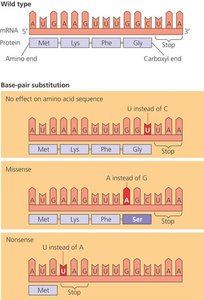
Silent Mutations
Silent mutations occur when a change in a base pair alters a codon, but both codons translate into the same amino acid. This results in no change to the protein's structure or function.
Example: If the DNA template strand changes from 3′–CCG–5′ to 3′–CCA–5′, the mRNA codon changes from GGC to GGU, but both code for glycine.
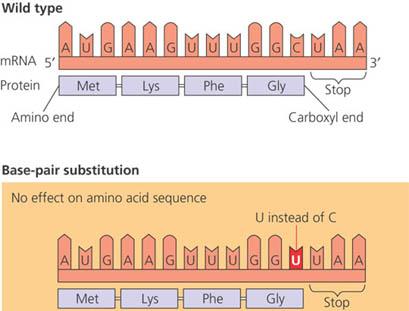
Missense Mutations
Missense mutations result in a codon that codes for a different amino acid. The protein may still be functional, but its activity or structure could be altered.
Example: Substitution of A for G in a codon changes the encoded amino acid from glycine to serine.
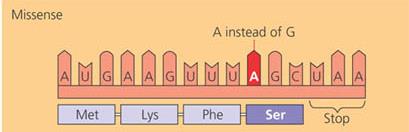
Nonsense Mutations
Nonsense mutations occur when a point mutation changes a codon for an amino acid into a stop codon. This leads to premature termination of translation and usually results in a nonfunctional protein.
Effect: The polypeptide is shorter than normal, often leading to loss of function.
Base–Pair Insertions and Deletions
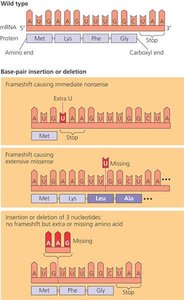
Insertions and deletions involve the addition or loss of nucleotide pairs in a gene. These mutations can disrupt the reading frame of the mRNA, leading to frameshift mutations.
Frameshift mutation: Occurs when the number of nucleotides inserted or deleted is not a multiple of three, causing all subsequent codons to be misread.
Effect: Extensive missense and often premature termination, usually resulting in a nonfunctional protein.
Insertion/deletion of three nucleotides: May add or remove an amino acid without causing a frameshift.
Hereditary Diseases Caused by Point Mutations
Point mutations in gametes or cells that give rise to gametes can be transmitted to offspring, potentially causing hereditary diseases. If the mutation adversely affects the phenotype, it is classified as a genetic disorder.
Example: Sickle–cell disease is caused by a missense mutation in the hemoglobin gene, resulting in the substitution of valine for glutamic acid.

Spontaneous Mutations and Mutagens
Spontaneous mutations arise from errors during DNA replication, repair, or recombination. Mutagens are physical or chemical agents that increase the mutation rate.
Physical mutagens: X-rays, ultraviolet (UV) light.
Chemical mutagens: Base analogs, chemicals that distort the DNA helix or alter base pairing.
Carcinogens: Most mutagens are also carcinogenic, meaning they can cause cancer.
Genetic Code Table
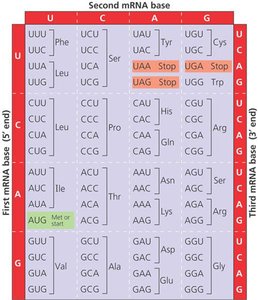
The genetic code table is used to determine which amino acid is specified by each mRNA codon. It is essential for understanding the effects of mutations on protein synthesis.
Summary Table: Types of Point Mutations and Their Effects
Type of Mutation | Effect on Protein | Example |
|---|---|---|
Silent | No change in amino acid | GGC to GGU (both glycine) |
Missense | Change in amino acid | GAG to GUG (glutamic acid to valine) |
Nonsense | Premature stop codon | UAA, UAG, UGA |
Frameshift | Extensive missense, premature stop | Insertion/deletion not a multiple of three |
Key Equations and Concepts
Mutation Rate: About 1 nucleotide in every is altered and passed on to the next generation of cells.
Frameshift Mutation: where is the number of nucleotides inserted or deleted.
