 Back
Polymerase Chain Reaction (PCR): Principles, Applications, and Interpretation
Study Guide - Smart Notes
 Tailored notes based on your materials, expanded with key definitions, examples, and context.
Polymerase Chain Reaction (PCR): Principles and Steps
Overview of PCR
The Polymerase Chain Reaction (PCR) is a molecular biology technique used to amplify specific DNA sequences, generating millions of copies from a small initial sample. PCR is fundamental in research, diagnostics, and forensic science due to its sensitivity and specificity.
Key Steps of PCR
Denaturation: The double-stranded DNA is heated (typically to 94–98°C) to separate it into single strands.
Annealing: The temperature is lowered (usually 50–65°C) to allow short DNA primers to bind (anneal) to their complementary sequences on the template strands.
Extension (Elongation): DNA polymerase synthesizes new DNA strands by adding nucleotides (dNTPs) to the primers, extending the DNA in the 5' to 3' direction.
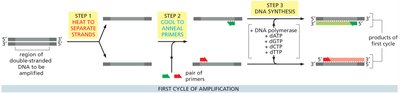
Each cycle of PCR doubles the amount of target DNA, leading to exponential amplification. The process is repeated for 20–40 cycles.
Required Reagents for PCR
Template DNA: The DNA sample containing the target sequence to be amplified.
DNA Polymerase: A thermostable enzyme (e.g., Taq polymerase) that synthesizes new DNA strands.
dNTPs (Deoxyribonucleotide Triphosphates): Building blocks (A, T, G, C) for new DNA synthesis.
Primers: Short, single-stranded DNA sequences (forward and reverse) that define the region to be amplified.
Buffer Solution: Maintains optimal conditions for enzyme activity.
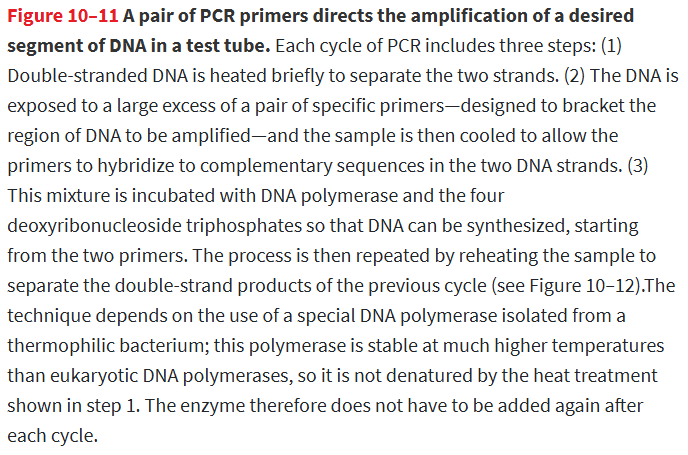
Mechanism of PCR Amplification
Each PCR cycle consists of three main steps, and the products of one cycle serve as templates for the next. This leads to exponential amplification of the target sequence.
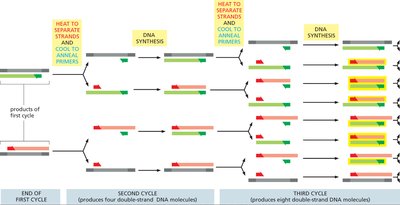
Equation for DNA Amplification:
After n cycles, the theoretical number of DNA copies is:
where is the initial number of DNA molecules and is the number of cycles.
Applications of PCR
PCR in Research
Genotyping: Verification of genetic modifications (knockout/knock-in models).
Gene Cloning: Amplification of specific genes for further study.
PCR in Diagnostics
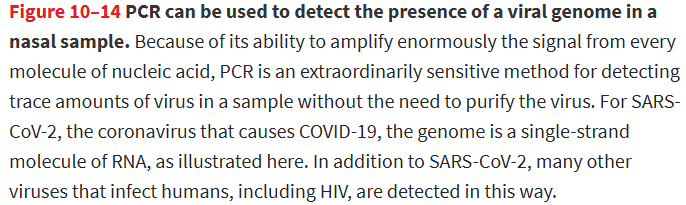
PCR is widely used to detect the presence of pathogens, such as viruses, in clinical samples. For example, detection of SARS-CoV-2 (COVID-19) involves reverse transcription of viral RNA to cDNA, followed by PCR amplification and analysis.
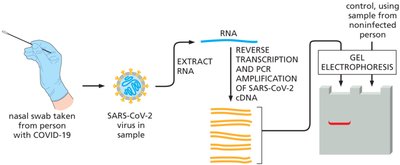
Additional info: Reverse transcription PCR (RT-PCR) is used for RNA viruses, converting RNA to cDNA before amplification.
PCR in Forensic Science
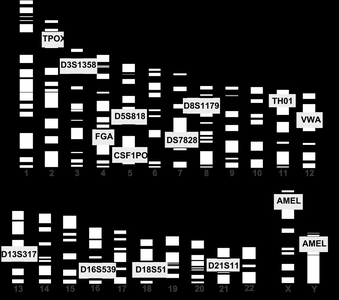
PCR enables the analysis of Short Tandem Repeats (STRs)—highly variable DNA regions used for individual identification. STR analysis is the basis of DNA fingerprinting, which is crucial in criminal investigations and paternity testing.
Each individual inherits different numbers of repeats at each STR locus from their parents, resulting in a unique DNA profile.
Interpretation of PCR Results
Gel Electrophoresis
After PCR, the amplified DNA fragments are separated by size using gel electrophoresis. The pattern of bands indicates the presence and size of the amplified products, allowing for comparison between samples.
Electropherograms
In forensic and diagnostic applications, capillary electrophoresis produces an electropherogram, a graphical representation of DNA fragment sizes and quantities. Each peak corresponds to an allele at a specific STR locus.
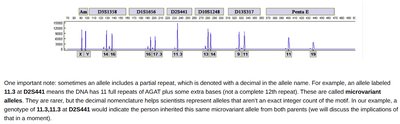
For example, at the D3S1358 locus, an individual may have alleles with 14 and 16 AGAT repeats, inherited from each parent.
Summary Table: Key Components and Steps of PCR
Step | Temperature | Purpose |
|---|---|---|
Denaturation | 94–98°C | Separates double-stranded DNA into single strands |
Annealing | 50–65°C | Allows primers to bind to complementary sequences |
Extension | 72°C | DNA polymerase synthesizes new DNA strands |
Key Terms and Concepts
Template DNA: The DNA sequence to be amplified.
Primers: Short DNA sequences that define the start and end points for amplification.
Taq Polymerase: A thermostable DNA polymerase from Thermus aquaticus.
dNTPs: Deoxyribonucleotide triphosphates (A, T, G, C) used as substrates for DNA synthesis.
STR (Short Tandem Repeat): Repeated DNA sequences used in genetic profiling.
Electropherogram: A plot showing the results of capillary electrophoresis, used to analyze DNA fragments.
Applications and Importance
Research: Gene cloning, mutagenesis, and genetic analysis.
Diagnostics: Detection of infectious diseases (e.g., COVID-19, HIV).
Forensics: Individual identification, paternity testing, and criminal investigations.
