 Back
Polymerase Chain Reaction (PCR): Principles, Applications, and Interpretation
Study Guide - Smart Notes
 Tailored notes based on your materials, expanded with key definitions, examples, and context.
PCR: Polymerase Chain Reaction
Principles and Steps of PCR
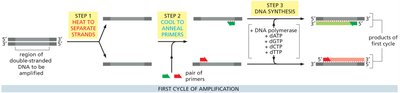
The Polymerase Chain Reaction (PCR) is a fundamental technique in molecular biology used to amplify specific DNA sequences. PCR consists of repeated cycles, each with three main steps: denaturation, annealing, and extension. This process enables the exponential amplification of a target DNA region, making it detectable and analyzable for various applications.
Step 1: Denaturation – The double-stranded DNA is heated (typically 94–98°C) to separate the strands.
Step 2: Annealing – The temperature is lowered (usually 50–65°C) to allow primers to bind (anneal) to their complementary sequences on the single-stranded DNA.
Step 3: Extension – DNA polymerase synthesizes new DNA strands by adding nucleotides (dNTPs) to the primers, extending the DNA in the 5' to 3' direction.
Example: PCR is used to amplify a gene of interest for cloning or diagnostic purposes.
Required Reagents for PCR
Several key reagents are essential for successful PCR amplification:
Template DNA – The DNA sequence to be amplified.
DNA Polymerase – Usually Taq polymerase, which is thermostable and can withstand high denaturation temperatures.
dNTPs (deoxyribonucleotide triphosphates) – The building blocks for new DNA synthesis (dATP, dGTP, dCTP, dTTP).
Primers – Short, single-stranded DNA sequences that define the region to be amplified; a forward and a reverse primer are required.
Buffer – Maintains optimal conditions for enzyme activity.
Mechanism of DNA Amplification
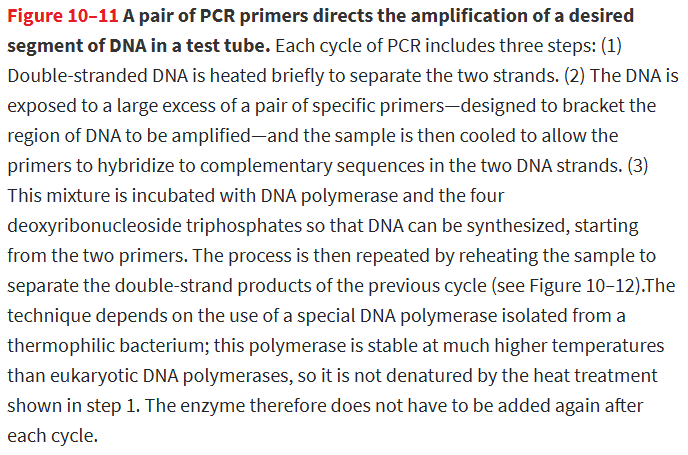
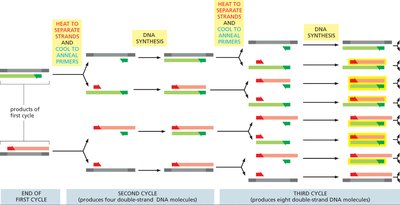
Each PCR cycle doubles the amount of target DNA, leading to exponential amplification. The newly synthesized DNA fragments serve as templates in subsequent cycles, resulting in a rapid increase in the number of DNA molecules matching the target sequence.
Exponential Amplification: After n cycles, the number of DNA molecules is approximately .
Specificity: Primers ensure that only the desired DNA region is amplified.
Endogenous Controls in PCR
Endogenous controls are internal reference genes or sequences included in PCR reactions to verify the integrity of the sample and the efficiency of the amplification process. They help distinguish between true negative results and technical failures.
Example: Housekeeping genes (e.g., GAPDH, ACTB) are often used as endogenous controls in quantitative PCR.
Gel Electrophoresis: Components and Interpretation
Gel electrophoresis is a technique used to separate DNA fragments by size after PCR amplification. The DNA samples are loaded into a gel matrix and subjected to an electric field, causing the fragments to migrate according to their length.
Agarose Gel: The most common matrix for DNA separation.
Ethidium Bromide: A dye used to visualize DNA bands under UV light.
Ladder: A DNA size marker for comparison.
Interpretation: The presence, absence, and size of bands indicate successful amplification and the length of the PCR product.
Electropherogram: Basics
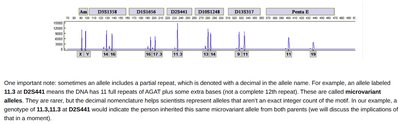
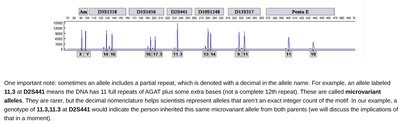
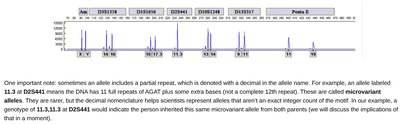
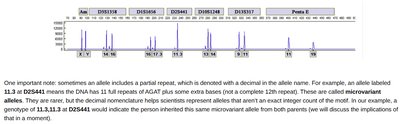
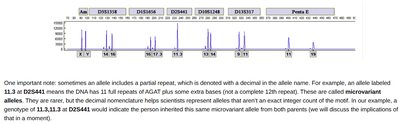
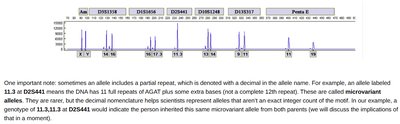
An electropherogram is a graphical representation of DNA fragment separation, often used in capillary electrophoresis. Peaks correspond to DNA fragments of specific sizes, allowing for precise analysis of genetic markers, such as STRs in forensic applications.
Applications of PCR
Research Applications
PCR is widely used in research for genotyping, gene knockout/knock-in verification, and detection of genetic modifications.
Knockout/Knock-in Verification: PCR can confirm the presence or absence of specific genetic modifications in experimental organisms.
Band or No Band: The presence of a band indicates successful amplification of the target sequence.
Diagnostic Applications
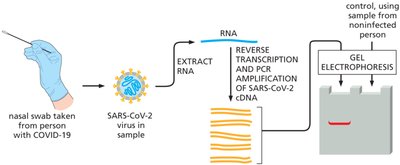
PCR is a sensitive method for detecting pathogens, including viruses, in clinical samples. For example, PCR is used to detect SARS-CoV-2 (COVID-19) by amplifying viral RNA after reverse transcription.
Reverse Transcription PCR (RT-PCR): Converts viral RNA to cDNA before amplification.
Gel Electrophoresis: Confirms the presence of viral genetic material.
Forensic Applications
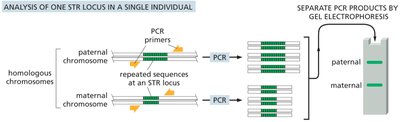
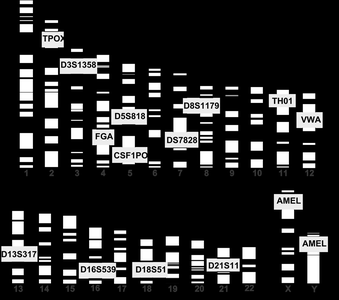
PCR is essential in forensic science for DNA fingerprinting and identification. Short Tandem Repeats (STRs) are analyzed to distinguish individuals based on the number of repeat sequences at specific loci.
STR Analysis: PCR amplifies STR loci, and gel electrophoresis separates the fragments by size.
DNA Fingerprinting: Unique patterns of STRs are used to identify individuals.
Probability: The chance of two unrelated individuals sharing the same DNA fingerprint at multiple loci is extremely low (e.g., 1 in 10 billion for 5–10 loci).
Interpretation of STR Profiles and Electropherograms
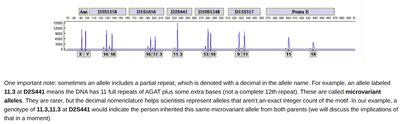
Each STR locus is analyzed for the number of repeat units, which is expressed as an allele number. Electropherograms display peaks corresponding to each allele, allowing for comparison between individuals.
Allele Number: Indicates the number of repeat units at a locus (e.g., 14 or 16 AGAT repeats).
Microvariant Alleles: Alleles with partial repeats, denoted with decimals (e.g., 11.3).
Combined Profile: Multiple loci are analyzed to create a unique DNA fingerprint.
Summary Table: PCR Steps and Reagents
Step | Purpose | Key Reagents |
|---|---|---|
Denaturation | Separates DNA strands | Heat |
Annealing | Primers bind to target | Primers |
Extension | DNA synthesis | DNA polymerase, dNTPs |
Summary Table: Applications of PCR
Application | Purpose | Example |
|---|---|---|
Research | Genotyping, gene editing | Knockout verification |
Diagnostics | Pathogen detection | COVID-19 testing |
Forensics | Identification | DNA fingerprinting |
Key Equations
Exponential Amplification:
Where is the number of DNA molecules after cycles, and is the initial number of template molecules.
Conclusion
PCR is a versatile and powerful technique in molecular biology, enabling the amplification and analysis of DNA for research, diagnostics, and forensic applications. Its specificity, sensitivity, and efficiency make it indispensable for modern biological sciences.
