 Back
Polymers and Carbohydrates: Structure, Function, and Diversity
Study Guide - Smart Notes
 Tailored notes based on your materials, expanded with key definitions, examples, and context.
Polymers and Macromolecules
Definition and Structure
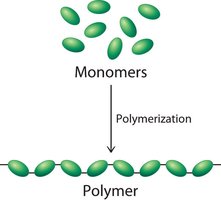
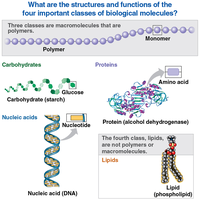
Polymers are large molecules composed of repeating subunits called monomers. These macromolecules are fundamental to biological systems, forming the basis of many cellular structures and functions.
Macromolecules are polymers with huge size and complexity.
Monomers are the building blocks that repeat to form polymers.
Polymerization is the process by which monomers are chemically bonded to form polymers.
Types of Chemical Bonds
Functional groups are joined to the carbon skeleton of large molecules primarily by covalent bonds, which are strong and stable, allowing for the formation of complex macromolecules.
Natural and Synthetic Polymers
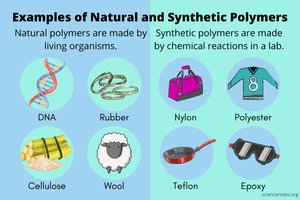
Polymers can be classified as natural (produced by living organisms) or synthetic (produced in laboratories).
Natural polymers: DNA, cellulose, wool, rubber
Synthetic polymers: nylon, polyester, teflon, epoxy
Building and Breaking Polymers
Dehydration and Hydrolysis Reactions
Polymers are assembled and disassembled through specific chemical reactions:
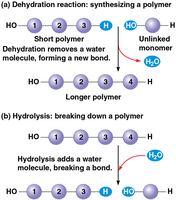
Dehydration reaction: Joins two monomers by removing a water molecule, forming a new covalent bond.
Hydrolysis: Breaks a polymer into monomers by adding a water molecule, reversing the dehydration process.
Enzymes catalyze both dehydration and hydrolysis reactions, increasing their speed and efficiency.
Diversity of Macromolecules
Biological Variation
Cells contain thousands of different macromolecules, which vary among cells, species, and even between organisms. This diversity arises from the vast array of possible combinations of monomers.
Carbohydrates: Structure and Function
Overview
Carbohydrates are essential biomolecules that serve as both structural components and energy sources in living organisms.
Monosaccharides: Simple sugars, the basic building blocks of carbohydrates.
Polysaccharides: Complex carbohydrates formed by polymerization of monosaccharides.
Monosaccharides
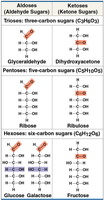
Monosaccharides typically have molecular formulas that are multiples of CH2O. Glucose (C6H12O6) is the most common monosaccharide.
Classified by the location of the carbonyl group (aldose or ketose) and the number of carbons in the skeleton.
Formation of Disaccharides and Polysaccharides
Monosaccharides can be joined by dehydration reactions to form disaccharides and polysaccharides.
Disaccharide: Formed when two monosaccharides are joined by a covalent bond called a glycosidic linkage.
Polysaccharides: Serve storage and structural roles; their function depends on the types of monomers and the positions of glycosidic linkages.
Storage Polysaccharides
Starch
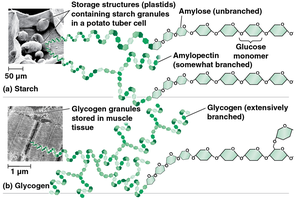
Starch is a storage polysaccharide in plants, composed of glucose monomers. Plants store starch as granules within chloroplasts and other plastids. The simplest form is amylose.
Glycogen
Glycogen is a storage polysaccharide in animals, stored mainly in liver and muscle cells. Hydrolysis of glycogen releases glucose when energy is needed.
Structural Polysaccharides
Cellulose
Cellulose is a major component of plant cell walls. Like starch, it is a polymer of glucose, but differs in the type of glycosidic linkages.
Cellulose has beta (β) linkages, while starch has alpha (α) linkages.
Hydroxyl groups on cellulose monomers can form hydrogen bonds with parallel molecules, providing structural strength.
Chitin
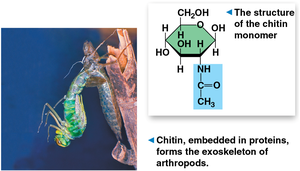
Chitin is a structural polysaccharide found in the exoskeleton of arthropods and in the cell walls of many fungi.
Summary Table: Types of Carbohydrates
Type | Structure | Function | Example |
|---|---|---|---|
Monosaccharide | Single sugar unit | Energy source | Glucose |
Disaccharide | Two sugar units | Transportable energy | Sucrose |
Polysaccharide (Storage) | Many sugar units, branched/unbranched | Energy storage | Starch, Glycogen |
Polysaccharide (Structural) | Many sugar units, β-linkages | Structural support | Cellulose, Chitin |
Key Terms and Concepts
Polymer: Long molecule made of repeating monomers
Monomer: Basic unit of a polymer
Dehydration reaction: Joins monomers by removing water
Hydrolysis: Breaks polymers by adding water
Glycosidic linkage: Covalent bond between monosaccharides
Starch: Plant storage polysaccharide
Glycogen: Animal storage polysaccharide
Cellulose: Plant structural polysaccharide
Chitin: Structural polysaccharide in arthropods and fungi
Important Equations
General formula for monosaccharides:
$\mathrm{C}_n\mathrm{H}_{2n}\mathrm{O}_n$
Dehydration reaction:
$\text{Monomer}_1 + \text{Monomer}_2 \rightarrow \text{Polymer} + \mathrm{H}_2\mathrm{O}$
Hydrolysis reaction:
$\text{Polymer} + \mathrm{H}_2\mathrm{O} \rightarrow \text{Monomer}_1 + \text{Monomer}_2$
----------------------------------------
