 Back
Polymers and Carbohydrates: Structure, Function, and Diversity
Study Guide - Smart Notes
 Tailored notes based on your materials, expanded with key definitions, examples, and context.
Polymers and Macromolecules
Definition and Overview
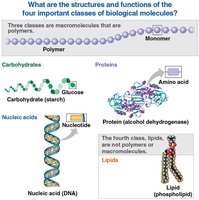
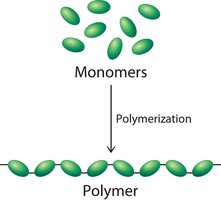
Polymers are large molecules composed of repeating subunits called monomers. These macromolecules are fundamental to biological structure and function, forming the basis of many cellular components.
Polymer: A long molecule consisting of many similar or identical building blocks (monomers) linked by covalent bonds.
Monomer: The repeating unit that serves as the building block of a polymer.
Macromolecules include carbohydrates, proteins, and nucleic acids; lipids are not true polymers but are also essential biomolecules.
Formation and Breakdown of Polymers
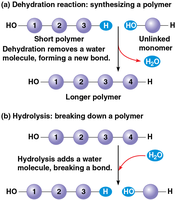
Polymers are synthesized and degraded by specific chemical reactions, often catalyzed by enzymes.
Dehydration Reaction: Two monomers are covalently bonded to each other with the loss of a water molecule, forming a polymer.
Hydrolysis: Polymers are disassembled into monomers by the addition of a water molecule, breaking the covalent bond.
Enzymes: Specialized macromolecules that speed up chemical reactions, including those involved in polymer synthesis and breakdown.
Diversity of Polymers
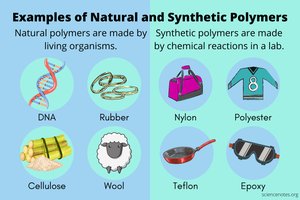
Cells contain thousands of different macromolecules, which vary among cells, species, and even more between different organisms. A vast variety of polymers can be constructed from a small set of monomers, contributing to biological diversity.
Natural polymers (e.g., DNA, cellulose, wool) are produced by living organisms.
Synthetic polymers (e.g., nylon, polyester) are made by chemical reactions in laboratories.
Carbohydrates: Structure and Function
Overview of Carbohydrates
Carbohydrates are organic molecules that serve as both building blocks and fuel for living organisms. They include simple sugars and their polymers.
Monosaccharides: The simplest carbohydrates, also known as simple sugars.
Polysaccharides: Carbohydrate macromolecules composed of many sugar building blocks.
Monosaccharides: Structure and Classification
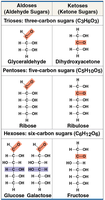
Monosaccharides have molecular formulas that are usually multiples of CH2O. Glucose (C6H12O6) is the most common monosaccharide. They are classified by the location of the carbonyl group and the number of carbons in the skeleton.
Aldose: Monosaccharide with the carbonyl group at the end of the carbon skeleton.
Ketose: Monosaccharide with the carbonyl group within the carbon skeleton.
Monosaccharides are also classified by the number of carbons: trioses (3C), pentoses (5C), hexoses (6C), etc.
Formation of Disaccharides and Polysaccharides
Monosaccharides can be joined together by dehydration reactions to form disaccharides and polysaccharides.
Disaccharide: Formed when a dehydration reaction joins two monosaccharides. The covalent bond formed is called a glycosidic linkage.
Polysaccharide: Polymers of sugars that serve storage or structural roles. Their properties depend on the types of monomers and the positions of glycosidic linkages.
Storage Polysaccharides
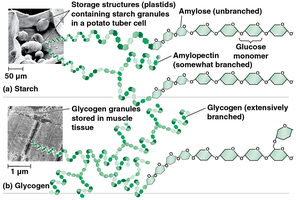
Storage polysaccharides are used by organisms to store energy for later use.
Starch: A storage polysaccharide in plants, consisting of glucose monomers. Stored as granules in chloroplasts and other plastids. The simplest form is amylose (unbranched), while amylopectin is somewhat branched.
Glycogen: A storage polysaccharide in animals, stored mainly in liver and muscle cells. Glycogen is extensively branched and can be rapidly hydrolyzed to release glucose when needed.
Structural Polysaccharides
Some polysaccharides serve structural roles in cells and organisms.
Cellulose: A major component of plant cell walls. Like starch, it is a polymer of glucose, but the glycosidic linkages differ, resulting in different properties. Cellulose molecules can form hydrogen bonds with each other, providing rigidity.
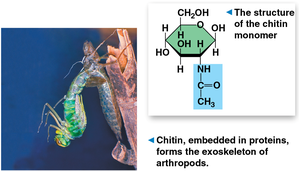
Chitin: A structural polysaccharide found in the exoskeleton of arthropods and in the cell walls of many fungi. Chitin is similar to cellulose but contains nitrogen-containing appendages.
Comparison: Cellulose vs. Starch
Both cellulose and starch are polymers of glucose, but their glycosidic linkages and biological roles differ.
Property | Starch | Cellulose |
|---|---|---|
Monomer | Glucose (α form) | Glucose (β form) |
Linkage | α-1,4 and α-1,6 glycosidic bonds | β-1,4 glycosidic bonds |
Function | Energy storage in plants | Structural support in plants |
Digestibility | Digestible by humans | Indigestible by humans (fiber) |
Key Terms and Concepts
Covalent bond: The type of chemical bond that joins a functional group to the carbon skeleton of a large molecule.
Glycosidic linkage: The covalent bond formed between two monosaccharides by a dehydration reaction.
Hydrogen bond: Important in stabilizing the structure of cellulose and other polysaccharides.
