 Back
Population Dispersion Patterns: Factors and Explanations
Study Guide - Smart Notes
 Tailored notes based on your materials, expanded with key definitions, examples, and context.
Q10. Describe the factors that might produce the following three types of dispersion patterns in populations.
Background
Topic: Population Ecology – Dispersion Patterns
This question is testing your understanding of the different ways individuals in a population can be distributed in space, and what ecological or behavioral factors might lead to each pattern.
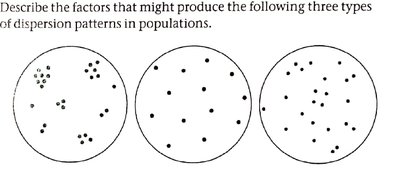
Key Terms:
Clumped Dispersion: Individuals are grouped in patches.
Uniform Dispersion: Individuals are evenly spaced.
Random Dispersion: Individuals are spread unpredictably.
Step-by-Step Guidance
Examine the three diagrams. The leftmost shows individuals in groups (clumped), the middle shows even spacing (uniform), and the rightmost shows no clear pattern (random).
For clumped dispersion, think about resources or social behaviors that might cause individuals to aggregate. For example, resources like water or food may be patchy, or animals may form groups for protection or mating.
For uniform dispersion, consider factors like territoriality or competition. Individuals may space themselves evenly to avoid competition for resources or due to aggressive interactions.
For random dispersion, think about environments where resources are consistently available and there is little interaction (positive or negative) between individuals. This pattern is less common in nature.
Try describing the factors for each pattern before checking the full explanation!
