 Back
BackPopulation Ecology and the Distribution of Organisms
Study Guide - Smart Notes
 Tailored notes based on your materials, expanded with key definitions, examples, and context.
Population Ecology & Distribution of Organisms
Introduction to Ecology
Ecology is the scientific study of interactions between organisms and their environment. These interactions occur at multiple levels of biological organization, from individuals to the entire biosphere. Ecologists investigate both living (biotic) and non-living (abiotic) components that influence the distribution and abundance of organisms.
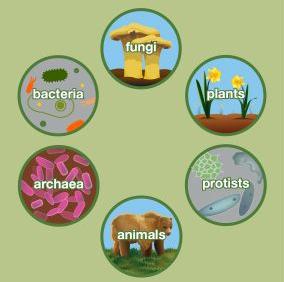
Biotic Factors: Living components such as animals, plants, fungi, bacteria, and other organisms that interact within an environment.
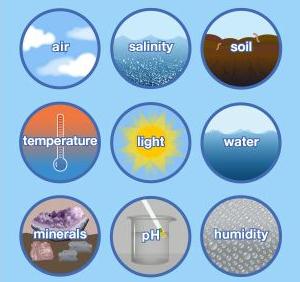
Abiotic Factors: Non-living chemical and physical attributes, including temperature, water, sunlight, wind, soil, salinity, pH, and humidity.
Levels of Ecological Organization
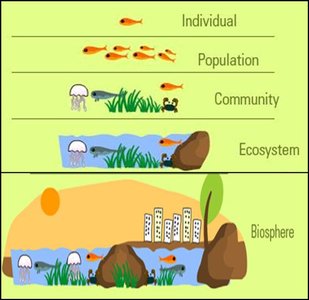
Ecologists study interactions at several hierarchical levels:
Individual: A single organism.
Population: A group of individuals of the same species living in a specific area.
Community: Groups of populations of different species in an area.
Ecosystem: The community of organisms and the physical factors with which they interact.
Biosphere: The sum of all the planet’s ecosystems.
Climate and Biome Distribution
Global Climate Patterns
Climate, defined as the long-term prevailing weather conditions in an area, is a major determinant of species distributions. It is shaped by temperature, precipitation, sunlight, and wind, all of which are influenced by Earth's geometry and movements.
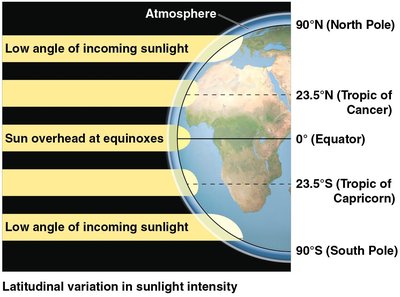
Latitudinal Variation: The curved shape of Earth causes sunlight to strike different latitudes at varying angles, resulting in more direct energy at the equator and more diffuse energy at higher latitudes.
Seasonal Variation: The tilt of Earth's axis leads to seasonal changes in light and temperature, which are more pronounced at higher latitudes.
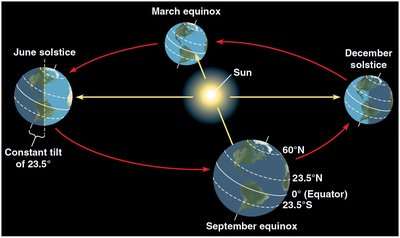
Atmospheric Circulation and Precipitation Patterns
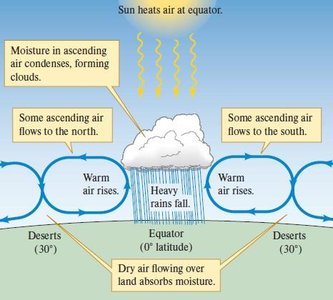
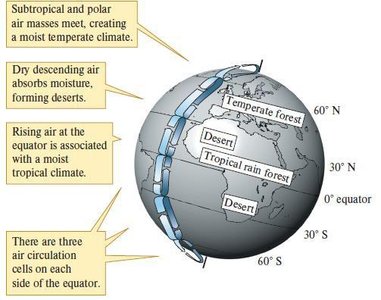
Global air circulation patterns, driven by solar heating, create distinct climate zones:
Warm, moist air rises near the equator, cools, and releases precipitation, supporting tropical biomes.
Dry air descends at about 30° N/S, creating deserts.
This pattern repeats at higher latitudes, forming temperate and polar biomes.
Wind Patterns and Ocean Currents
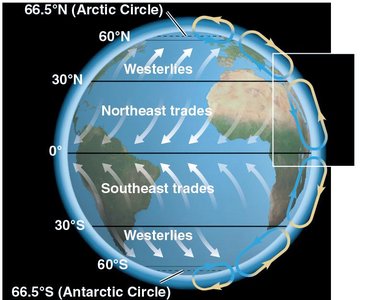
The rotation of Earth (Coriolis effect) causes predictable wind patterns, such as trade winds and westerlies, which in turn influence ocean currents. Ocean currents redistribute heat and affect coastal climates.
Trade Winds: Blow east to west in the tropics.
Westerlies: Blow west to east in temperate zones.
Ocean Currents: Warm and cold currents modify coastal temperatures and precipitation.
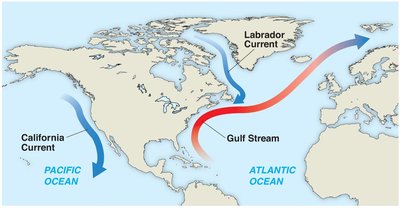
Mountains and Local Climate
Mountains influence climate by affecting sunlight exposure and precipitation. The rain shadow effect occurs when moist air rises over a mountain, cools, and releases precipitation on one side, leaving the other side dry.
Biomes
Biomes are major life zones characterized by dominant vegetation (terrestrial biomes) or physical environment (aquatic biomes). Climate, especially temperature and precipitation, determines the distribution of terrestrial biomes.
Climograph: A plot of annual mean temperature and precipitation for a region, used to visualize biome distribution.
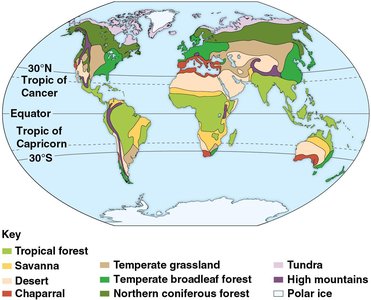
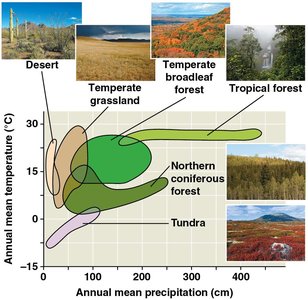
Examples of Major Terrestrial Biomes
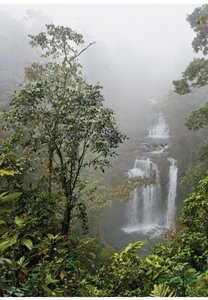
Tropical Forest: High biodiversity, warm temperatures, and high precipitation year-round.
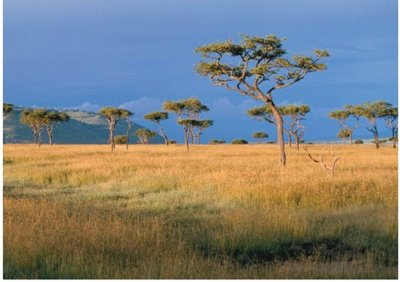
Savanna: Grasslands with scattered trees, seasonal rainfall.
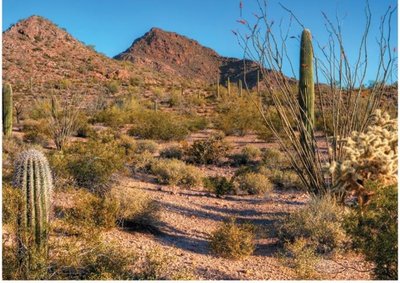
Desert: Low precipitation, extreme temperature variation.
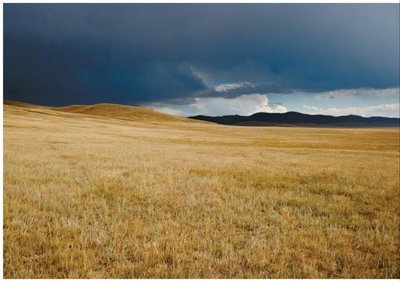
Temperate Grassland: Seasonal temperature and precipitation, dominated by grasses.
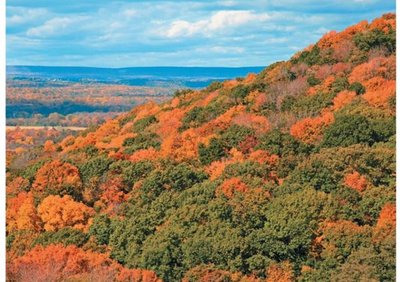
Temperate Broadleaf Forest: Deciduous trees, moderate climate.
Tundra: Cold, low precipitation, permafrost.
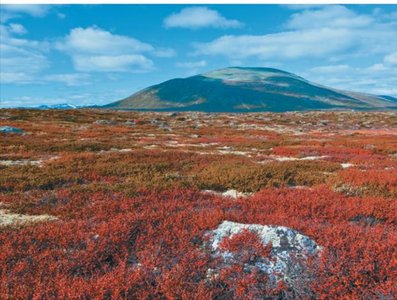
Population Ecology
Population Characteristics
Population ecology focuses on the factors that affect population size and composition over time. Key characteristics include:
Distribution: The size, shape, and location of the area a population occupies.
Density: The number of individuals per unit area.
Abundance: The total number of individuals in a specified area.
Limits on Distribution
Both biotic and abiotic factors limit the distribution of species. Dispersal, or the movement of individuals away from their origin, also shapes distribution patterns. Habitat corridors can facilitate dispersal in fragmented landscapes.
Biotic Factors: Interactions such as predation, competition, mutualism, and parasitism.
Abiotic Factors: Physical conditions like temperature, water, oxygen, sunlight, and salinity.
Dispersion Patterns
Dispersion refers to the pattern of spacing among individuals within a population. Three main types are recognized:
Clumped: Individuals aggregate in patches, often due to resource availability or social behavior.
Uniform: Individuals are evenly spaced, often due to territoriality or competition.
Random: The position of each individual is independent of others, occurring where resources are consistent and interactions are minimal.
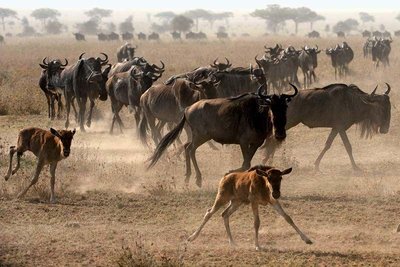
Population Density and Size
Population density varies widely among species and is often inversely related to organism size. Understanding density helps ecologists compare environments, assess rarity, and inform management decisions.
Population Dynamics and Growth
Population Dynamics
Population dynamics examines the factors influencing population expansion, decline, and maintenance. Populations change in size due to births, deaths, immigration, and emigration.
Life Table: An age-specific summary of survival and reproductive rates.
Demography: The study of birth, death, and migration rates over time.
Survivorship Curves
Survivorship curves graph the proportion of offspring surviving to different ages. Three general types are recognized:
Type I: High survivorship in early/middle life, increased mortality in older age groups (e.g., humans, large mammals).
Type II: Constant death rate over the lifespan (e.g., some birds, rodents).
Type III: Low survivorship among young, higher survivorship for those reaching maturity (e.g., many fish, plants).
Population Growth Models
Exponential Growth: Occurs when resources are abundant and all individuals reproduce at maximum capacity, producing a J-shaped curve. Rarely sustained in nature.
Logistic Growth: Occurs when resources are limited, producing an S-shaped (sigmoidal) curve as the population approaches carrying capacity (K).
Population Growth Rate Equation:
where r is the growth rate, b is birth rate, d is death rate, i is immigration, and e is emigration.
Limits to Population Growth
Density-Dependent Factors: Biotic factors that regulate population size and are influenced by population density (e.g., competition, disease, predation).
Density-Independent Factors: Abiotic factors that affect population size regardless of density (e.g., weather events, habitat destruction).
Summary Table: Types of Dispersion Patterns
Pattern | Description | Main Causes |
|---|---|---|
Clumped | Individuals aggregate in patches | Resource availability, social behavior |
Uniform | Individuals evenly spaced | Territoriality, competition |
Random | Position independent of others | Consistent resources, minimal interactions |
Key Terms
Ecology: Study of interactions between organisms and their environment.
Biome: Major life zone defined by vegetation or physical environment.
Population Density: Number of individuals per unit area.
Carrying Capacity (K): Maximum population size an environment can sustain.
Survivorship Curve: Graph showing the proportion of a cohort surviving at each age.
