 Back
BackPopulation Ecology: Concepts, Models, and Applications
Study Guide - Smart Notes
 Tailored notes based on your materials, expanded with key definitions, examples, and context.
Population Ecology
Overview of Population Ecology
Population ecology is the study of populations—groups of individuals belonging to the same species that live in the same area at the same time. This field focuses on understanding the factors that influence population size, density, age structure, and growth rate.
Population: All members of a species in a defined area.
Population ecology: Examines how and why populations change over time and space.
Population Density
Population density is the number of individuals per unit area or volume. It is estimated using various sampling techniques, such as quadrats, mark-recapture, or transect methods.
High density can lead to increased competition for resources.
Low density may reduce mating opportunities and increase vulnerability to extinction.
Population Age Structure
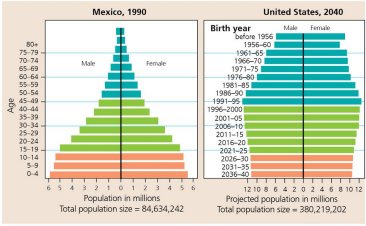
The age structure of a population is the distribution of individuals among different age groups. Age structure diagrams (population pyramids) provide insights into future population growth and social trends.
A wide base indicates a high proportion of young individuals, predicting future growth.
A narrow base suggests a stable or declining population.
Life Tables and Survivorship Curves
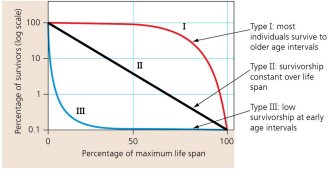
Life tables track the probability of individuals surviving to various ages. Survivorship curves graphically represent the number of survivors in a population over time and are classified into three types:
Type I: High survivorship until old age (e.g., humans, large mammals).
Type II: Constant survivorship throughout life (e.g., some birds, rodents).
Type III: Low survivorship at early ages, with few individuals reaching adulthood (e.g., many fish, invertebrates).
Life History Traits as Adaptations
Life history traits are characteristics that affect an organism's schedule of reproduction and survival. These traits are shaped by evolutionary adaptation and can be categorized as:
Opportunistic (r-selected) life histories: Rapid development, early reproduction, many offspring, little parental care (e.g., insects, weeds).
Equilibrial (K-selected) life histories: Slow development, late reproduction, few offspring, extensive parental care (e.g., elephants, humans).
Population Growth Models
Population growth can be modeled mathematically to predict changes over time. Two primary models are:
Exponential Growth Model: Describes unlimited population growth under ideal conditions. The equation is:
Where N is population size, r is the per capita rate of increase, and t is time.
Growth accelerates as population size increases.
Logistic Growth Model: Incorporates environmental limits (carrying capacity, K). The equation is:
Growth rate slows as population approaches carrying capacity.
Regulation of Population Growth
Population growth is regulated by:
Density-independent factors: Affect populations regardless of size (e.g., weather, natural disasters).
Density-dependent factors: Intensify as population density increases (e.g., competition, predation, disease).
Some populations exhibit boom-and-bust cycles due to these factors.
Applications of Population Ecology
Conservation of Endangered Species: Identifying and providing critical habitat factors to support small populations.
Sustainable Resource Management: Using population models to determine sustainable harvest levels.
Invasive Species: Non-native organisms that disrupt ecosystems, often with opportunistic life histories.
Biological Control of Pests: Introducing natural enemies to control pest populations, with caution to avoid new invasions.
Integrated Pest Management (IPM): Combining biological, chemical, and cultural methods for sustainable pest control.
Human Population Growth
The human population has grown rapidly, especially in the 20th century. Growth rates differ between developed and developing countries due to differences in birth and death rates.
Demographic transition: Shift from high birth/death rates to low birth/death rates as countries develop.
Population momentum: Continued growth after fertility rates decline, due to a large proportion of young individuals.
Our Ecological Footprint
An ecological footprint measures the amount of land and water required to support an individual's or nation's resource consumption. There are significant disparities in resource use between developed and developing nations.
Reducing ecological footprints is essential for global sustainability.
