 Back
BackPopulation Ecology: Growth, Regulation, and Metapopulation Dynamics
Study Guide - Smart Notes
 Tailored notes based on your materials, expanded with key definitions, examples, and context.
Population Ecology
Introduction to Population Ecology
Population ecology is the study of how and why the number of individuals in a population changes over time and space. It is fundamental for understanding species survival, resource management, and conservation biology.
Population Growth Models
Exponential Growth
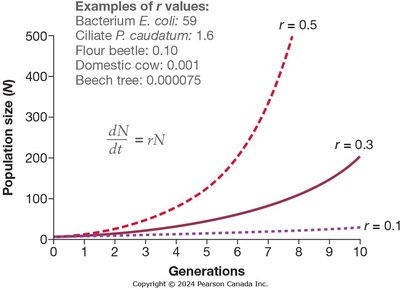
Exponential growth describes how populations can increase rapidly when resources are abundant and environmental conditions are ideal. The rate of population increase is proportional to the current population size, leading to a J-shaped growth curve.
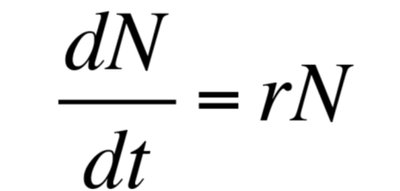
Exponential Growth Equation: where N is population size, r is the intrinsic rate of increase, and t is time.
Key Features: Growth rate accelerates as population size increases.
Examples: Bacteria and other organisms with high reproductive rates can exhibit exponential growth under ideal conditions.
Limits to Exponential Growth
In nature, populations cannot grow indefinitely due to resource limitations and environmental resistance. Eventually, growth slows and stabilizes.
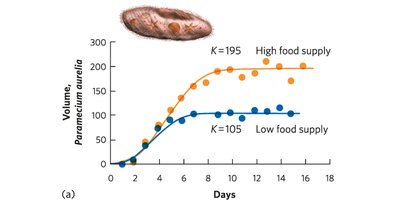
Carrying Capacity (K): The maximum population size that an environment can sustain indefinitely.
Density-Dependent Factors: Factors whose effects on population size increase with population density (e.g., competition, disease).
Density-Independent Factors: Factors that affect population size regardless of density (e.g., weather, natural disasters).
Logistic Growth
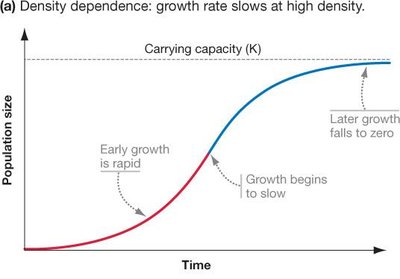
Logistic growth incorporates the concept of carrying capacity, resulting in an S-shaped curve. Growth rate decreases as the population approaches K.
Logistic Growth Equation:
Early Growth: Rapid and nearly exponential when N is much less than K.
Growth Slows: As N approaches K, resources become limited and growth rate declines.
Equilibrium: Population size stabilizes at or near K.
Population Regulation
Population size is regulated by a combination of density-dependent and density-independent factors.
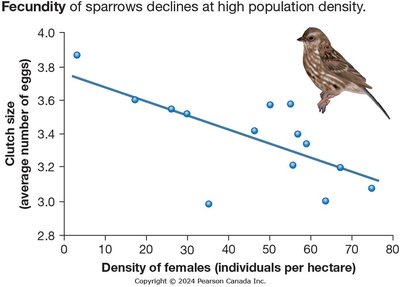
Density-Dependent Regulation: Increased competition, predation, disease, and waste accumulation at high densities reduce birth rates and/or increase death rates.
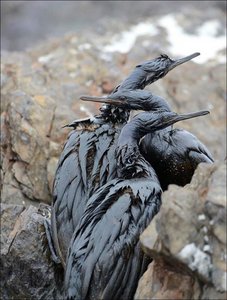
Density-Independent Regulation: Catastrophic events such as floods, fires, or extreme weather can reduce population size regardless of density.
Population Crashes and Overshoots
Overshooting Carrying Capacity
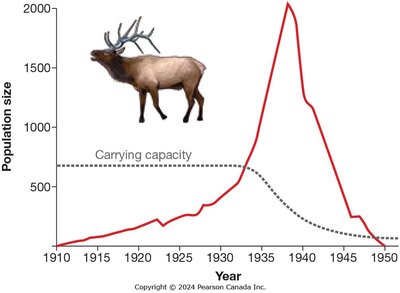
Populations may temporarily exceed their carrying capacity, leading to resource depletion and population crashes. This is often followed by a die-off event, after which the population may stabilize at a lower carrying capacity.
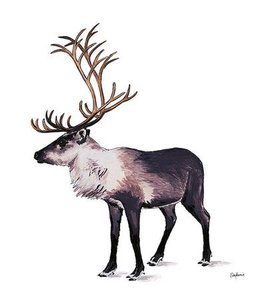
Example: The reindeer population on an Alaskan island grew rapidly after introduction, overshot carrying capacity, and then crashed due to over-foraging.
Population Cycles
Predator-Prey Dynamics
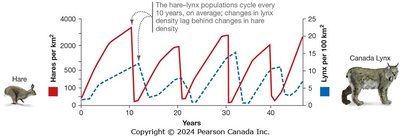
Some populations exhibit regular cycles of growth and decline, often driven by interactions between predators and their prey. For example, the populations of snowshoe hares and Canada lynx cycle approximately every 10 years.
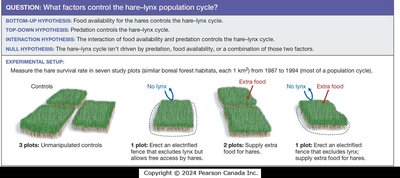
Bottom-Up Hypothesis: Prey populations are limited by food availability; predator populations respond to changes in prey abundance.
Top-Down Hypothesis: Predator populations control prey abundance through predation.
Interaction Hypothesis: Both food availability and predation interact to regulate population cycles.
Experimental Evidence
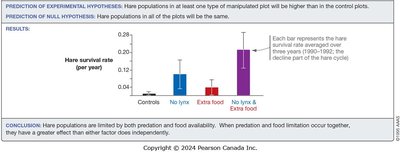
Field experiments manipulating food supply and predator access demonstrate that both predation and food limitation can regulate prey populations, and their effects are often synergistic.
Habitat Fragmentation and Metapopulations
Habitat Fragmentation
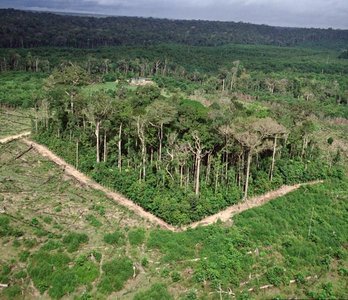
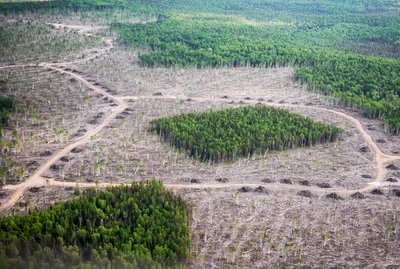
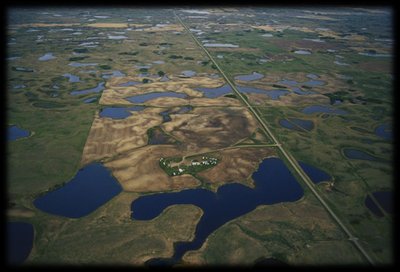
Fragmentation of habitats leads to isolated patches, which can reduce population sizes and limit genetic exchange. This increases the risk of local extinctions.
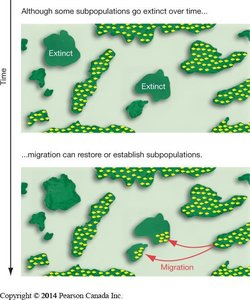
Metapopulation: A group of spatially separated populations of the same species that interact through migration.
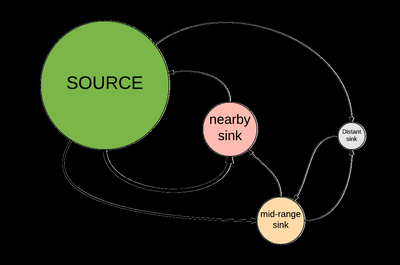
Patch Quality: Not all habitat patches are equal; some serve as sources (net exporters of individuals), others as sinks (net importers).
Metapopulation Dynamics
Metapopulations are characterized by local extinctions and recolonizations. Migration between patches can restore extinct subpopulations, maintaining overall stability.
Source-Sink Dynamics: High-quality patches (sources) maintain population numbers and can rescue declining populations in low-quality patches (sinks).
Rescue Effect: Immigration from source populations prevents extinction in sink populations.
Factor | Density-Dependent | Density-Independent |
|---|---|---|
Definition | Effect increases with population density | Effect unrelated to population density |
Examples | Competition, disease, predation | Weather, natural disasters, pollution |
Impact | Regulates population near carrying capacity | Can cause sudden population declines |
Summary of Key Concepts
Population growth can be modeled using exponential and logistic equations.
Carrying capacity (K) limits population size due to resource constraints.
Density-dependent and density-independent factors regulate population size.
Population cycles can result from predator-prey interactions and resource availability.
Habitat fragmentation leads to metapopulation dynamics, with sources, sinks, and migration playing key roles in population persistence.
