 Back
BackPopulation Ecology: Principles, Models, and Applications
Study Guide - Smart Notes
 Tailored notes based on your materials, expanded with key definitions, examples, and context.
Population Ecology
Introduction to Population Ecology
Population ecology is the study of the factors that affect population size and how these factors change over space and time. Understanding population dynamics is essential for species management, conservation, and predicting ecological outcomes.
Population: A group of individuals of the same species living in a specific area.
Density: The number of organisms per unit area.
Population ecology uses demography—the statistical study of populations, including birth rates, death rates, age distributions, and population sizes.
Population Growth and Demographic Tools
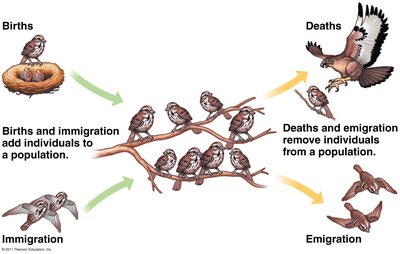
Population growth is determined by the balance of births, deaths, immigration, and emigration. Demographic data, such as age-specific survival and reproduction, are used to predict future population trends.
Birth rate (b): Number of births per individual per unit time.
Death rate (d): Number of deaths per individual per unit time.
Per capita growth rate (r): The difference between birth and death rates:
Net reproductive rate (R_0): The average number of female offspring produced by a female during her lifetime.
Life Tables and Survivorship Curves
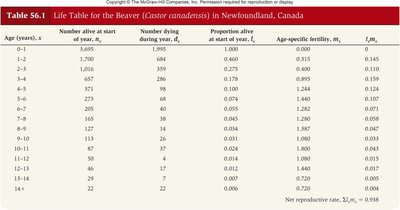
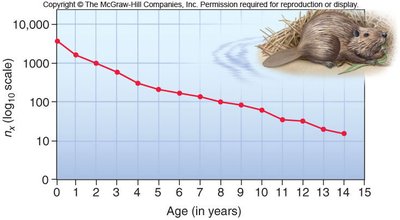
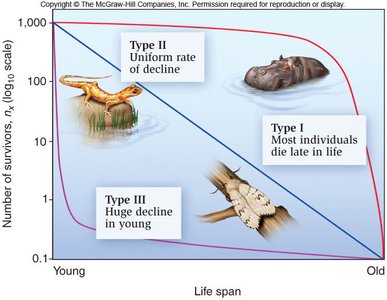
Life tables summarize the survival and reproductive rates of individuals at each age. Survivorship curves graphically represent the number of individuals surviving at each age.
nx: Number alive at the start of age x.
lx: Proportion of individuals alive at the start of age x.
mx: Number of female offspring produced per female at age x.
lxmx: Contribution of each age class to overall population growth.
Population Growth Models
Population growth can be modeled mathematically to predict changes over time. Two primary models are exponential and logistic growth.
Exponential Growth
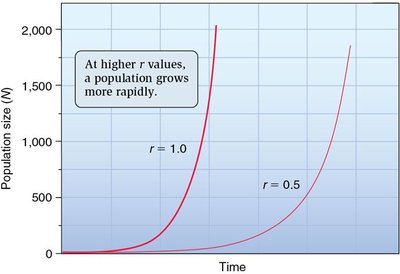
Exponential growth occurs under ideal conditions with unlimited resources. The population increases at a constant rate per individual.
Equation:
rmax: Intrinsic rate of increase (biotic potential).
Logistic Growth
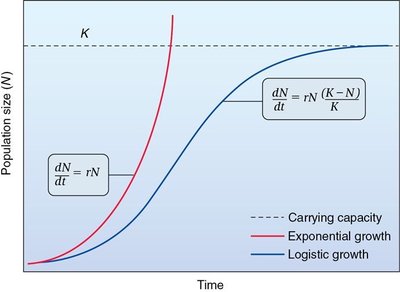
Logistic growth incorporates resource limitation. As the population approaches the carrying capacity (K), growth slows and stabilizes.
Carrying capacity (K): The maximum population size that the environment can sustain.
Equation:
Density-Dependent and Density-Independent Regulation
Population size is regulated by both density-dependent and density-independent factors.
Density-dependent factors: Effects increase with population density (e.g., competition, predation, disease).
Density-independent factors: Effects are unrelated to population density (e.g., weather, natural disasters).
Life History Strategies
Species exhibit different life history strategies, often classified as r-selected or K-selected.
r-selected species: High reproductive rates, short generation times, poor competitive ability (e.g., many insects).
K-selected species: Lower reproductive rates, longer generation times, strong competitive ability (e.g., elephants).
Applications and Human Population Growth
Population ecology principles are applied in wildlife management, conservation, and understanding human demographic trends. Age structure and total fertility rate (TFR) are used to predict future population growth.
Age structure: Distribution of individuals among different ages in a population.
Total fertility rate (TFR): Average number of children born per woman.
Examples of Population Dynamics
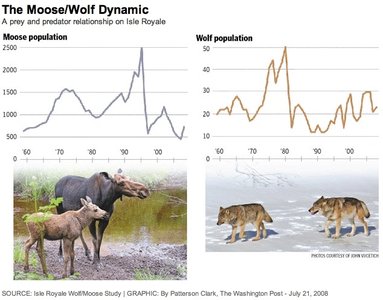
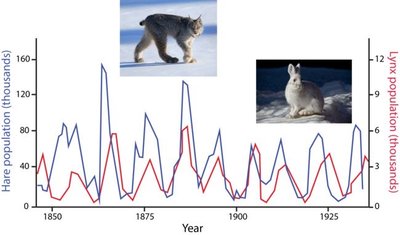
Predator-prey interactions and resource availability can cause population cycles and fluctuations.
Summary Table: Key Terms in Population Ecology
Term | Definition |
|---|---|
Population | Group of individuals of the same species in an area |
Carrying Capacity (K) | Maximum population size an environment can sustain |
Exponential Growth | Population growth under unlimited resources |
Logistic Growth | Population growth with resource limitation |
Per Capita Growth Rate (r) | Birth rate minus death rate per individual |
Net Reproductive Rate (R0) | Average number of female offspring per female |
Density-Dependent | Regulation affected by population density |
Density-Independent | Regulation not affected by population density |
r-selected Species | High reproductive rate, low competitive ability |
K-selected Species | Low reproductive rate, high competitive ability |
Key Equations
Exponential growth:
Logistic growth:
Net reproductive rate:
Additional info:
Population cycles, such as those seen in predator-prey systems (e.g., lynx and hare), are classic examples of biotic interactions influencing population dynamics.
Life tables and survivorship curves are foundational tools for ecologists to assess population viability and predict future trends.
