 Back
Population Ecology: Structure, Dynamics, and Growth
Study Guide - Smart Notes
 Tailored notes based on your materials, expanded with key definitions, examples, and context.
Population Ecology
Introduction to Population Ecology
Population ecology is the study of populations in relation to their environment, including environmental influences on population density and distribution, age structure, and variations in population size. Understanding population ecology is essential for conservation biology, resource management, and understanding evolutionary processes.
Population Characteristics
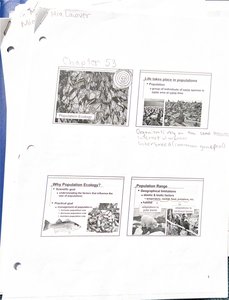
Population: A group of individuals of the same species living in the same area at the same time.
Population Density: The number of individuals per unit area or volume.
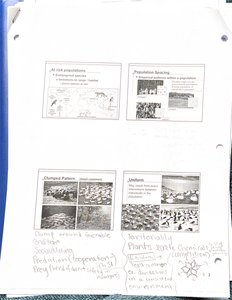
Population Dispersion: The pattern of spacing among individuals within the boundaries of the population (clumped, uniform, random).
Population Ranges and Distribution
Populations have geographic ranges, which can be influenced by abiotic and biotic factors. Distribution patterns include:
Clumped: Individuals aggregate in patches, often due to resource availability or social behavior.
Uniform: Individuals are evenly spaced, often due to territoriality or competition.
Random: Position of each individual is independent of others, often when resources are consistently available.
Measuring Population Density
Population density can be measured using various methods:
Direct counts: Counting all individuals in a population (practical only for small populations).
Sampling techniques: Estimating population size using quadrats, transects, or mark-recapture methods.
Population Growth and Regulation
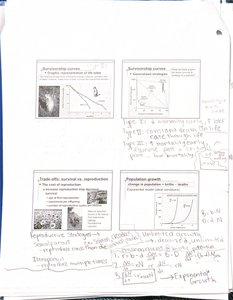
Population size changes due to births, deaths, immigration, and emigration. Population growth can be described mathematically:
Exponential Growth: Population increases under ideal conditions, forming a J-shaped curve.
Logistic Growth: Population growth slows as it approaches carrying capacity (K), forming an S-shaped curve.
Exponential Growth Equation:
Logistic Growth Equation:
Life History Strategies
Life history traits affect how populations grow and persist. These include:
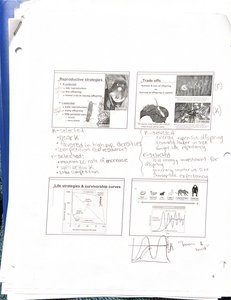
r-selected species: High reproductive rates, short lifespan, little parental care (e.g., insects, annual plants).
K-selected species: Low reproductive rates, long lifespan, extensive parental care (e.g., mammals, birds).
Survivorship Curves
Survivorship curves show the proportion of individuals surviving at each age:
Type I: Low death rates early and middle life, high death rates in older age (e.g., humans).
Type II: Constant death rate over the organism's life span (e.g., some birds).
Type III: High death rates for young, lower for survivors (e.g., oysters, many fish).
Demography and Age Structure
Demography is the study of vital statistics of populations and how they change over time. Age structure diagrams show the relative number of individuals at each age, which helps predict population growth trends.
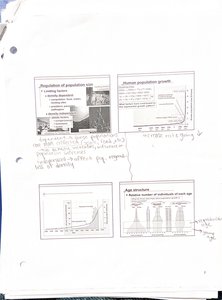
Population Regulation
Population size is regulated by density-dependent and density-independent factors:
Density-dependent factors: Competition, predation, disease, and waste accumulation increase with population density.
Density-independent factors: Weather, natural disasters, and human activities affect populations regardless of density.
Human Population Growth
Human populations have shown exponential growth, but growth rates are declining in many regions due to demographic transitions. Age structure and resource use are important for predicting future trends.
Key Terms and Concepts
Carrying Capacity (K): Maximum population size that an environment can sustain.
Intrinsic Rate of Increase (r): Maximum per capita growth rate of a population under ideal conditions.
Demographic Transition: Shift from high birth and death rates to low birth and death rates, often associated with industrialization.
Summary Table: Population Growth Models
Model | Equation | Curve Shape | Key Features |
|---|---|---|---|
Exponential | J-shaped | Unlimited resources, rapid growth | |
Logistic | S-shaped | Growth slows near carrying capacity |
Additional info: These notes integrate foundational concepts from population ecology, including population structure, growth models, and regulatory mechanisms, as well as human demographic trends. The images included directly reinforce the explanations of population patterns, growth curves, and age structure.
