 Back
Population Ecology: Structure, Dynamics, and Life-History Strategies
Study Guide - Smart Notes
 Tailored notes based on your materials, expanded with key definitions, examples, and context.
Population Ecology
Introduction to Population Ecology
Population ecology is the study of how and why the number of individuals in a population changes over time and space. This field is crucial for conservation biology and resource management, as it helps biologists understand population trends and predict future changes.
Population: A group of individuals of the same species living in a specific area.
Range: The geographic distribution of a species, which can be global, regional, or local.
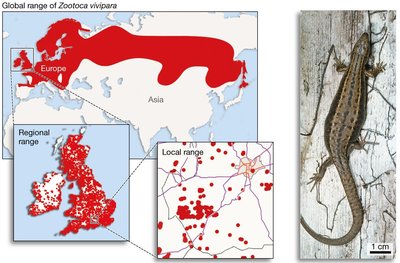
Patterns of Population Distribution
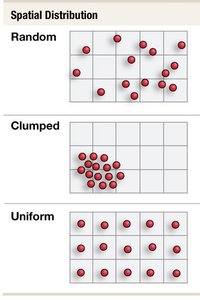
The spatial distribution of individuals within a population can vary and is influenced by environmental factors and species interactions.
Random Distribution: Individuals are spread unpredictably.
Clumped Distribution: Individuals are grouped in patches, often due to resource availability or social behavior.
Uniform Distribution: Individuals are evenly spaced, often due to territoriality or competition.
Measuring Population Size: Mark and Recapture Method
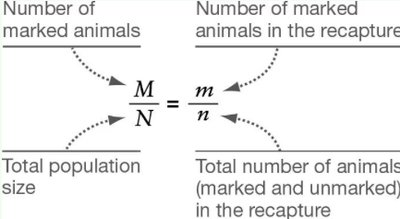
Biologists estimate population size using the mark and recapture technique, which involves marking individuals, releasing them, and then recapturing a sample to see how many are marked.
Formula: Where:
M = Number of marked animals
N = Total population size
m = Number of marked animals in the recapture
n = Total number of animals in the recapture
Factors Affecting Population Size
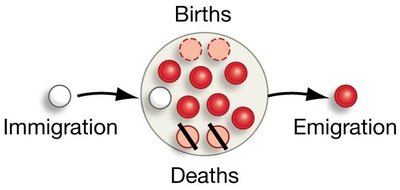
Four main processes affect population size:
Births: Increase population size.
Deaths: Decrease population size.
Immigration: Individuals move into the population.
Emigration: Individuals leave the population.
Population Growth Models
Exponential Growth
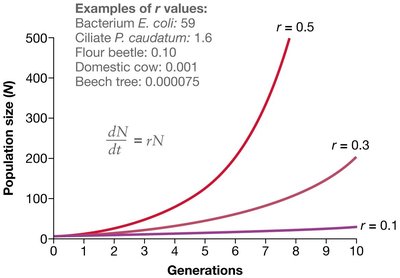
Exponential growth occurs when the per-capita rate of increase (r) is constant and not affected by population size (density independent).
Equation:
Population size increases rapidly, especially when r is high.
Examples: Bacteria, invasive species.
Density-Dependent Growth and Carrying Capacity
Real populations often experience density-dependent growth, where competition for resources slows growth as population size increases.
Carrying Capacity (K): The maximum population size that the environment can sustain.
Logistic Growth Equation:
Growth rate decreases as N approaches K.
Density-Dependent Effects: Example with Bridled Gobies
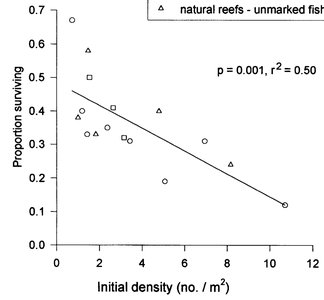
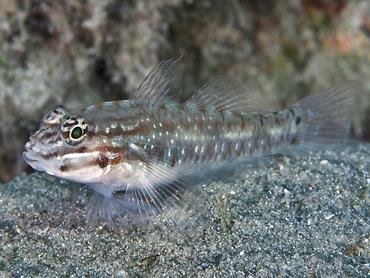
Density-dependent growth can be observed in species like bridled gobies, where higher population densities lead to lower survivorship due to increased competition.
Survivorship decreases as initial density increases.
Higher death rates reduce the per-capita rate of increase (r).
Demography and Life Tables
Demography
Demography is the study of factors that determine the size and structure of populations over time, including age classes, sex ratios, and generation time.
Generation Time: The average time between a mother's first offspring and her daughter's first offspring.
Life Tables
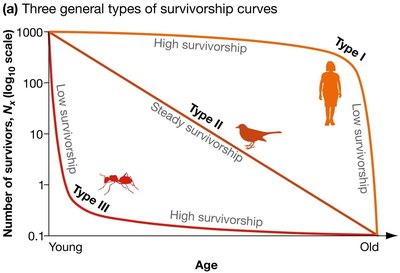
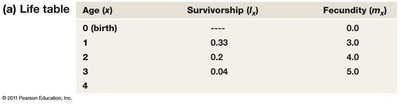
Life tables summarize demographic data by age class and sex, calculating fecundity (offspring per female) and survivorship (proportion surviving to each age).
Survivorship (Ix): Where:
Nx = Number of females in age class x
N0 = Number of original females
Age (x) | Survivorship (Ix) | Fecundity (mx) |
|---|---|---|
0 (birth) | ---- | 0.0 |
1 | 0.33 | 3.0 |
2 | 0.2 | 4.0 |
3 | 0.04 | 5.0 |
4 |
Life-History Strategies
Fitness Trade-Offs and Life-History Patterns
Life-history strategies reflect trade-offs in how organisms allocate energy and time to growth, reproduction, and survival.
r-selected species: Adapted to unstable environments, reproduce quickly, produce many offspring.
K-selected species: Adapted to stable environments, reproduce slowly, produce fewer but more competitive offspring.
Population Fluctuations and Dynamics
Population Fluctuations
Most populations experience cycles of increase and decline due to density-dependent and density-independent factors.
Density-dependent: Time-delayed effects like food shortages or predator-prey interactions.
Density-independent: Environmental changes such as temperature or natural disasters.
Metapopulations
Metapopulations consist of populations separated by space but connected by migration. Dynamics depend on birth, death, immigration, emigration, and local extinction rates.
Habitat fragmentation can create metapopulations.
Human activities can both contribute to and mitigate fragmentation.
Summary Table: Population Growth Models
Model | Equation | Key Features |
|---|---|---|
Exponential Growth | Density independent, rapid increase | |
Logistic Growth | Density dependent, growth slows near carrying capacity |
Key Terms
Population: Group of individuals of the same species in a given area.
Range: Geographic distribution of a species.
Carrying Capacity (K): Maximum population size the environment can sustain.
r-selected species: Fast reproduction, many offspring.
K-selected species: Slow reproduction, few competitive offspring.
Metapopulation: Group of populations separated by space but connected by migration.
