 Back
Population Genetics and the Hardy-Weinberg Principle: Study Notes
Study Guide - Smart Notes
 Tailored notes based on your materials, expanded with key definitions, examples, and context.
Population Genetics and Evolution
Key Definitions
Population genetics is the study of genetic variation within populations and how evolutionary forces shape this variation. Understanding these terms is fundamental:
Population: A group of organisms of the same species living in the same area, capable of interbreeding and producing fertile offspring.
Gene pool: The sum of all alleles at all gene loci in all individuals of a population.
Species: Organisms that can interbreed and produce fertile offspring.
Evolution: The change in populations over time; populations evolve, individuals do not.
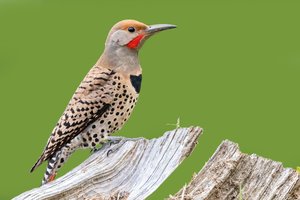
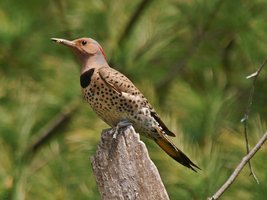
Example: Two populations of Northern Flicker (Colaptes auratus) in Oregon and New York are the same species but represent different populations.
Mechanisms of Evolution
Evolution occurs through several mechanisms, primarily described by Darwin and Wallace:
Natural selection: Genetic variation leads to differences in traits. Individuals with advantageous traits produce more surviving offspring, increasing the frequency of those traits in the population. Selection acts directly on phenotypes and indirectly on genotypes.
Fitness: The relative number of surviving offspring an individual produces for the next generation. Selection favors phenotypes with the greatest fitness.
Descent with Modification
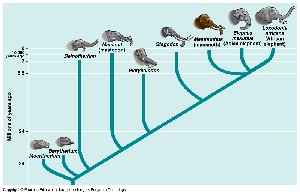
Over time, species accumulate differences, leading to the emergence of new species from ancestral ones. This process is called descent with modification.
Darwin vs. Lamarck
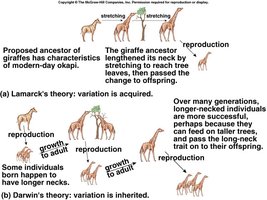
Two historical theories of evolution:
Lamarck: Individuals acquire changes during their lifetime and pass these traits to offspring.
Darwin: Individuals are born with either advantageous or disadvantageous traits; only inherited traits are passed on.
Population Genetics: The Hardy-Weinberg Principle
Hardy-Weinberg Equilibrium (HWE)
The Hardy-Weinberg principle states that allele frequencies in a population remain constant from generation to generation if certain conditions are met. When these conditions are satisfied, the population is said to be in Hardy-Weinberg equilibrium (HWE), indicating no evolution is occurring.
Conditions for HWE:
Infinitely large population (no genetic drift)
Random mating
No new mutations
No immigration or emigration (no gene flow)
No selection (all genotypes have equal reproductive success)
Agents of Evolutionary Change
If any HWE condition is violated, the population is evolving. The five main agents are:
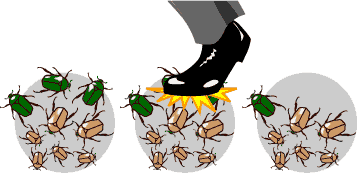
Genetic drift
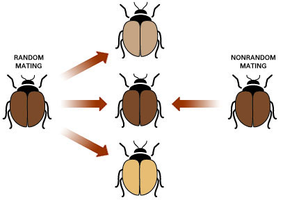
Non-random mating
Mutation
Gene flow
Selection
Genetic Drift
Genetic drift refers to changes in allele frequencies due to chance, especially in small populations. Two important effects:
Founder effect: A few individuals establish a new population, resulting in a small gene pool.
Bottleneck effect: A drastic reduction in population size alters the gene pool.
Non-random Mating & Mutation
Assortative mating: Individuals mate with others of similar phenotype, affecting genotype frequencies.
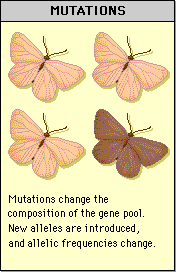
Mutation: Changes in the genetic code introduce new alleles, altering allele frequencies. Mutation rates are typically low.
Gene Flow (Migration)
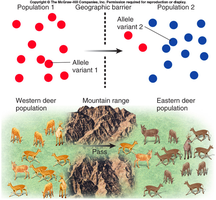
Gene flow is the movement of alleles between populations via migration of individuals or gametes. It tends to reduce variation between populations and can affect fitness depending on the alleles introduced.
Selection
Selection alters allele frequencies by favoring certain phenotypes:
Disruptive selection: Eliminates intermediate types.
Directional selection: Eliminates one extreme phenotype.
Stabilizing selection: Eliminates both extremes, favoring intermediate phenotypes.
Natural Selection
Variation must exist among individuals.
Variation must be genetically inherited.
Variation must affect survival and reproductive success (fitness).
Example: Adaptive melanism in rock pocket mice: different melanic forms are favored in different environments.
Heterozygote advantage: Heterozygotes may be favored, maintaining both alleles in the population. Example: Sickle cell anemia heterozygotes are less susceptible to malaria.
Artificial Selection
Humans exert selection through breeding and agriculture, shaping traits in domesticated animals and plants.
The Hardy-Weinberg Rule: Calculating Allele Frequencies
Allele and Genotype Frequencies
For a gene locus with two alleles (A and a):
p: Frequency of dominant allele (A)
q: Frequency of recessive allele (a)
Since there are only two alleles:
Genotype frequencies are given by:
AA (homozygous dominant):
Aa (heterozygous):
aa (homozygous recessive):
The Hardy-Weinberg equation:
Hardy-Weinberg Practice Example
Given allele frequencies in a flower population: p = 0.8 (red), q = 0.2 (white). Observed phenotypes: 89 red, 27 pink, 4 white. Is the population in Hardy-Weinberg equilibrium?
Find population size: 89 + 27 + 4 = 120
Calculate expected genotype frequencies:
Expected red:
Expected pink:
Expected white:
Subtract expected from observed to find deviation, then use a Chi-square test to evaluate equilibrium.
Variation and Population Capacity
Populations have the capacity to increase in numbers, but resources limit growth. Individuals compete for resources, and alleles producing successful phenotypes become more common over time, increasing fitness and adaptation.
Summary Table: Agents of Evolutionary Change
Agent | Description | Effect on Population |
|---|---|---|
Genetic Drift | Random changes in allele frequencies | Reduces genetic variation, especially in small populations |
Non-random Mating | Assortative mating | Changes genotype frequencies |
Mutation | Changes to genetic code | Introduces new alleles |
Gene Flow | Migration of alleles | Increases or decreases variation |
Selection | Natural or artificial selection | Favors certain phenotypes |
Additional info: Academic context was added to clarify the Hardy-Weinberg principle, agents of evolutionary change, and the practice problem steps.
